
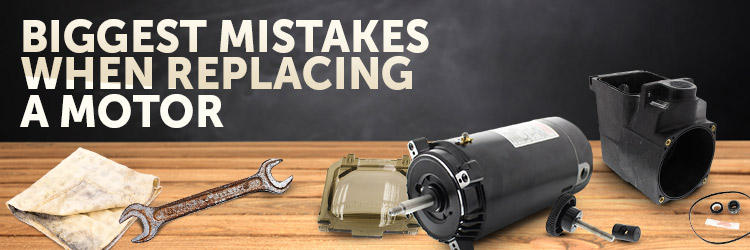
I talk to thousands of customers each year about replacing their pool pump motors and the vast majority of our customers install the motors themselves without a hitch. However, occasionally we do encounter mistakes which are made when replacing your motor. So I decided to poll my fellow co-workers, manufacturers and vendors to come up with a list of the seven most common mistakes when replacing a pool motor. The results are in… Drum roll please…
#1 Replace Your Shaft Seal
The # 1 reason for motors going bad is corrosion to the motor due to shaft seal failure. We can’t emphasize enough the importance of replacing your shaft seal when you replace your pool motor. An important reason for replacing your shaft seal is that the warranty offered by the motor manufacturer is voided if there is seal failure. The manufacturer can spot a seal failure pretty easily as the face of the motor will get a scale build-up and often the shaft of the motor will completely seize. Typically if you use your old shaft seal, it will not line up properly with the new motor and you will have leakage. The good thing is that a shaft seal is pretty inexpensive (normally in the $15 range) and shaft seal installation is easy. We have made a video and step-by-step guide here showing how to install a shaft seal.
Another route you may consider is to get a tune-up kit, also known as a Go-kit. This kit consists of the $15 shaft seal, diffuser gasket, lid O-ring, housing gasket and lubricant for these O-rings. When you have the motor disassembled from your pool pump, it is an easy time to replace your O-rings and gaskets. Tune-up kits are normally in the $35 price range.
A few things to remember when replacing your shaft seal:
- Don’t touch the ceramic portion of the seal with your fingers as the oils from your skin will break down the ceramic.
- Remove both pieces of the old shaft seal as some customers have mistakenly tried to install the new seal over the top of the old seal.
- Follow our video guide on How to install a shaft seal.
#2 Service Factor Service Factor, Service Factor
So you’re telling me a 1 HP motor is the same as a 1.5 HP motor? Well, in some cases this is correct. The topic of service factor is often an area of confusion, but can be fairly easily explained by understanding a few key concepts. The label on your current motor will have two very important pieces of information namely horsepower (HP) & service factor (SF).
If you multiply the horsepower rating times the service factor, you will determine your True Horsepower. So in our example below the 1 HP motor is the exact same as the 1.5 HP version of the motor.
1.0 HP X 1.65 SF = 1.65 True HP
1.5 HP X 1.1 SF = 1.65 True HP
High service factor motors are typically called Full Rate motors and low service factor motors are called Up Rate motors. Normally a Full Rate motor is equivalent to the next size HP in an Up rate model. Below is a handy-dandy chart illustrating this phenomenon.
| Motor Rating | Horse Power (HP) | Service Factor (SF) | True HP |
|---|---|---|---|
| Full Rate | .75 | 1.5 | 1.13 |
| Up Rate | 1.0 | 1.13 | 1.13 |
| Full Rate | 1.0 | 1.65 | 1.65 |
| Up Rate | 1.5 | 1.1 | 1.65 |
| Full Rate | 1.5 | 1.5 | 2.25 |
| Up Rate | 2.0 | 1.13 | 2.25 |
| Full Rate | 2.0 | 1.3 | 2.6 |
| Up Rate | 2.5 | 1.04 | 2.6 |
#3 Follow a Video Installation Guide
I know whenever I do any home repairs around my house I like to jump on Youtube to watch an expert perform the repair. This always seems to make the task go a little smoother. There are many videos online on how to replace a pool motor and these will help out tremendously during your installation. We would like to think our step-by-step motor installation guide and video is one of the best. We also cover how to remove your pool pump impeller, how to replace a shaft seal and how to wire a pool pump motor.
#4 Increasing or Decreasing Horsepower
On many occasions pool owners want to increase or decrease the horsepower of their motors. If you do decide to go this route then you will need to replace your impeller and possibly your diffuser.
Here are a few scenarios which are pretty common:
Switching to a larger HP motor – You currently have a 1 HP motor and you want to increase to a 1.5 HP motor. In this scenario if you stay with the 1 HP impeller you will only be getting the Gallons Per Minute (GPM) of a 1 HP pump, but you would be paying for the increased operational costs of running a 1.5 HP motor.
Switching to a smaller HP motor – You decide to downsize from a 1 HP motor to a .75 HP motor to save on electricity. If you do this without replacing your impeller to a .75 HP impeller then you will quickly burn out your new motor. This occurs because the .75 HP replacement motor will be overstressed by trying to output the water of the 1 HP impeller.
Sometimes when changing HP you will need to replace your diffuser. This is not always the case and varies according to pump model and HP. In most cases pool owners want to increase their HP, but more times than not the pump is already oversized for the pool. If you do increase your HP then the cost of operation for your pump will increase. A properly sized pool pump should be sized to turn your pool over in an eight hour time period. Here are a few considerations to take into account when increasing your HP:
- Can your filter handle the increased output of water?
- Can your plumbing handle the increased output?
- Should you change your impeller?
- How quickly will the new motor turn your pool over? (Quicker than eight hours may be overkill)
#5 Order the Correct Motor
Know your pump manufacturer & model
The easiest way to determine the motor you need is by determining the manufacturer and model of your pump. This will require that you inspect your pool equipment. Normally the manufacturer’s name and model of your pump can be found on the side of the pump housing near your strainer basket or on the motor label. I have listed some of the most common pump models here as I would estimate these account for 80% of the pumps on the market. These are: Hayward Super Pump, Hayward Super II, Hayward Power Flo, Pentair Whisperflo, Pentair Challenger, Sta-Rite Dura Glas, Sta-Rite Max-E-Glas & Jacuzzi Magnum. If you don’t see your pump listed here then visit our main pool motor page for a listing of all the replacement motors we carry.
Get the specifications from your motor label
If you are going to be heading out to your pool equipment for the manufacturer’s name and model of your pump then it would be helpful to jot down the following information from your motor label namely the HP, SF, Volts, Amps, RPMs, Cat #, Model #. This information will be on the label of the electric motor.
Armed with your pump manufacturer, model name and specs, it should be relatively easy to select your replacement motor from our main pool pump motor page. Also If you are able to obtain a model # from your motor then you can enter the model # directly into our search box and your motor should magically appear on our site.
Send us a photo, email, live chat or call
If you are having trouble tracking down the correct replacement motor for your pump then let us do it for you (this is what we get paid to do). So head on out to your pool pump with your smartphone or digital camera and snap a couple of photos of your motor label and pump and then send the photos to us at upload@inyopools.com. We will get back to you quickly with a motor recommendation. If you don’t want to send in photos then you can catch us on Live Chat or give us a call at 1-877-372-6038 and we would be happy to help.
#6 Go Energy Efficient?
Today there are some awesome energy efficient options for replacement pool motors. If you stay in an area of the country where energy costs are high then it definitely makes sense to consider an energy efficient motor. Traditionally the most expensive areas in the United States for electricity are California, Hawaii, Alaska (a huge pool state =)), New York and the Northeast. If you live in one of these areas, it makes sense to check out energy efficient options. There are a few different types of energy efficient motors: single speed motors, dual speed motors and variable speed motors.
Energy Efficient Single Speed Motors (33% Savings) – Single speed motors are the most common motors and are used on the majority of pools around the world. There are now energy efficient single speed motors which cost 20% – 30% less to operate than standard efficiency motors. Energy efficient single speed motors range from $185 – $350 depending on your horsepower.
Dual Speed Motors (58% Savings) – A step up in energy efficiency would be a dual speed motor. A dual speed motor can run at two speeds – a high speed (3450 RPM) and a low speed (1725 RPM). The two benefits of a dual speed motor are decreased operational cost and quietness during operation. The operational cost savings are determined by running your motor for a longer period of time each day at the low speed. Below are two examples which illustrate these savings.
Pool #1 – The Traditional Approach (Cost: $51.90 per month)
This 25,000 gallon pool has a normal 1.5 HP pool pump. It runs for eight hours per day. It pumps about 80 gallons per minute, which means that it circulates 38,400 gallons each day. The pump draws 9.0 amps at 240 volts. At a cost of 10 cents per kilowatt-hour, it translates to a cost of $1.73 per day or $51.90 per month to operate the pool.
Pool #2 – The Two-Speed Approach (Cost: 19.50 per month)
This 25,000 gallon pool has a two-speed 1.5 HP pool pump. It runs for 12 hours per day in low speed mode. In low speed mode it pumps about 40 gallons per minute which means that it circulates 28,800 gallons each day. Remember that the pool only needs to turn the water over once each day. The pump draws 2.25 amps at 240 volts in low speed mode. At a cost of 10 cents per kilowatt-hour, it translates to a cost of $0.65 per day or $19.50 per month to operate the pool.
The only time you really need to turn it to high speed is for backwashing or vacuuming, or if you need to increase the flow rate temporarily.
In this example you are moving less water, but the reality is that most pumps are oversized and as a result the pools are over-circulated. The two-speed pump provides just the circulation that your pool needs at a fraction of the cost.
Keeping the pool circulating for a longer period of time each day has a couple of advantages:
- The longer periods of circulation will help to reduce the occurrence of algae.
- If you have a salt system, you can run the system many more hours per day and get increased chlorine production if needed.
Dual speed motors range from $300 – $450 depending on your horsepower.
Variable Speed Motors (80% Savings) – Variable speed motors have gained widespread popularity over the past few years as they are the most energy efficient motors. Variable speed motors allow you to dial the motor into the exact RPM. You would typically select a range of 600 – 3450 RPMs. This allows for an almost infinite range of speeds for this motor.
The same principles for energy savings which were outlined in the dual speed motor example apply to variable speed motors, however, variable speed motors allow for far more flexibility. I personally think variable speed motors make a lot of sense if you live in area where energy is really expensive or if you have a pool set-up which requires more flexibility. On my pool I have quite a few water features and the variable speed motor is great because when I run my waterfall I can dial it in to a certain RPM. When I run my cleaner I use a different RPM, when I run my spa I also use a different RPM and when I run my filter pump I use yet another RPM.
Variable speed motors range from $490 – $700 depending on your horsepower.
#7 You Can Do This Yourself!
Remember you don’t need to pay hundreds of $$$ to a pool service company to replace your motor or pump. You can do this yourself and we have assisted thousands of homeowners with this process. If you follow these tips then you should have an easy time replacing your motor on your own without a professional. On average you are looking at $150 – $200 to replace your pool motor on your own versus $400 – $600 for a pool professional to do the job.
If you are not handy and don’t feel comfortable replacing your pool pump motor then you can still purchase the motor online and then call a local pool company to install the motor. Most customers just call around locally and say, “Hi! I need to get a price for the installation of a pool motor. I will be supplying the motor and shaft seal and I just need a price for the labor.” By taking this approach you can still save hundreds of $s. If you ever need any help with your pool equipment repairs, please let us know and we would be happy to assist.






Leave a Reply