Home / Articles / Above Ground Pool Ionizers: Good or Bad?

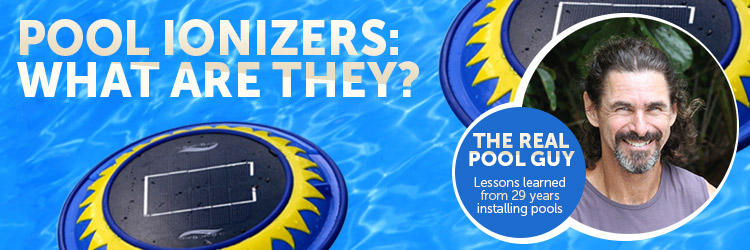
Above Ground Pool Ionizers: Good or Bad?

Above Ground Pool Ionizers: Good or Bad?

Every year manufacturers come out with a ton of new products. Pool retailers get bombarded with new toys, better pumps, filters, liners, chemicals, tiles, building products, and of course, new equipment add-ons. During the twenty-nine years that I have been in the pool business I’ve seen new products promise great things, especially  the area of swimming pool water chemistry.

The promises that come with a new product don’t get any sillier than the promises made by pool chemistry helper products. Promises such as “just add this frog-shaped pill to your pool and you’ll never have to add anything else” or “plumb in this electronic device and always have perfect pool water” are just two examples of the ridiculousness pool professionals have to endure. These notions are completely inaccurate, but who is the average innocent pool owner going to believe – the ponytailed pool guy with holes in his shorts that are caused by chlorine or the supercool new 3-D store display with a picture of a smiling dolphin swimming with a happy family?

It seems like every year I have to defend my knowledge of water maintenance against these million-dollar marketing ploys and I often lose. People will buy into this stuff anyway and I can’t blame them. How can they know any better? Usually a couple years later they know better as these expensive items will show their uselessness. This is no exception in the above ground sector of the pool industry. I recall many years ago this new item called an ionizer became popular with the new construction of in-ground pools. About five years later, the manufacturers started making them for above ground pools and for a little while they were everywhere. Today ionizers are still around for some reason. So, since they are available to the new pool owner, I guess I should talk about them.

So What Is an Ionizer and How Does It Work?

OK, I’m not a chemist and I’m not going to get into the boring details of how heavy metal ions are made and how they kill living things. This is the Internet so if you’re a nerd or don’t want to take an Ambien to sleep, look up copper ions and read away.  Here instead is the common guy’s description of ionizers for pools.

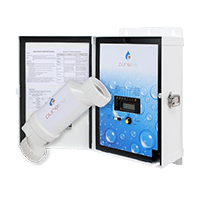
When you hear of ionizers for swimming pools, you’re hearing of copper ionizers. Little things want to live and reproduce in our swimming pools. We don’t Swimming Pool Ionizerwant those little thigs to live in the water that we swim in. When some heavy metals like copper are present in water, those little things have a harder time living. This is where a copper ionizer comes in. It introduces copper into the pool making it harder for little things to live.

An ionizer is a simple device. It’s a tube with a solid copper block inside it with a couple of wires attached to the block. The wires connect to a simple electronic device that sends an electric current to the copper block when you plug it into an electric outlet. So, this tube with the copper block is plumbed into the pool equipment after the filter and back to the pool. When the pool pump is turned on, water flows through this tube with the copper block. As the water flows through, an electrical charge is sent to the copper block causing it to break up a little and release into the water that sends copper into the pool. Over time the block gets smaller and smaller as it breaks up and is released into the pool. Every year or two the block of copper has to be replaced in the ionizer. And that’s it.

An Ionizer Does Work, but Is It Worth Having?

Many things that are designed for pools don’t work at all. At least an ionizer does kill things in the water. Is it worth spending the money on one though? My opinion is that it is not worth it. I may just be a jaded old pool guy remembering the simple days when swimming pools had only a pump and a filter, so let me explain myself just in case.

SLEEPY EXPLANATION ALERT: GRAB SOME COFFEE!

A swimming pool’s water chemistry has to accomplish two major things in order to keep the pool safe and healthy. It has to sanitize and oxidize little living Swimming Pool Ionizer Electrodethings. Now sanitize is the tree-huggers word for “killing” and oxidize is the same as the Mafia term “getting rid of”. In regular guy terms then, pool chemistry has to kill and then get rid of what’s been killed. You can’t have one without the other. You can’t kill and then not get rid of it.  The pool would then be like an episode of “The Walking Dead” and that’s clearly not healthy. And you can’t get rid of things that aren’t dead yet. That would require a massive refugee camp for microorganisms somewhere outside the pool. Not gonna happen.

An ionizer only sanitizes and doesn’t oxidize. This means that a pool needs more than just an ionizer. It cannot stand alone and must have help with at least something doing the oxidizing. Actually though, an ionizer also needs help doing the sanitizing too as the job of killing is just too great for it. What I am getting at here is a pool with an ionizer still needs something major to kill and get rid of it so at best it is just a helper for swimming pool chemistry. Whether it is a really good helper is certainly in question.

The Bottom Line

Here’s my bottom line on this. I ran a swimming pool maintenance company for thirteen years and during that time we recorded chemical usage in every pool. The pool routes had every possible variation of pool equipment add-ons including some with ionizers. In my observation and recordings, the pools with the working ionizers did not use fewer chemicals than the ones without ionizers. Also, the pools with ionizers presented no fewer problems associated with pool water chemistry.

Ionizers do provide some sanitation in swimming pools and they are safe to use with above ground pools as they cannot affect the vinyl liner. However, I don’t think they are worth the cost as a $300 dollar ionizer and a $100 every two years for a replacement block can buy a lot of chlorine.

author avatar
Dan Dougher

Related Videos

66 responses to “Above Ground Pool Ionizers: Good or Bad?”

  1. Dr.Mr.Sc Aaron Wilks Avatar

    So much misinformation here!!!
    To run copper ionizer successfully, it is a MUST to prepare water BEFORE you use it.
    The best would be to drain your pool and start with fresh water and test, test, test…

    Here is what to test and bring water to correct levels:
    1. pH level 7.2 – 7.8
    2. total alkalinity 80 – 140ppm (120ppm is perfect)
    3. calcium hardness 200 – 350ppm
    4. total disolved solids 1000 – 2000ppm
    5. run ionizer until copper residual is 0.3 – 0.5ppm

    Once you reached the 0.3 – 0.5ppm, maintain all of the above and 3 times a month in
    summer and 1-2 in winter just add liquid chlorine in the evening around the pool walls.

    Following this you will never get “copper stains”, water will be crystal clear and usage
    of nasty chemicals will be minimal. No bad smell, no chlorine burning eyes, no clothes
    bleaching, and if you spill some on your lawn – no dead grass. And you will save money.

    Enjoy!!!

    1. Davey Avatar

      Agree 100% with you.. he is just a Ionizer hater

    2. Cynthia O'Reilly Avatar

      I love my pool with the ionizer. It was installed in late 2015 and first year swimming was Spring 2016. What do you recommend for Pool Opening? any kit suggestions?
      Thank you!

  2. Sonja Avatar

    Hi there my husband would like to not have a copper ionizer anymore. Basically because he believes it’s a ploy and that it’s too expensive. My pool has been doing awesome with putting one gallon of liquid Clorox in the pool twice a week along with it algaecide and proenzyme. Now if I stop the copper enzyme would I need to do anything different? My pools ph has been slightly high so add 2 cups muriatic acid as need usually once a week. My husband would like for me to start using a 10% chlorinating liquid twice a week instead of the gallon chlorox which is only 6%. I have an above ground 24ft pool. What is the right thing to do? Thanks Sonja

  3. Johnny Avatar

    My water source has an very high PH (almost 9). I have about 15000 gallons in the pool.
    I usually add a couple gallons of muratic acid to drop the PH some and I use Trichlor tablets
    My water stays pretty clear (unless we get alot of rain). With the hot summers I lose a alot of water to evaporation and I have to add that alkaline heavy water back so I can never get and keep my PH down to a neutral range. Any suggestions?

    1. Dan Dougher Avatar

      I’m wondering if you have a leak. Leaking pools will have issues like this. The rate of evaporation depends on where you live but the greatest rate of evaporation is one-third of an inch per day and that’s in a super dry air place like Pheonix Arizona. Most places in the country will only have a max summer evaporation rate of maybe one-eighth of an inch per day. Make sure you don’t have a leak first because all bets are off if you have one with maintaining certain chemical levels.

      If you’re not leaking, check the TA(total alkalinity) and adjust according to directions. I usually lowered persistently high ph by adding small amounts of muriatic acid often.

  4. Véronique Avatar

    Hi, how do long winters (approx. 5 months of permanent snow and ice) impact your recommendation if at all? Thank you.

    1. Dan Dougher Avatar

      I don’t have any experience with cold and freezing winters as I live in Florida. As far as pool products go though, I don’t think it matters much. I would suggest getting a cartridge type filter instead of a sand type so you can disconnect it during the winter and bring it inside somewhere.

      1. pmcdunnough Avatar

        We live in a 3 month winter area. We used to have a sand filter and switched to a cartridge one. As far as the winter goes, the sand filter was just fine. Just make sure to drain, etc… We do take the cartridges in, of course. We have a salt system from Hayward and it seems pretty effective at keeping the pool clean. There is a new salt system called Dive, I believe, which includes an ionizer and has a built in electrical generator which works off the water flow from the pump. Neat idea but you have to make sure the flow is above a certain level. There’s Wi-Fi built in and an app. In any case am happy with a salt only system and would probably be just as content with adding chlorine.

  5. T. Hadden Avatar

    Hello

    We are looking to get am 21ft round above ground pool In Michigan..with the Perma Salt/copper system. If I’m understanding the comments. The Ionizer/Copper system works well, however it can be expensive and adding a Chorline is helpful is that correct? Also make sure we keep up with our maintenance!

    1. Eric Avatar

      I have the Perma Salt system and it works excellently. You only need to use chlorine to shock the pool every couple of weeks. The copper cartridge has lasted 2 seasons with moderate pool usage and the PH/alkaline/calcium levels are very easy to maintain. Highly recommended!

    2. Dan Dougher Avatar

      I’m not a huge fan of ionizers but, with or without, you’ll definitely be using chlorine.

  6. Ch_in_TN Avatar

    I bought a house with a 27″ above ground round pool which used a power ionizer. I spend $100 /year on a cartridge and float a chlorine tab in it with the smallest opening. Its been 6 years now and never had a problem. I keep PH balanced. IF and only if the pools starts to get a hint of cloudy, I will use 1 bag of shock and a couple ounces of clarifier. Will clear up over night. So, ionizer keeps algae down and hint of chlorine for sanitation. The pool is used by adults so no “accidents” in pool.

    I’m sorry I don’t see any of the problems that have been posted on here. Its common sense to me that you monitor the water but floating a tablet with balance and checking the ph has been really successful for me and my family anyway.

  7. Debs Avatar

    So you are saying I can just start adding chlorine to my pool and it won’t harm the copper filter?

    1. Dan Dougher Avatar

      There is no such thing as a copper filter but if you mean ionizer, then yes but keep the PH correct.

  8. Scott C. Avatar

    I am a water chemist working in the industrial and commercial water treatment field. I started in 1974. My wife and I installed a 24′ above ground pool three summers back. I went with the copper ionization and UV Light as the main algae/bacteria control. I also have a chlorine tablet floater. I add about 4 tablets every two weeks. I buy a 40 lb pail of chlorine tablets every two years. That is it. My water chemistry is always excellent. I keep the Free Chlorine in the 2-3 ppm range. We don”t feel or smell the chlorine…ever. So my annual chemical cost is less than $100. In my opinion the up front cost of the UV Light and Copper Ionization Systems was well worth the money spent. Just my five cents worth. I should point out that we take the extra time to clean and vaccum the pool to remove the organic build up. We have never experienced an green algae bloom. nuf said. Scott C

    1. Dan Dougher Avatar

      Hi Scott. You may have said (e)nuff about your specific situation. You have enjoyed success with one 14k gallon body of water with one bather load pattern in one area of the country with one configuration of surrounding nature over the span of a few years. I hope you don’t consider this extremely narrow field of observation as one that can make any accurate deductions or conclusions industry wide. My reasons for not being a fan of certain products or technologies are the result of more than just the swimming pool in my own back yard. I’m happy that your pool is easy to maintain though.

    2.  Avatar

      what u v light and copper ion system did u use?

  9. gezza1973 Avatar

    Hi Dan, I have a 55,000 lt inground cement tiled pool with in floor cleaning, I am looking at changing to biozonic system after having to replace two salt cell in the last year and now the chlorinator after the chlorinator was short circuited by a lizard and now needs to be replaced have you ever worked with this system it has three componants. the biozonic system is a Australian company based in Qld. I have not had a easy run with local pool shops so have lost all trust in them. To his day my pool pipes are still leaking due to dodgy workmanship and I only had them come out last week when I phoned on the day I had work done to say that the pipes were still leaki
    ng I was told he would come back out but there would be another $70 – $90 call out fee . so I told him to forget it.

    1. Dan Dougher Avatar

      Sorry. I know nothing of the biozonic system. Cool name though, bro.

  10. mike davis austin texas Avatar

    Hi Dan,
    I came across your site checking out ionizer info. I have a spring fed pool that drains into a creek so I cannot use chlorine or shock in the pool. Further I want to open a b and b here and the natural pool is the attraction. I heard barley straw or extract is a good environmentally safe clarifier to use and I have a filter system on it now. I may have to combine several systems to make the water last longer. As it is, I spray 1 gallon of bleach on the pool walls when it is empty and plugged for refill and the water seems to last about one week before it turns emerald and we start seeing some algea production. I like to drain just before so clean up is easier. Do you have any ideas for this type of “situation”? What about the infared light I had also heard about. I thank you for any advice you may provide.

    1. Dan Dougher Avatar

      I’m excited for what you have there but have no experience with your situation. You may try allowing some new water to enter and existing water to exit continuously if you can. That of course depends on your water source. That’s how some of the very first pools were. I always thought that was cool.

    2. Rob Avatar

      Mike Davis , you mean UV Light, like in hot tubs, yes?

Leave a Reply

Your email address will not be published. Required fields are marked *