Home / Articles / How to Break Chlorine Lock

How to Break Chlorine Lock

Chlorine is your pool’s immune system, without it, your pool would become ill, wretched and die. OK, that was a little overdramatic, but without chlorine, your pool would turn green, scummy, and become your very own backyard mosquito hatchery. And for this reason, we must keep our chlorine in check.

But what happens if your chlorine is “too” in check? By that, I mean too much cyanuric acid (CYA), and not enough chlorine.

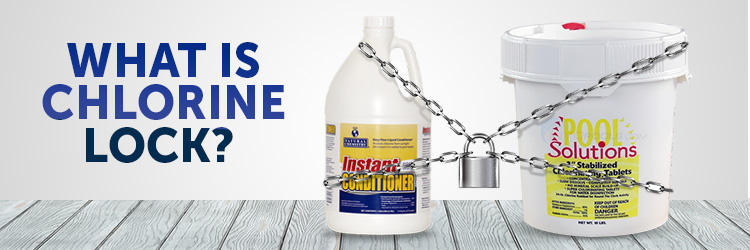
What Is Chlorine Lock?

The phenomenon of “Chlorine Lock” occurs when a pool’s free chlorine (FC) is overpowered by its cyanuric acid (also known as CYA or Stabilizer). Though CYA is vital in stabilizing (hence the name) chlorine for sanitation, too much of it decreases the effectiveness of chlorine. The sudden drop in your chlorine’s ability to kill bacteria, allows bacteria and algae to take over your pool quickly. Chlorine Lock can put your pool in a sort of limbo, where there is not enough chlorine to sanitize your pool properly, but not too little where a carnival of mosquitoes and algae come to party.

There are some pool boffins, and chemical whizzes that say Chlorine Lock does not exist their reasoning is that “Chlorine Lock” is more of an is an umbrella term that overstates an issue.

Why Does My Pool Need Cyanuric Acid?

Chlorine hates sunlight, because sunlight can burn off chlorine almost as fast as an algal bloom. Let’s look at it from a human perspective, what do you do to prevent sunburn? You use sunscreen. And that is where the cyanuric acid comes in, because CYA is chlorine’s sunscreen. The cyanuric acid shields chlorine from sunlight allowing it to seek and destroy any bacteria or virus in your pool. This relationship keeps everyone healthy.

Side note: If you want a really in-depth look at the relationship between chlorine and cyanuric acid, read our man Charlie’s article:  The Relationship Between Chlorine and Cyanuric Acid

But When Does a Healthy Amount of Stabilizer Become Too Much Stabilizer?

Traditional Chlorine

CYA LevelMinimum FCTarget FCShock FC
20*23 – 510
3024 – 612
4035 – 716
5046 – 820
6057 – 924
70*58 – 1028
80*69 – 1131
90*710 – 12 35
100*811 – 1339
*Outside of recommended level

Saltwater

CYA LevelMinimum FCTarget FCShock FC
603424
703528
804631
*Outside of recommended level

Because CYA protects chlorine, if there is too much of it in your pool it blocks the chlorine from working. Unlike chlorine, CYA does not dissipate, the only way to lower your stabilizer levels is to drain and refill a portion of your pool water. Chlorine Lock generally happens in older pools that use dichlor or trichlor tabs. These tabs can contain up to 50-60 percent CYA. Eventually, this CYA builds up to levels that must be compensated for.

And thanks again to Trouble Free Pool (TFP) and their pool chemistry experts for creating this handy-dandy Free chlorine to CYA use chart. The first columns show your CYA level, the following columns list Minimum FC and Target FC level needed to maintain proper levels. And the last column denotes the level of FC needed to shock your pool.

How Do You Fight Chlorine Lock?

An easy way to fight Chlorine Lock is to add more non-stabilized chlorine or cal-hypo to up your FC levels. This can be done by adding high percentage pool shock or bleach (yes, the kind you find at those big box stores). But not the splashless bleach, because additives within the formula foul your water.

For you skim readers out there, here is a quick and easy process to break Chlorine Lock:

1)  Test your water’s CYA Levels.

2) a) If CYA is low, use the TFP calculator chart to add the correct CYA dosage to pool.

b) If high, drain 10 percent of your water, then SLAM (Shock, Level and Maintain).

3)   Retest your water and repeat step 2 if necessary.

If you have another way on how to avoid or break chlorine lock, please leave a comment down below.

author avatar
Matthew Simmons Technical Writer & Pool Product Expert
Swimming pool expert at InyoPools and host of Poolside Chat, brings over a decade of experience in the pool industry.

Related Videos

48 responses to “How to Break Chlorine Lock”

  1. John Avatar

    Hi all,

    I’ve heard contradictory statements on where to drain from to reduce CYA. I’ve seen a couple sites say CYA sits near the surface, so you should pump out some water from near the surface of the pool, and other sites saying it’s at the bottom of the pool, so use the main drain

    Which is it? Or is it evenly distributed and removing any water is just fine

    Thanks!

  2. Narelle Avatar

    I have chlorine lock and need to drain off some water.Will this pool water kill my grass?

    1. Matthew Simmons Avatar

      The water shouldn’t harm your lawn unless you have recently put in a dose of algaecide. You also want to make sure you don’t drown your lawn. move around the drain hose, so one spot does not get oversaturated.

    2. NY100K Avatar

      Hope you can help me. Here are the current readings:
      FC 0.14
      TC 0.87
      Combined 0.74
      PH 7.5
      Hardness 233
      Alkalinity 111
      CYA 2ppm

      Pool is tinged green and cloudy. 40k gallons.

      Pool store says it’s in lock, and wait a few days to let it burn up.

      Should I be fixing the CYA levels now?

      Please advise if that is the best approach.

      1.  Avatar

        Another way to break chlorine lock is to shock the pool with a non-chlorine shock. Non-chlorine shock oxidizes the water, restoring the balance and making it cleaner. To break chlorine lock with shock, breakpoint chlorination is being done.

  3. Michael Barnidge Jr Avatar

    No CYA chlorine lock? What else can cause this to happen? My total chlorine is higher but my free chlorine reads low. However, my pool is essentially indoors with no direct sun so I use no stabilizer. My CYA level is 0. My pool is also completely clear and not slippery?? Any thoughts??

    1. Matthew Simmons Avatar

      It looks like you need to lower your chloramine level which can be done by dosing with non-chlor shock or with liquid shock. If your pool has a stronger “chlorine smell” than usual, that is from high levels of chloramines.

  4. Steven Avatar

    Hi, tanks for this information.
    I rigourously measure free Chlorine, Combined Chlorine, pH, CYA & TA.
    Current values:
    * pH 7.3 (which I consider optimal?)
    * TA 91 (I aim for 100, but since above 80, I consider this one quite ok)
    * CYA 46 (…and climbing… I will start backwashing a bit more, and intend to drain the pool half soon)
    * fCl 4.8
    * cCl 0.3 (total Chlorine 5.1)

    What puzzles me, is that at these levels of CYA, I will have to maintain high free Cl levels, according to the chart, above 5ppm.
    Many websites mention that one should not swim in the pool if fCl is above 5ppm, because it’s considered unsafe?
    Thanks in advance for clarifying this further to me

    1. Matthew Simmons Avatar

      Your Total Chlorine is too high, add some liquid shock or non-chlor shock to bring down your chloramines.

  5. […] How to Break Chlorine Lock […]

  6. Cat Avatar

    I’m certain I have chlorine lock… while I do have my water tested at a pool supply shop, the usual response from whatever kid they put behind the desk will say to continue to add more shock to the pool. Somehow I think this puts me in a worse state that before. Now I have that nice bleachy smell.
    Here are my latest readings: FC .24ppm, TC 1.24, Combined Chlorine 1ppm, Ph 7, Alk 75 PPM, CA 50 PPM, HARDNESS 318.

    How do I proceed to break the lock???? Help needed!!

    1.  Avatar

      One way to break the chlorine lock is shocking your pool with non-chlorine shock. Non-chlorine shock oxidizes the water, restoring the balance and making it cleaner. To break chlorine lock with shock, breakpoint chlorination is being done.

  7. steve Avatar

    Does it make since that pool people tell me that I have a chlorine lock , but I need to add more stabilizer?

    1. Matthew Simmons Avatar

      What are your stabilizer levels? That’s an important bit of information.

  8. Jon Avatar

    I have a 30k gallon pool and I’m testing with strips. Two brands of strips are identical. I think I have Chlorine lock. I opened the pool 2 days ago and it was blue but foggy. It went green fast. Went to a pool store and they said I probably had chlorine lock. All my levels are fine except FC. In fact the store said my CYA was low. It’s been 48 hours, 18 gallons of liquid chlorine and 8lbs of shock later. I’ve also drained 15% of my pool and refilled it. The green is gone but it’s foggy and reading no FC and high high Total Chlorine. What am I doing wrong?

    1. Matthew Simmons Avatar

      First, did you add the necessary CYA? There is no chlorine because it was used up killing the algae, which has now become that cloudiness. Use a clarifier or a floccing agent to get rid of the dead algae, correct your CYA level,s then resume using liquid chlorine or tablets as normal.

  9. Doris Avatar

    I have a problem. I have a 10, 000 gal pool. I used a liquid natural stabilizer in my pool. Then I added 4 gal of pool chlorine. It would never register any stabilizer with my strips. Plus the chlorine never registered either. Next I gradually put in about 5 lbs of granulated stabilizer. The strips measured ok stabilizer after that. Next I added 4 more gal of pool chlorine. Nothing on the strips. Next thing that happened was a creamy slimy sludge was in my pool. I’m guessing it was the first stabilizer I put in. Next I backwashed to waste until I got the murky stuff out and added quite a bit of new water and gradually added 4 packages of shock. Of course then my stabilizer was back down and the chlorine has still never registered. Now after adding more stabilizer, it does not appear to be changing the reading at all. I’ve added so much stabilizer and chlorine that’s it’s scary. Any ideas??

    1. Matthew Simmons Avatar

      Do you have the results of your latest water tests? We need to know the full picture, including the FC, pH, Alk, Calcium, and any other things your test kit can measure. Without actual numbers, I can’t give you a solid answer.

  10. Randy Avatar

    Good thought, I just tested it with my strips, but no. I can have the pool store test as

    1. Matthew Simmons Avatar

      Let us know the results of the tests.

Leave a Reply

Your email address will not be published. Required fields are marked *