Home / Articles / Converting a Salt Pool Back to Traditional Chlorine

Converting a Salt Pool Back to Traditional Chlorine

Converting a Salt Pool back to Traditional Chlorine

This may come as a surprise to some, but not everyone loves salt chlorine generators. Each pool owner has their reasons for not liking salt pools. Some people experience rusting, others have softstone decks, or just don’t like plunking down a few hundred dollars for a replacement cell. No matter what the reason is, these pool owners want the easiest way of converting their pool from saltwater to traditional chlorine, a.k.a. freshwater.

In this article, we will discuss the water chemistry and hardware hurdles to overcome when making the switch. But the question asked most often is the following:

Do I have to drain my pool?how to drain a swimming pool

Not entirely, but you will be draining a portion of your pool’s water that will be replaced with fresh water to lower the cyanuric acid (CYA) levels. The chemical CYA is sometimes referred to as stabilizer. Chlorine created by salt generators is a pure form, meaning salt pools require of you to add CYA to protect the chlorine. A salt pool’s CYA levels hover around 80-90 parts per million (ppm), whereas chlorine pools should be about half that at 40 ppm.

CYA, unlike chlorine, does not dissipate from pool water. So, to lower your CYA, you must drain a portion of your pool and then refill with fresh water. A good method of draining is the percentage method. If your CYA level is 80 ppm and you want it at 40 ppm, drain about 50 percent of your water.

For you folks in areas with high water tables, like us Floridians, be mindful of when you drain the pool. Do not drain your pool in the rainy season or after periods of heavy rain, or you may pop your pool.

Balancer Chemicals for Traditional Chlorine
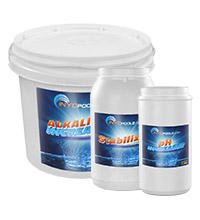
pool water chemical balancers

You will essentially be continuing your regiment of testing pH, alkalinity, and hardness, applying pool chemicals as needed. You can probably chuck your bottles of CYA, because tablets and liquid chlorine contain stabilizer within their formulas.

For a guide on pool chemistry, follow this link: How To Maintain A Swimming Pool Part 1 (Chemicals).

Will residual salt affect my pool?pool deck deck damage caused by saltwater
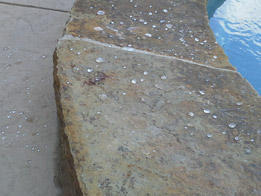
No, the leftover salt in your pool water does not pose a danger to your pool equipment. The electrolysis created by the reaction to the salt cell is what caused most of the corrosion in your pool, not the salt itself. Without the cell, the salt will be relatively harmless.

And before you fire up the keyboards talking about the corrosiveness of seawater, be aware that seawater contains 35,000 ppm salinity level, and your pool water has about 3,500 ppm tops. After you have purged so much water to lower your CYA, your pool water’s salinity level will be a fraction of the 3,500 ppm.

Picking a Chlorinator

how to pick a pool chlorinator

We cover the pros and cons of various types of chlorinators in the video above. I have it cued to the section explaining the differences between the three main choices which are floating, in-line, and off-line chlorinators.

For the in-line and off-line types, the biggest concern will be location and spacing. Chlorinators should be the last piece of equipment on your plumbing line, after your filter, gas heater or solar panels. So, you will need to find a spot with straight pipe that is long enough and with enough clearance above and below to install and service the chlorinator.

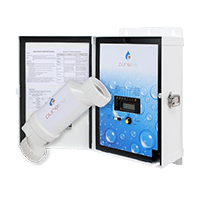
Regular flow-through salt cells like the Intellichlor, AquaRite, and Pureline are long enough for an in-line chlorinator to be slotted in its place. If your equipment pad is a tight squeeze or your cell has an odd configuration like a CompuPool or Jandy AquaPure Ei, an off-line chlorinator will be the better choice. It requires a small hole to tap the plumbing line and for the return feeder line. And it can be set beside the equipment pad instead of on the pipe.

Removing and installing equipment

Removing the old salt system is pretty simple and most would follow these three steps:

  • Shut off the power to the control box, then unmount it.
  • Remove the flow switch from the tee mount, plug the tee tap or remove the tee and replumb the section.
  • Unscrew the cell from the plumbing line.

If you have one of those flow through cells like the Hayward AquaRite, then those steps are simple. But if you have a CompuPool upside down U-shape or the AutoPilot manifold design, the removal of the cell and associated piping will likely require some PVC elbow grease.

author avatar
Matthew Simmons Technical Writer & Pool Product Expert
Swimming pool expert at InyoPools and host of Poolside Chat, brings over a decade of experience in the pool industry.

Related Videos

45 responses to “Converting a Salt Pool Back to Traditional Chlorine”

  1. Robert Kline Avatar

    I don’t like having to keep the solar cover off for 24 hours (and lose they heat) while regenerating with the salt water pool. The 3 step chlorine process was so much easier.

  2. Steven Walter Loomis Avatar

    I was told that because we removed the salt cell years ago that it caused my heater to malfunction. FYI my heater is 12 years old and is now leaking.

    1. Matthew Simmons Avatar

      How many years ago did you remove the salt system? If the heater is 12 years old and you just removed the salt system 2 or 3 years ago there could be some residual damage from the decade of salt water going through it. But that wouldn’t be out of the ordinary.

      A pool heater usually lasts around 10 years anyway. If you are just now experiencing heat exchanger issues, then I would consider yourself semi-lucky. I say semi because you still need to get it repaired or replaced which equals a lot of moolah.

  3. steve Avatar

    About a year ago I switched my indoor pool from salt to chlorine because it was pitting my stainless steel sides (I have stainless sides and a glass tile bottom), and, it was destroying my limestone coping.

    I now get a light film on the surface of the water everytime I open and close the vinyl pool cover. It eventually dissipates but reappears when I close then open the pool cover. it is a fine film that dissipates with a drop of dawn dish soap, but never goes away. It also shows little white flakes on the surface sometimes as well.
    When I switched I drained the pool for cleaning and repair and added new water. Then filled and the problem started. I drained the pool again, scrubbed the underside of the pool cover twice, changed chlorine tabs, refilled the the problem re-occured a week later. Since then I’ve replaced the filters, installed a new pool cover (thinking the plasticizers were leaching out, and even had an HVAC company check the dehumidification system that uses the pool water to evac heat (and it tested perfect) thinkin that coolant was escaping into pool . My pool chemistry is good and I’ve had it double checked by Leslie Pool.
    Any ideas? thank you in advance.

  4. Ken Harvey Avatar

    Hi Matthew, I purchased a home in Costa Rica and we are having a fiberglass pool installed. We are being asked if we would like to have a chlorine or salt water pool with standard pump or variable speed pump. The climate is warm all year and the pump will be running all year round. In this scenario would you still recommend a salt water pool over a chlorine pool? We are planning to rent it out occasionally as well if that makes a difference and the additional costs for a salt water pool is $800US and the variable speed pump is also $800US extra.

    Pool size is 271 square feet and 4.6 feet deep.

    Any thoughts?

    1. John B Avatar

      15 years of salt pool when initially built and tired of all the issues mentioned above, switched to tabs. Salt pool require so much extra work. Not just salt cell replacement. Cords need replacing regularly, PH is biggest issue causing scaling and muriatic acid addition each day, flow issues, trouble codes and lights and trying to figure out why chlorine isn’t being generated on any given day, trying to get the % correct, not noticing generator not making chlorine for any number of reasons, salt causing corrosion on stamped concrete and other salt issues in landscape, list goes on forever. Forget the extra cost each week and claims it is cheaper in long run, it is not. The time and frustration of keeping a salt system working correctly is my biggest pool chore by far. Salt pools are way way over hyped, little to no advantage compared to the extra work and problems it introduces.

      1. Kelly Avatar

        I agree I moved to Florida and I have a saltwater pool now I had a chlorine pool in Corpus Christi and it was a lot simpler I was gonna wait till the generator quit working but I’m thinking about just going to Chlorine right now getting it done

      2.  Avatar

        John what you said is so true I have a salt pool an it has worked me to death an always buying something to put in it I want to go back to chlorine but not sure how.

  5. René in La Avatar

    Hi Erica. My question/issue is the same as yours & I like this blog but haven’t seen Matthew answering lately. I’m hoping this prompts a new question that needs attention.
    I have a great “looking” setup behind the scenes but going to chlorine is definitely for me (from previous experience). My pool is FINALLY algae free, clear blie & I can visually tell if it needs backwashing, ez. The man at my pool store (large chain, I think he’s well experienced) told me that all I had to do was turn off/unplug the salt cell, keep chlorine tabs floating & shock it 1x/wk. I had to shock more, backwash more, add water more at beginning but now again it’s just a visual thing. BUT.. it’s also chilly weather with not much rain so I’m sure that’s affecting things. Oh Salt on control box (which is for lights, everything) says ck salt level 0000 ppm. Sounds good to me. MY CONCERN – is the plugged in salt cell doing any harm (like do the plates inside it cause issues with the water?). ALSO, I am now but will stop, running pump 24/7 til water cleared up. Just forgot to set timer.
    Matthew???

    1. Matthew Simmons Avatar

      The cell’s plates may accumulate some scale which you would want to monitor. Generally, if you are switching back to chlorine the cell is removed pretty soon thereafter, so I am not wholly sure of the longterm effects of keeping it in place.

  6. Erica Avatar

    We bought our home with a salt generator installed and the next season I issues with the flow switch several times and now the circuit board. The pool tech who came out to give us an estimate said we could just switch over to chlorine without changing anything. Since my system isn’t actually working, do I still need to plug anything off or remove my salt cell? I have a vinyl lined inground pool approx 15,000 gal. Also, we have a floating chlorinator that was recommended to us by our local pool store but we had trouble keeping the chlorine level adequate this year. Any suggestions on why? Chemistry was in check otherwise.

    1. Erica Avatar

      I should add that this summer we did not fix the SWG and just used the chlorine floater and weekly shock with the setup unchanged.

      1. Matthew Simmons Avatar

        Erica, if you read the article above it pretty much tells you everything asked in your question.

        1. Erica Avatar

          Thank for your reply. I did read the article above. I’m wondering if the 3 steps mentioned are required to do, or if that’s if you want to remove the SWG for aesthetic reasons. For example, as long as the power is off, I wouldnt need to unmount the control box (this would probably look worse, since the siding behind it is likely darker being protected from the elements). But how about plugging the switch? And removing the cell would add cost because I’d have to get a dummy in its place as you suggested to someone who asked. But would it hurt to just leave it connected? Is it doing anything if the power to the box is off?

  7.  Avatar

    I have a saltwater pool and it destroying my coping and moss rock, which the builder never said anything to us about salt and natural rock. They guy at the pool store told me to pull my salt cell off and put a cell pipe/ winterizing cap as a replacement and use chlorine tablets. I have a jandy aquapure Ei series apure 35. My question is what do I do with the cell leads once I take off the cell? Any information will be helpful

    1. Matthew Simmons Avatar

      Hello – what are you describing when you say “cell leads”? If you are referring to the holes in the pipe, you can plug them or cut out that portion of pipe then fill the gap with a fresh piece with unions. If you are referring to the actual electrical leads of the salt cell, you can do whatever you like with them if you don’t plan on reinstalling the cell.

Leave a Reply

Your email address will not be published. Required fields are marked *