

When people find out that I deal with swimming pools on a daily basis, one of the most common questions I get is, “What do you think about salt pools?” to which I find myself going into a little sales blurb on what a salt pool is. I would say 90% of the people have heard of salt pools, but don’t really know how they work. Most know they are supposed to be nicer than chlorine pools and think that salt pools don’t use chlorine, but this is not the case. This article will explain how a pool salt system works, if one is the right choice for you and then the process of converting your pool from traditional chlorine to salt.
What is a salt water pool?
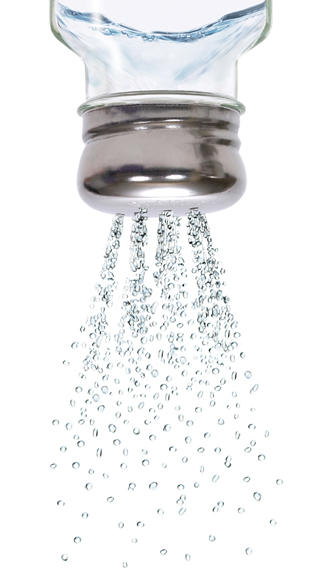
With a salt pool, you add salt to your pool water. This amount is below the taste threshold meaning you don’t taste a strong salt taste like associated with the ocean. Ocean water is at 50,000 parts per million (PPM) of salt. A salt pool is a mere fraction of this and only has 3,000 PPM of salt. In a salt pool an electrode (also called a salt cell) is installed in your plumbing and as the diluted salt water passes through the cell, the electrical reaction between the electrode and the salt water creates chlorine. So, with a salt pool you are still using chlorine to sanitize your pool as you are just manufacturing your own. The chlorine that is produced by a salt pool is a higher quality of chlorine that does not have the negative effects of traditional chlorine like the chlorine smell, red eyes and itchy skin. With a salt pool you no longer need to purchase chlorine tablets, liquid chlorine or shock as the salt system will be creating all of your chlorine. Salt systems also have a superchlorination feature that acts as shocking your pool. If you’re interested in learning more about salt water pools then I would suggest reading our recent blog post on “What is a Salt Water Pool” which goes into much greater detail on this topic.
The pros & cons of salt pools
Pros:
- No more buying chlorine – A salt system manufactures natural chlorine. That means no more buying chlorine tablets, shock or liquid chlorine!
- No more manually adding chlorine – On a salt system you dial in your chlorine production and that is it. This is a major benefit over traditional chlorine where you have to make sure to add your chlorine to the pool each week and if you forget or go on vacation then you are faced with issues. I have to admit this is my favorite benefit of a salt pool.
- No chlorine smell, red eyes or itchy skin – The negative effects of chlorine like the chlorine smell, red eyes and itchy skin are all due to chloramines. The chlorine that is produced by a salt pool does not have chloramines. This means all of these traditional side effects of chlorine are eliminated. This is the reason why many people who swim in a salt pool think that it is a non-chlorine pool.
Cons:
- High pH & calcium build-up – In salt pools the pH level of the water likes to rise. If you don’t keep your pH levels in check then this can lead to calcium scaling in your pool or your salt cell. This is easily maintained by testing your pH levels weekly and adding muriatic acid if you need to lower your pH.
- Salt cell replacement – Every 3-7 years you will need to replace your salt cell which costs between $200 – $700.
- More parts – On a salt system there are more parts which can become faulty like the circuit board, salt cell, flow sensor or flow switch.
- Corrosive to pool and equipment? – This topic is open for debate as many pool professionals feel salt water is perfectly fine for your equipment and others feel you need special equipment. Our experience is that sometimes the shaft seal on your pool pump may fail a little quicker, but this is an easy inexpensive fix. If you are adding a heater to your pool you may consider a cupro nickel heater as this heater has a heavy duty heat exchanger which is supposed to hold up better to salt. The last item you may consider is a sacrificial zinc anode. You place this zinc disk in your skimmer and the anode absorbs all the corrosion
Converting from chlorine to salt
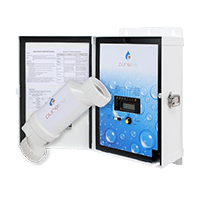
Once you have made the decision that you want to convert from a traditional chlorine pool to a salt pool then your first decision will be which salt system to choose. A few considerations you will want to take into account when selecting your salt system are listed below.
Selecting your salt system
- Pool size: Salt systems range from pools 10,000 gallons – 100,000 gallons. You will need to select the system based on your pool size. You can always go with a larger unit on a smaller pool. This will allow you to run the salt system for shorter periods of time and you will have longer time between replacing your salt cell.
- Budget: Salt Systems can cost anything from $500 – $2,000. The less expensive models have few bells and whistles where the higher end systems have a bunch of fancy features including the ability to control all your pool equipment.
- Features: Salt systems vary in regards to the features offered. Some of these features include: salt readout, self cleaning, self diagnostics, digital readout and the ability to control pool equipment.
- Replacement cell cost: This is an important factor and is often overlooked. Your salt cell will need to be replaced every 3-5 years. Replacement salt cells range from $200 – $700. So, if you get a salt system which uses a $200 cell then you could replace this cell 3½ times before it costs as much as replacing the $700 cell.
- Where to buy: Here you can check out our full line Salt Chlorine Generators we even have a model for in-ground pools starting at $499.
Installation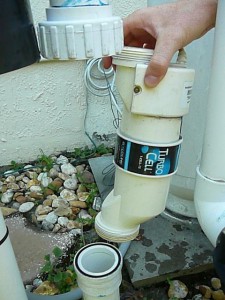

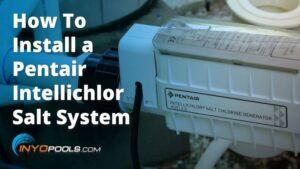
Now it is time to decide if you are going to hire a pool company to install the salt system or do it yourself. If you go the pool company route, then you are looking at $300 – $500 for installation. Many homeowners decide to tackle this DIY project themselves as this is usually a 3-6 hour job that can be tackled over the weekend. We have put together a step-by-step video on “How to Install a Salt Chlorine Generator” which would be a good primer to see if you think you can tackle the job. The installation consists of some basic plumbing and electrical work.
Adding the salt
After you have installed your salt system the next step is to add the salt to your pool. We have put together a guide on “How to Add Salt to a Pool“ which discusses this process in greater detail, but we will touch on the basics which are:
- How much salt do you need?
- Testing water
- Selecting salt
- Adding salt
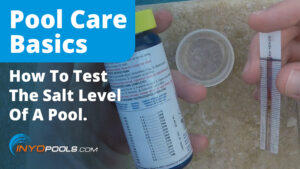
The first thing you will want to do is check the owner’s manual to determine how much salt you will need. Normally this will be between 400 lbs. – 1,000 lbs. based on the size of your pool. You will want to pick up some pool salt test strips as you don’t want to assume that you are starting at 0 PPM of salt as often your water will have some salt in it (for example you may be starting off at 200 PPM of salt). The salt strip will also be used after you add all of your salt to ensure you are within the 3,000 – 3,5000 PPM salt range.
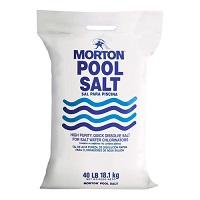
Next you will need to pick up some pool salt. This can be easily found at your local home improvement store, pool store or even grocery store. You will just want to make sure the salt you choose is at least 99.8% NaCl and that it is granular (no pellets or rock salt). Often people get concerned when they hear that they need to add 400 lbs. of salt, but this is just 10 bags of salt (40 lb. bags) and salt costs about $5 per bag so this would be about $50 in salt. Salt does not dissolve from water meaning that you will only need to add additional salt if you experience evaporation, heavy rain, water being splashed out of the pool or a leak. Normally you would add several bags of salt throughout the year to maintain the required salt levels.
Now it is time to add the salt to your pool. Your pool pump should be turned on and the salt system should be turned off. You will want to broadcast the salt evenly around the pool for even distribution. Avoid adding the salt directly to the skimmer or main drains at the bottom of the pool as this can damage your equipment. You will run your filter pump for 24 hours to allow for the salt to mix evenly through your pool water. After 24 hours use your salt test strip to verify that you have the correct salt reading of 3,000 – 3,500 PPM of salt.
Starting up the salt chlorine generator
It is very important to start off with good pool water. Your water chemistry should start off at the following values:
Salt: 3,000 – 3,500 PPM
Free Chlorine: 1.0 – 3.0 PPM
pH: 7.2 – 7.8
Cyanuric Acid (Stabilizer): 50 – 75 PPM
Total Alkalinity: 80 – 120 PPM
Calcium Hardness: 150 – 400 PPM
At start up it is best to shock your pool from an outside source like a standard granular pool shock. Then, wait until the chlorine level has returned to between 1 to 3 PPM before turning on the salt system. Now it’s time to kick on your salt system. We suggest setting the system to 50% chlorine production and let the system run for 24 hours. After 24 hours test your pool water with a good test strip to see if your free chlorine is between 1-3 PPM. If your chlorine is too high or too low, dial your chlorine product up or down in 10% increments and retest your chlorine in 24 hours. Repeat this process until the proper chlorine level is reached. The nice thing is that once the salt system is dialed in it is pretty much a set-it-and-forget system, because it is always there producing natural chlorine for your pool at the desired amount to keep your pool crystal clear. Salt systems also have a superchlorinate feature which shocks your pool. So if you ever run into demanding water conditions then this feature comes in handy to shock your pool and get your pool water looking clear again.
Maintenance
Testing your water
Now that you have your salt system up and running you will want to periodically test your water to make sure that your water chemistry is in balance with the values listed earlier in this article.
Prolonging the life of your salt cell
Salt cells normally last 3-7 years. To get longer life out of your cell, you will want to follow certain steps.
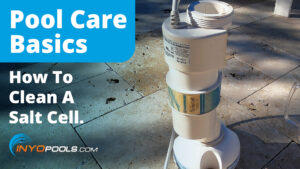
As your salt cell is in use, calcium deposits will build up on the blades of your salt cell. To remove this calcium build up, soak your cell in diluted acid solution. To prolong the life of your cell, you will want to clean it at least once a season. On the flip side you want to make sure you do not clean your cell too often or with too highly concentrated acid solution as this can strip the cell of its titanium coating making it useless.
Calcium build-up
Salt pools tend to make the pH in your pool want to rise so it is important that you are monitoring your pH levels and adding muriatic acid to reduce the pH. High pH levels cause much quicker calcium build up on your salt cell as well as on your pool tiles. I learned this the hard way! If you want to get fancy, many pool owners are coupling their salt systems with an acid feed pump. This is nice as the production of chlorine in your pool is automatically produced by the salt chlorine generator and the pH levels are automated by the feed of acid from the acid pump.
Need help converting your pool to saltwater?
When I built my pool I installed a salt system and I can honestly say it is one of my favorite features of my pool. After the initial set up, I really did not had to worry about my chlorine at all. If you have decided that you want to convert your pool from traditional chlorine to salt then post any questions in the comments below and we would be happy to help. Also if you have already made the switch, we would love to hear about your experience. You can also always reach us by phone at 1-877-372-6038 with any questions.






Leave a Reply