Home / Articles / The Difference Between Pool Clarifier and Flocculant

The Difference Between Pool Clarifier and Flocculant

The Difference Between Pool Clarifier and Flocculant

Cloudy pool water is usually caused by dead algae or mists of particles suspended in your pool water. The job of a coagulant agent, like clarifier or flocculant, is to clump these tiny particles into larger clumps so that they can be collected by your filter or flushed to waste. 

Now, clarifier and flocculant (floc and vac) are two sides of the same coin. Both are types of coagulant agents that accomplish the same task using different routes. The key differences are the time it takes for the reaction to take place and the extra elbow grease needed from you to finish the job. We will discuss the pros and cons and the best times to apply which chemical. 

Clarifier 

clarifier clears cloudy pool
Cloudiness Can Floating Dead Algae

Pros: 

  • Least amount of work for the user 
  • Great for light cloudiness and superfine silt 

Cons: 

  • Takes several days to get the desired result 

Pool clarifier is a mild coagulating agent that boosts your filter’s cleaning capabilities by clumping small dirt particles into larger particles your filter media can trap. Safe to use with sand, DE and cartridge filter systems, clarifier requires that your pump and filter are run continuously for at least the first 24 hours for optimal results. 

Clarifier is a milder chemical than flocculant making for a slower work rate. Your pool’s reaction to the clarifier may take a couple of days before you see the results. So, if you are needing a quick fix for a pool party only hours away, clarifier will not be the choice for you.  

Clarifier is the ideal choice for mild cloudiness or a regular part of a cleaning regimen to give your water that extra sparkle.  

Flocculant 
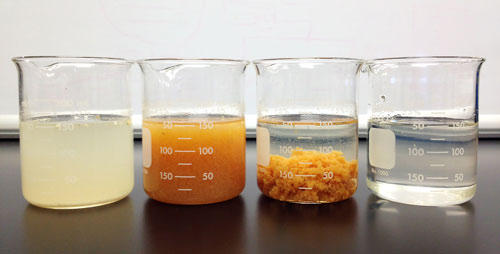
flocculant fixes cloudy pool
Flocculant at Work

Pros: 

  • Shows results within a few hours 
  • Super effective  

Cons: 

  • Requires vacuuming 
  • Water waste 
  • Can’t be used on systems with cartridge filters (unless there is a bypass) 

Flocculant’s coagulation process is basically a supercharged version of a clarifier. But instead of relying on a pool filter to do the cleaning, it requires vacuuming. Floc clumps the dirt into large clots, so large that they no longer float, dropping all the dirt to the pool floor where you can then vacuum to waste. Your pool should show marked improvement within a few hours of its application, making it ideal for procrastinators (like me) cleaning just before a pool party. 

Floc can be used for mild cases of cloudiness all the way up to murky. However, I usually suggest it as a last resort, because you must vacuum it to waste. You can lose a good bit of water while cleaning the pool. 

Floc should never come in contact with your filter media as the clumping agent can cause havoc. Floc is only suggested for use with filters with bypass options, i.e. sand and DE filters with multiport or slide valves. It is not suggested to use floc with a cartridge system, unless you have plumbed a bypass for the filter.  

So which is best for you? 

Clarifier is best suited for basic maintenance, and picking up straggling silt your filter just can’t seem to catch. Flocculant is best for more severe cases, like part and spring cleanup. Flocculant shows results within a few hours, making it great for cleaning in crunch time. 


author avatar
Matthew Simmons Technical Writer & Pool Product Expert
Swimming pool expert at InyoPools and host of Poolside Chat, brings over a decade of experience in the pool industry.

Related Videos

65 responses to “The Difference Between Pool Clarifier and Flocculant”

  1. Jeff Avatar

    I have a saltwater pool and my pump has a turbo cell. My pump has the waste function so if I put flock in my pool then vacuum to waste, will it mess up the cell???

    1. Matthew Simmons Avatar

      If this is a standard set for above ground and inground pools, the salt cell should be plumbed in after the filter. So, if the filter’s valve is set to waste, all the water flowing through the pump will go out the waste line and none will reach the cell.

  2.  Avatar

    What kind of filter Are you running

    1. Matthew Simmons Avatar

      To whom are you asking this question?

  3. Kell Avatar

    Hello I have an above-ground Intex pool it’s 52 inch high and 24 foot round I’ve been working on it for about a month-and-a-half and it will not come clear it looks like milk I do not have the waste setting on my filter so I don’t know how I can use the flock could I just backwash it out please help I’m going crazy I’ve wasted hundreds and hundreds of dollars just for all different kinds of chemicals thank you in advance

    1. Matthew Simmons Avatar

      Backwash allows the water to go through the sand, which is something you want to avoid with flocculant. If your filter does not have a waste function, then I suggest using a clarifier or a product called Pool First Aid.

      1. Kelly Avatar

        What happens if you get flock or HTH green to blue in your sand filter, I vacuumed to waste and ran the filter and also then vacuumed it regular, my pool is cloudy and when I backwash the water is clear. HELP

        1. Matthew Simmons Avatar

          As you probably saw when it was in your pool, flocculant clumps small particles together. Now, imagine what it would do in a big ball filled with water and grains of sand. Not very good for filtering, to say the least.

          There is not much you can do other than backwash and hope it clears the flocculant well enough to be able to use that sand again. If not, you will need new sand.

    2. Babs Avatar

      Pop up pool filters are junk. I can’t recommend but I can tell you what I did. Simple modification with a better filter and pump solves the problem. Warrantee is voided yes but you will have better filtration and circulation which means cleaner water. I have a summer waves pool had a Dough Boy pool that was beyond its use kept all filter parts. A short section of PVC pipe, threaded elbow with slip, straight slip with threaded end for adjustable eyeball, and double threaded part for the inside return, out return threaded barb and gaskets inside and outside pool. Cut pool wall for wider opening. Connected return hose to sand filter. Skimmer I lined up inside screw plate held in place with a few screws each side utility knife cut opening attached skimmer housing with gaskets and put my Hayward Pump with Sand Dollar filter together as I normally would. I’m able to use the filter the same as I did with the old pool. My pop up pool is much cleaner than those who use the sand filters that are made for these pools because I can adjust the return lower and it circles around pushing debris into the skimmer. A good pump and filter aren’t cheap but they’re worth it not spending money on chemicals to clean it.

  4. Amanda Avatar

    Help! I’m frustrated. I flocked our pool did everything right. Backwashed this morning before work and was amazed at how well the pool went from green to clear overnight. Here’s the big BUT…I planned on coming straight home from work to vacuum and get it back looking fabulous again. But kids came home from gmas and of course, jumped in the pool and stirred it all up. Anything I can do to get it back to the floor to vacuum out? Do I just wait till it settles again or do I need to put something else in?

    1. Matthew Simmons Avatar

      All you can do is wait for it to resettle.

  5. Patrick Avatar

    My system is pump/filter/heater/ return.

  6. Patrick Avatar

    How does flocking a pool affect a pool heater connected to a sand filter? The water will be pumped to waste but will go through the heater. Obviously the heater will not be running.

    1. Matthew Simmons Avatar

      The floc can go through the heater without causing any damage, but I would refer to your specific floc bottle’s instructions to confirm there are no warnings as such. Also, going by your descriptions it sounds like your heater is in between your pump and your filter. Or is your waste line somehow diverted through your heater?

  7. Diana Avatar

    We just had a massive rain that washed dirt from our new gardens into our pool. It’s a muddy mess. My pool store recommended we use Flocculant to clear it up. I have followed the instructions and by 8am tomorrow morning the pump will have been off for 16 hours. I’m hoping it will have done it’s job by then and I can vacuum. My question is: how do you know you’ve removed *all* of th flocculant? If I miss a little bit and turn the filter on (sand filter) will it really damage it? I’m worried I might miss some and cause damage. Thanks so much! Helpful article 🙂

  8. Sherrick footman Avatar

    What to buy to clean a cloudy pool or what does it mean to have a cloudy pool

    1. Matthew Simmons Avatar

      As I cover throughout the entire article, both of these can be used to clean a cloudy pool. Here is a list of reasons why a pool would be cloudy: Why Is My Pool Cloudy?

  9. Deborah Soto Avatar

    Floced the pool three weeks ago. Everyday since, I have vacuumed on waste. How long will this go on? Seems like an endless task

    1. Matthew Simmons Avatar

      The pool shouldn’t need to be flocced that often. What type of debris are you getting rid of?

  10. Raina Avatar

    I’m new to this pool maintenance thing and have been battling a slighlty green and cloudy pool for two weeks now. I’ve added clarifier just two days ago and saw this morning that the algae has settled at the bottom of the pool (when the filter/pump is off overnight). Should I be vacuuming on waste to remove this too? It seems to be very light and just mixes with the water too easily with any motion in the pool. I can also see small cellular looking blobs of green floating around the pool, which I also assume is normal to see when you use clarifier.
    I am hoping to have a clear and green-free pool by tomorrow (day 3). How can I expedite that? Can floc also be added in now after the clarifier?
    Thanks for any help you can give me – this newbie really needs it!

    1. Matthew Simmons Avatar

      The only way to clear your up green water is by maintaining high chlorine levels until the green turns cloudy white. The cloudiness in your water mixed with the green water is dead algae. The clarifier is not treating the cause of the problem, so once the clarifier dissipates, the algae are going to pop up. We have this guide that you should follow How to Clean a Green Pool

Leave a Reply

Your email address will not be published. Required fields are marked *