Home / Articles / The Difference Between Pool Clarifier and Flocculant

The Difference Between Pool Clarifier and Flocculant

The Difference Between Pool Clarifier and Flocculant

Cloudy pool water is usually caused by dead algae or mists of particles suspended in your pool water. The job of a coagulant agent, like clarifier or flocculant, is to clump these tiny particles into larger clumps so that they can be collected by your filter or flushed to waste. 

Now, clarifier and flocculant (floc and vac) are two sides of the same coin. Both are types of coagulant agents that accomplish the same task using different routes. The key differences are the time it takes for the reaction to take place and the extra elbow grease needed from you to finish the job. We will discuss the pros and cons and the best times to apply which chemical. 

Clarifier 

clarifier clears cloudy pool
Cloudiness Can Floating Dead Algae

Pros: 

  • Least amount of work for the user 
  • Great for light cloudiness and superfine silt 

Cons: 

  • Takes several days to get the desired result 

Pool clarifier is a mild coagulating agent that boosts your filter’s cleaning capabilities by clumping small dirt particles into larger particles your filter media can trap. Safe to use with sand, DE and cartridge filter systems, clarifier requires that your pump and filter are run continuously for at least the first 24 hours for optimal results. 

Clarifier is a milder chemical than flocculant making for a slower work rate. Your pool’s reaction to the clarifier may take a couple of days before you see the results. So, if you are needing a quick fix for a pool party only hours away, clarifier will not be the choice for you.  

Clarifier is the ideal choice for mild cloudiness or a regular part of a cleaning regimen to give your water that extra sparkle.  

Flocculant 
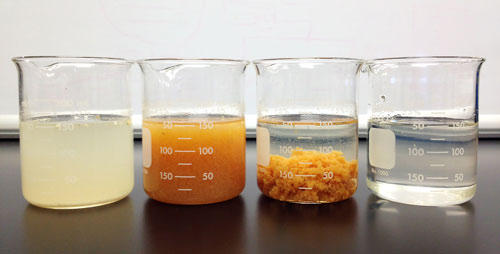
flocculant fixes cloudy pool
Flocculant at Work

Pros: 

  • Shows results within a few hours 
  • Super effective  

Cons: 

  • Requires vacuuming 
  • Water waste 
  • Can’t be used on systems with cartridge filters (unless there is a bypass) 

Flocculant’s coagulation process is basically a supercharged version of a clarifier. But instead of relying on a pool filter to do the cleaning, it requires vacuuming. Floc clumps the dirt into large clots, so large that they no longer float, dropping all the dirt to the pool floor where you can then vacuum to waste. Your pool should show marked improvement within a few hours of its application, making it ideal for procrastinators (like me) cleaning just before a pool party. 

Floc can be used for mild cases of cloudiness all the way up to murky. However, I usually suggest it as a last resort, because you must vacuum it to waste. You can lose a good bit of water while cleaning the pool. 

Floc should never come in contact with your filter media as the clumping agent can cause havoc. Floc is only suggested for use with filters with bypass options, i.e. sand and DE filters with multiport or slide valves. It is not suggested to use floc with a cartridge system, unless you have plumbed a bypass for the filter.  

So which is best for you? 

Clarifier is best suited for basic maintenance, and picking up straggling silt your filter just can’t seem to catch. Flocculant is best for more severe cases, like part and spring cleanup. Flocculant shows results within a few hours, making it great for cleaning in crunch time. 


author avatar
Matthew Simmons Technical Writer & Pool Product Expert
Swimming pool expert at InyoPools and host of Poolside Chat, brings over a decade of experience in the pool industry.

Related Videos

65 responses to “The Difference Between Pool Clarifier and Flocculant”

  1. Rick M Avatar

    I used lo phos max to remove phosphates which were above 3000. I now have sediment on my pool floor which it seems is too fine for the robot cleaner to pick up. It seems to just kick up this debris. Should I try a clarifier and see if the filter will remove it? Is the only way to remove it is to vac to waste?
    I have NO idea where my high levels of phosphates originate each year. No leaves, fertilizer, pets, birds…..it’s real mystery.
    Thanks for your help.

    1. Melissa Avatar

      I have the same issue and no one seems to have an answer! All I can tell you is we have been backwashing every day and slowly it’s clearing up. I will never EVER put phosphate remover in again. After a lot of research if your water stays balanced the phosphates will be too. Sorry wish I had a better answer!

  2. Deborah Avatar

    Awesome Informative blog…
    Thanks to everyone for your various questions, situations and suggestions…
    More importantly is that the owner of the blog and it’s readers.., took the time to answer!
    WONDERFUL SITE! Thank you all!

  3. Hollie Avatar

    This article grabs your attention by stating that your pool could be clear the next day – with floc and some work. I haven’t found any that required less than 24-48 hours of resting time. Even 24 hours would be great because I’ve never had anything work under 48 hours. Which brand are you talking about? I’d love to see a difference in just a few hours!!!

  4. Mark Avatar

    Hey, these are great tips!

    My situation is that we have a mesh safety cover on during the winter which leaves us with a nearly full pool with quite a lot of fine dirt and silt settled on the bottom when it is time to open. Running the Polaris just stirs it up and the mesh is not fine enough to capture it either. So I am looking at using a flocculant and possibly investing in a vacuum that I can direct manually. I have a cartridge filter so running it off the skimmer is not ideal.

    So my question is what type (Brand? Model?) of vacuum do you suggest that will either discharge over the side, or into its own canister ?

    Thanks!

    1. Abby Avatar

      I use a vacuum head and hose that I purchased from Walmart to siphon vacuum. Submerge your vacuum and hose like you normally would to purge air, then drop the end of the hose over the side of the pool below the water line. Doing this creates a siphon the sucks everything out to waste. You’ll lose a good quantity of water in the process but as least you’ll have the nastiness from the floc product out of your pool!

    2. Matthew Simmons Avatar

      The Polaris cleaners have a sand/silt bad that is great for fine material. Are you using that attachment? An example of the fine mesh bags is the Sand/silt Bag (280) (k14)

  5. James Avatar

    I used floc last night, and it has been over 12 hours that I have not been running the pump. The water is mostly a cloudy blue with pockets of whitish scum on the surface. I still cannot see the bottom of the pool and cannot tell if there is anything on the bottom to vacuum. What do you suggest? Thanks!

    1. Matthew Simmons Avatar

      Did you let the pump run for few a hours before letting it sit?

      I’d let it sit for a few more hours then vacuum to waste.

  6. becky Avatar

    My pool place told me to use floc last year … me not knowing any better used it not knowing that it can’t be used with a cartridge filter I don’t not have a vacuum to waste option now here we are this year opened my pool today and floc is still on the bottom of my pool HELPPPPPP … WHAT I CAN I DO BESIDES EMPTY MY POOL WE JUST FILLED

    1. Abby Avatar

      Becky,
      I don’t have a vacuum to waste option with my filter either but I got around it by creating a siphon vacuum using just the vacuum head and hose.

      Submerge your vacuum and hose like you normally would but instead of hooking the hose to suction, drop the end over the edge of the pool (I use a small bungee to keep the hose from sliding around on the top rail while I’m working). This creates a siphon that will accomplish the same goal as vacuum to waste.

    2. Matthew Simmons Avatar

      Not much. You can try using a sump pump to purge the floc.

  7. Sheena Avatar

    Hi Matthew, I used Aluminum Sulfate to floc my pool trying to get rid of high pollen. The pool was crystal clear with globs of slime looking debris at the bottom next morning. I used a Dolphin automatic cleaner to vacuum which was a mistake as it stirred up all the slime debris and now the pool is a blue haze so cloudy. What do I do now? I have a manual vaccum and can vacuum to waste but I don’t know how to attach the vacuum to get suction. My pool has 2 skimmer baskets and I don’t know which side is suction and which is return. Ideally I am wondering if I can add a clarifier and let the filter do the work now or is it too late ?

    1. Matthew Simmons Avatar

      The suction ports of your inground pool are the main drains, skimmers and some have dedicated suction lines. The most comment way to hook a manual vacuum is connecting a hose through your skimmer. The video and guide on this link will show you how to set up your pool equipment for vacuuming: How To Manually Vacuum A Pool

      For now, I would vacuum first, and see how your pool water looks afterward. Also, your pool equipment should valves that can open and close your skimmer’s lines. If you go the route of vacuuming through your skimmer port, try closing the unused skimmer line to increase suction throuwh the hose.

Leave a Reply

Your email address will not be published. Required fields are marked *