
Home / Articles / Does Using 230 Voltage Save Money?

Does Using 230 Voltage Save Money?

Does 230 Voltage save money?

A question that popped up a bunch when I began in the pool business was “if I use 230 voltage will it save me money?” To be honest, I thought I knew the answer and that hubris made me look like a fool my first day. But after a little research I quickly found the knowledge and now it’s time for you to be let in on this secret.

The Confusing Partvolts and amps
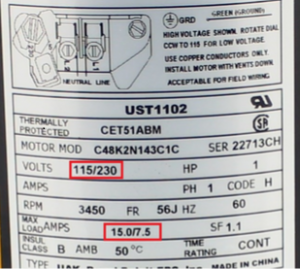
Look at a dual voltage (runs on either 230 or 115 volts) pump motor and read the ratings. In our example the volts read 115/230 and the amps are to be read respectively. That means on 115 volts the motor draws 15 amps and on 230 it uses 7.5 amps.

My first and admittedly ignorant understanding was that the power consumption/cost was linked solely to amp usage. That led me to believe that 230 was naturally more energy efficient than 115. After all it uses half the amps, but not so fast Mr. Jump-to-Conclusions – that is wrong. Power bills use Kilowatts Per Hour as their unit of measurement. And the formula to figure out watts usage requires both voltage and amperage.

Watts Formula: Watts = Volts x Amps

120V x 15A = 1800 Watts

compare to

240V x 7.5A = 1800 Watt

Kilowatts Per Hour Formula: Watts x Hours Run ÷ 1000

1,800 Watts x 10 Hours ÷ 1000 = 18 kWh

The watt usage is virtually identical when calculated in this manner. Part of the reason watts is the same is because of the way the two voltages are wired. The amp rating shows the usage per “hot” wire, also called load-bearing wire. A 115 volt circuit is wired with one hot wire that carries the current with one neutral and a ground wire; while 230 volt circuits are wired with two hot wires and a ground.  The amp load is split between the two hot wires which provides the somewhat deceptive amp draw on the motor label.

But Why Use 230V Instead of 115V?

Most major countries outside of the US (especially in Europe) utilize 230 voltage for their electric grid while the US uses 115 as our standard. Early development of the US electric grid took place before most of the world, and coincided with a period during which light bulbs and appliances were very susceptible to failure due to high voltage. This made the American power companies install and standardize the 115 volt power stations we see today. By the time Europe was building its electrical infrastructure, most of the kinks had been worked out for bulbs and electrical components to safely run on high voltage. This was perfect timing as 230 voltage is a more efficient way of conveying electricity over long distances.strawheader3

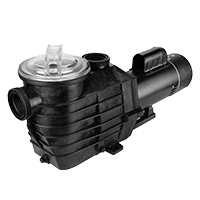
Most houses in the US still have access to 230 volts as you may have noticed when installing heavy duty appliances such as a washer and dryer or electric range. In the pool industry, pool motors with a horsepower output of two or above almost always are 230 volt hook up only. This is because with high voltage comes great amperage.

When we flick the switch on a monster of a 3 HP  motor, that mechanism demands amps to be able to fire the capacitor, switches and windings. If there is a delay in amps reaching the motor, it may cause the motor to overwork and overheat to compensate. This extra work put in by the motor means it is more likely to fail earlier than it should.

Think of it as if we were sipping a thick milkshake but all we have is a thin straw. When you begin to sip on the straw no matter how hard you try, you will go red and eventually quit with your thirst not quenched. That is essentially what happens to a big motor using 115 volts.  It’s got a fever, and the only prescription is more amps. Now switch that tiny straw with a hefty wide straw, your work load lessens, you’re cool as the other side of the pillow. Voltage is the straw, and the amps are the milkshake. Voltage is just there to help convey the amps to the unit.

author avatar
Matthew Simmons Technical Writer & Pool Product Expert
Swimming pool expert at InyoPools and host of Poolside Chat, brings over a decade of experience in the pool industry.

Related Videos

29 responses to “Does Using 230 Voltage Save Money?”

  1. Kirk S Avatar

    Question —
    I have a 1 1/2 HP pool pump running on 115v, 20 amp breaker; 12/2 wire, with bare ground. White/Black/Bare
    As it is nearing the end of life, if I buy a new 1 1/2 – 2 hp pump with 230v… can I do it?
    My 12/2 wire is faintly warm… barely, but you can feel a bit of temperature difference. 115 /18.6 amps or 230 / 9.3 amps.
    Wire is buried (way before I moved here)…
    So can I use White = Hot, Black = Hot, Bare = Ground and get my 230v ? I need to switch out a Breaker to a double pole (two hots)…
    what about my 24hr timer it all runs through? And the on/off switch at the pump (seems to be a standard light switch in appearance).
    So if I understand everything I’ve read above, the Amp draw, per Hot will be half of what it is today? i.e. wires would be cooler… using the same number of KWH, just cooler..
    Do-able?

  2. Andrew Avatar

    Wow lots of opinions for both scenarios . I want to change my 1hp to 230 from 115 but this thread has made me go…. ummmmm? I feel the general consensus is, that if you have the option to easily switch to 230…..then do it correct? Would everyone agree? Looking forward to the continued opinions ! Thanks for the help everyone !

    1. Matthew Simmons Avatar

      If I can put in my vote, I would prefer 230 volts over 115.

      1. J Avatar

        I have Hayward 1/2 hp 230/115 new replacement motor
        I have a three wire set – black, white & green
        In the panel a 20amp breaker
        Which do I use ?? The 115 or the 230 🤔

        1. Matthew Simmons Avatar

          If the color coding is correct, the black and white wires means it is a 115-volt circuit.

  3. Kris C Kersch Avatar

    From what I understand is the motor works better, more efficient. It will do the job better and last longer. Better torque say for an air compressor.

  4. Ethan Lamoreaux Avatar

    You were right the first time, but not for the reason you thought. Running a motor on 230 volts is more efficient than running the same motor with the same wiring on 115 volts. The reason is not because the motor itself draws any less power, because as you observed, the wattage is the same. The chief difference is the amount of current drawn is cut in half when you double the voltage. Most pool pumps are connected using 12 gauge wire, which is rated for up to 20 amps. The reason there is a current limit is because as you increase the current, the wire heats up more. As it heats up, it increases its resistance, and so the motor will draw even more current to compensate, which causes more heating, and also causes your motor to heat up more, and shortens the life of the motor. Even if you only draw 15 amps at 115 volts, your wire will heat up more than if you draw 7.5 amps, and so you will be wasting energy by heating up your supply wires. Raise the voltage, cut the current, save energy, increase the life of your pump motor, and SAVE MONEY.

    Whether in North America or Europe, the electric grid does not run on 115 or 230 volts, it runs on much higher voltages. For instance, in North America, power on the grid is typically sent over transmission lines at voltages ranging from 69 to 765 THOUSAND volts. Closer to where it is used, there are substations which lower the voltage to typically 7,200 to 14,400 volts (single phase) for local distribution. Within a few hundred feet of your house, the voltage is reduced to 230/115 volts. The main difference between Europe and North America is that in Europe, the power is typically distributed to buildings at only 230 volts over 2 wires, whereas in N. America it is distributed at both 115 and 230 volts over 3 wires. While it is true that 230 volts is more efficient over long distances, at that voltage the distances involved are generally only a few hundred feet, the distance from the transformer to the building. It has nothing to do with the grid, which spans hundreds or thousands of miles.

  5. Tom Avatar

    What happens when you run 115 but the back of the pump is switched to 230.

    1. Matthew Simmons Avatar

      Check the motor label. If the label says it is a dual voltage 115/230 then you would switch the motor to 115, and follow the wiring directions. If it is a 230 only, then you need to buy a different motor or set your circuit up for 230.

Leave a Reply

Your email address will not be published. Required fields are marked *