
OK, riddle me this, you’re standing in a pool store’s showroom and you’re in awe of all the shiny new pumps. You finally make your decision on the model you want and have a hunch it will work well in your 20 000-gallon pool, but the salesperson drops a bomb on your plans by asking the simple question, “What is your feet of head?” Wait a minute, what? My head is about 10 inches. but I’ve never actually measured my own skull…
Wrong head.
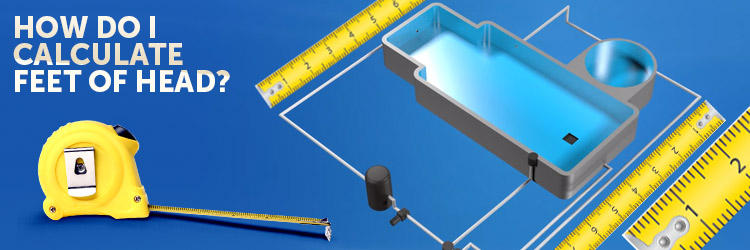
Total Dynamic Head (TDH) refers to the total equivalent height that a fluid will be pumped by taking into consideration any friction losses in the pipe. Essentially “dynamic head” is the measurement of resistance working against your pool pump as it pulls water from your basin and pushes it back to the pool. The total sum of the pipes’ lengths, rise in elevation and addition of 45-degree /90-degree turns will affect the feet of head number. All the aforementioned plumbing quirks add up to more friction the water accrues as it travels. The more friction, the harder the pump must work to push the water through the pipe, which demands that you go to a higher HP or use a larger pipe. If you need to install a new pump or replace your filter, you need to calculate the system’s feet of head to determine the best fit. A pump’s flow rate is dependent on the feet of head.
If you need to install a new pump or replace your filter, you need to calculate the system’s feet of head to determine the best fit. A pump’s flow rate is dependent on the feet of head of your plumbing system, and that measurement is featured in every pump curve chart. If you want to turn over your 20 000 gallons once in 5 hours, you will need to average at least 67 gallons per minute (GPM). We will use that GPM to calculate our pool’s feet of head.
Measure the Lengths of All the Pipes
Yes, I mean all. Measure the pipes’ lengths that span from your main drains, skimmers and any other suction ports that draw water from your pool. While measuring lengths, also note the depth of the pipe as well as the number of turns and the type (45-degree or 90-degree.) The type of turns will affect the friction loss as we total up at the end. Measure the lengths of the pressure side pipes in the same manner, noting the degree of turns and any valves you can see. The chart shows the feet of head per 100 feet of pipe according to the pipe diameter of Schedule 40 PVC in congruence with the flow rate of your pump. So, let us estimate you have 200 feet of 2” PVC with a flow rate of 70 GPM, your feet of head would be 15.2.
| GPM | 1-1/2″ PVC | 2″ PVC |
|---|---|---|
| 40 | 9.43 | 2.75 |
| 50 | 14.3 | 4.16 |
| 60 | 20 | 5.84 |
| 70 | 28.6 | 7.76 |
| 80 | 36.7 | 9.94 |
On top of that 15.2 feet of heads, you can add the rise in elevation from the pool’s surface to the pump. For example, if the pool’s pump is 3’ above your pool’s surface, add 3’ feet to 15.2.
Pipe section feet of head: 18.2
Because you know the gallons of your pool and you know that you want to turn over your water twice, you can calculate the desired rate of flow to turn it over in a period of 3-5 hours.
Add up the Dips, Turns, and Twists
We must now add in the effect of all the valves, turns and couplings in your plumbing line. Each of those plumbing add-ons tack on a value of feet of head to your plumbing line. The value will vary according to the flow rate you put in. I used 70 GPM as our flow rate in my calculations.
The table below provides the equivalent feet of straight pipe for representative connectors for 1 ½’ and 2’ at 70 GPM. The total of these values will have to be converted to feet of head as we will show in the example:
| Description | 1-1/2″ PVC | 2″ PVC |
|---|---|---|
| 45-Degree Elbow | 2.4 | 3.1 |
| 90-Degree Elbow | 7.6 | 8.7 |
| Check Valve | 1.7 | 2.2 |
| 3-Way Diverter Valve | 2.5 | 2.3 |
| 2-Way Diverter Valve | 1 | .7 |
| Tee | 6.2 | 7.5 |
| Coupling | 1.5 | 2 |
| Count | Description |
|---|---|
| 5 x 8.7 = 43.5’ | 90-Degree Elbows |
| 4 x 2.0 = 8.0’ | Couplings |
| 3 x 2.2 = 6.6’ | Check Valves |
| 1 x 2.3 = 2.3’ | 3-Way Diverter Valve |
| 60.4 / 100 x 7.76 = 4.69 | Total of 4.69 added feet of head for connectors. |
Total of 60.4 added equivalent feet of straight pipe.
To convert this value to feet of head, multiply 60.4 ‘ by the same number used in the length of pipe calculation above for 70 GPM and 2’ PVC diameter pipe, 7.76 per 100’ of pipe.
60.4 / 100 x 7.76 = 4.69
Total of 4.69 added feet of head for connectors.
Don’t Forget Your Filter, Valve or Heaters
Filters can be a real drag on water as it rushes through your plumbing. So, we must account for that extra resistance. Pentair has a thorough Head Loss Chart that lists the ratings for their products. You may not have a Pentair, but the ratings should give you an idea of where your similar sized filter will fall on the chart. For your specific model’s head loss rating, check your owner’s manual or contact the manufacturer. Click the chart for an expanded view.
As for heaters, the head loss varies depending on flow rate and model. Here is a graph of Hayward listed flow rates to give you an idea, what the ranges may be. To be on the safe side I would add 15 feet of head to the count for a preliminary calculation, but for an actual number you will need to contact the manufacturer for calculations.
| GPM | Feet of Head |
|---|---|
| 40 | 5.12 |
| 50 | 6.16 |
| 60 | 7.23 |
| 70 | 7.5 |
| 80 | 7.8 |
| 90 | 8.84 |
| 100 | 9.86 |
The final total:
Pipe lengths and rise = 18.2
Valves and turns = 4.7
Cartridge filter 70 sq. ft. = 7.5
Heater = 7.5
Total feet of head = 37.9








Leave a Reply