Home / Articles / How Long Should I Run My Pool Pump?

How Long Should I Run My Pool Pump?

How long should I run my pool pump?

The above question is posed to the likes of me (pool industry folk) on a regular basis. Actually strike that – I impose the answer to that question on homeowners every day because I am tired of seeing them throw away good money.  A pump does not need to run 24/7 to keep your pool water pristine. If properly sized, a pump should spin through your water in a fraction of the time, allowing it to be dormant for the rest of the day. Thereby, relieving your wallet of the heavy burden of high electric bills.

Well, What Is the Answer, Smart Guy?

Residential pool water only needs to be turned over once daily to have proper filtration.  Twice through the filter may be necessary after heavy usage such as a pool party. Only commercial pools require water to be turned several times a day to maintain proper sanitation. Anything more than a 1-2 filter cycles in a day is superfluous, almost as superfluous as someone using the word superfluous.

The key to a properly sanitized pool is not only filtered water but also well-balanced water chemistry. If your water is unbalanced then issues will arise no matter how much the water churns. A good once through your filter system should alleviate you of troublesome bacteria barring some kind of major chemical imbalance.

How Do I Calculate a Filtering Cycle?

With a few measurements and some math (oh no!) we can assess our proper pump run time.  Before we begin we will need a few things: overall dimensions of your pool including length, width, and depths (shallow and deep ends), the model number of your pump, and a rough estimate of the length of pipe to your pool (feet of head.)

Calculating Pool Gallons

To know how long to filter, we need to know how much we are filtering.  For this step, we will be using a trick of trade called the Pool Volume Calculator by Penair.  This easy to use calculator provides your pool gallonage in a few keystrokes. No complex volume formulas for this guy.

For our example, we will say our pool is a total of 24,000 gallons.

Pumping for Information

Now we must determine the approximate water flow produced by our pump. For this we must know the model number of the pump and the feet of head of the pool. Again, the feet of head is the average length of pipe leading from the pool’s skimmers and main drain to your pump.

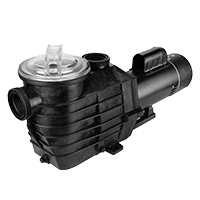
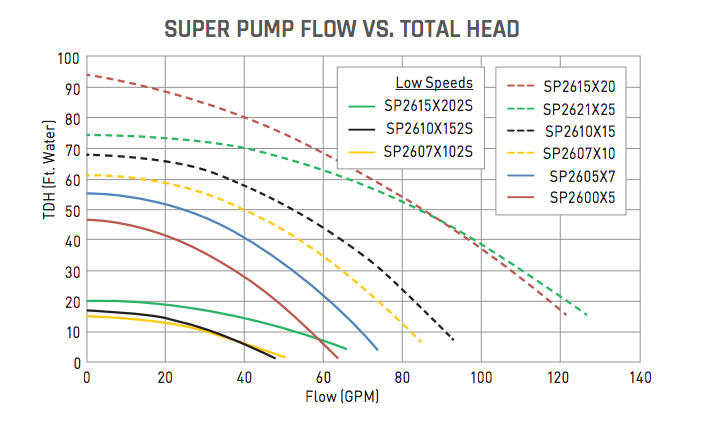
For our example, I have chosen a Hayward Super Pump 1.5 HP Single Speed, model number SP2610X15. And for our imaginary pool the length of pipe to the main drain is 20 feet and the pipe feeding the skimmer at the other end of the pool is 60 feet, totaling an average of 40 feet of head.

Feet of Head Calculation:

20 Feet +  60 Feet = 80 Feet

80 Feet ÷ 2 Pipelines = 40 Feet of Head

Using the model number SP2610X15 and calculated feet of head on the below chart we can see that the approximate rate of flow is 65 gallons per minute (GPM.)
And then…..  

The hard part is done but we still have 2 more calculations to complete to determine the run time for one filtering cycle of our pool. Using the numbers we deduced from previous calculations we use:

24,000 Gallon Pool ÷ 65 GPM Flow Rate = 369 minutes for full-cycle

369 minutes ÷ 60 Minutes = 6.15 Hours for Filtering Cycle

And there is the answer,  6.15 hours filtering time will cycle your water once.  This equation can be applied to any pool and adjusted for any run time. We normally suggest having a run time of 6-12 hours for filter cycles.

As usual, if after reading our blog posts more questions arise or there is a further explanation needed, do not hesitate to call our techs at 877-372-6038.

author avatar
Matthew Simmons Technical Writer & Pool Product Expert
Swimming pool expert at InyoPools and host of Poolside Chat, brings over a decade of experience in the pool industry.

Related Videos

72 responses to “How Long Should I Run My Pool Pump?”

  1. Mike Avatar

    Matt i replaced my old single run pump with a variable speed pump and i recently replaced my worn out swg as well-We live in the desert with temps in the 100’s and i need to run my pump longer to get the chlorine needed to keep it up–So i am turning my water 3-4 time a day to do this–12000 in ground pool pump set at 1500 for 12 hours a day.Lower speed for long times is what i am reading–Is this correct and is it bad to turn the water that much.And i have my swg set at 100% ?Some are saying run it at a even lower speed for longer time to keep up?

    Any thought on this?

    Mike

    1. Matthew Simmons Avatar

      What is your swg rated for? How many gallons? What are your chlorine levels? it is hard to say if you are doing it too much without knowing what your water chemistry is.

      The point of having a variable speed is to run it for long periods on low speeds but if your chlorine generator can’t handle the boy of water and temperatures, you may be forced to keep running the system in this way.

  2. RobertC Avatar

    Am I calculating this wrong? The measurements of the pool show that I have a 12,187 gallon pool. The head is 30 feet average. The pump is made by US motors and says 3450 RPM on it. I am coming up with about 73 minutes per day?

    1. Matthew Simmons Avatar

      To figure out the runtime we would need to know the model number of the pump housing. US motors just make the motor, and that motor can be fitted to dozens of different pumps with varying flow rates.

      1. RobertC Avatar

        I looked all over the pump housing and did not see any type of label anywhere, is there a general guideline that I can go by?

        1. Matthew Simmons Avatar

          Not really, because not all pumps are made equally. A 1 hp pump in this model may do double the GPM output of this other 1 HP pump. Consider it like this, could you guess the 0-60 time of a vehicle if the only info you had was that it had four wheels and motor? Probably not.

          You can try opening the pump to take a look at the impeller number.

          1. RobertC Avatar

            I looked at 1 of your other posts about replacing equipment that you cant find a model# for. I looked on the strainer lid as that post suggest and found the number C3-139P, does that help?

          2. Matthew Simmons Avatar

            As I said before, I need the number of the impeller. The impeller is on the inside of the pump. It is a disk with fans that is attached to the end of the motor shaft.

  3. Perry michael Avatar

    I have a new pool, 21000 gal, and an electric cover. Planning to install a salt system and trying to decide between a Hayward super pump I already own or using a variable speed pump. So I’m not sure if it is covered 90% of the time can I circulate the water less? Am I better off using a variable speed pump in this setup?

    1. Matthew Simmons Avatar

      If the pool is covered most of the time, that means you can run your pump less. The less exposure to the elements, the less chlorine is burned off and fewer particulates dirt and grime accumulate in the water. A single speed should be fine, but you could always replace the old single speed motor with a variable speed. It is cheaper than the whole pump and will save you money in the long term. V-Green 1.65 and the 2.7

  4. lucy Avatar

    HI there, I’ m pretty bad with the calculation. I have a 8 x 4 meters pool, 1.2 meters deep. I don’t use it during the winter time either, how many hours do I need to keep the pump running per day to keep the water clean? The electricity bill has been very expensive, i really want to work out an efficient way to save on the bill. Thanks a lot.

    1. Matthew Simmons Avatar

      As the article mentions, the size of the pool is just part of the calculation. We need to know the feet of head of your pool plumbing and the model of your pool pump. If you do not have that other info, then you can use a flowmeter to gauge the strength of water flow. With the flow figured out, you can use pool volume calculator in the article to find your pool gallons.

      1. lucy Avatar

        Thanks a lot for your prompt reply, that was very helpful. Really appreciated. 🙂

  5. Lary Avatar

    Hello, I have an average-size saltwater pool in Sacramento and it’s not used during winter months (November-March). It gets cold during winter, but not freezing temperature cold. Question: Should I turn my pump off completely (will it damage the water?), or how long should I run the pump daily during winter months (while cold, but not freezing)? If I still need to run it, can I skip a few days weekly to preserve energy and extend motor life? Thank you!

  6. Carolyn Avatar

    You referenced a chart when calculating the rate flow, but I don’t see a chart. Was it removed?

    1. Jeff Avatar

      Yes, I don’t see it either

      1. Matthew Simmons Avatar

        I posted an updated flow chart for the Super pump and adjusted the necessary math.

  7. Vince Avatar

    Ok so I think I’m on the right track here. Its seems that feet of head is a constant number so what I don’t understand is that if there’s 45ft of head, based on the performance chart why would I run the pump at anything under 2500rpm to get flow. If the pump is running at 1400rpm, how would I read the chart at 45ft of head??? Many people run low rpm for several hours a day so i feel a little lost. Thank you for the help.

    1. Matthew Simmons Avatar

      Once the pump is primed on at the higher RPMs, it should be able to hold that prime if you drop below 2000 RPMs.

      Also, looking at other’s pool pump settings and comparing to your own is a good way to go batty. Even pools of similar sizes have different plumbing configuration, pipe dimensions, and pump models, making it hard to make an apples to apples comparison.

      1. Lynda Avatar

        I have the same question as Vince. I have the same intellipro variable speed filter with a 8616 gallon pool and 44 ft of TDH. My installer suggested 35gpm for 4 hours at about 2450 RPM. But what if I want to save money and run my filter for longer than 4 hours at a speed lower than 2450 RPM? The way I read it, the graph doesn’t appear to allow for running the filter at anything lower than 2450.

        1. Matthew Simmons Avatar

          Yes, you can run it at a lower speed for longer RPMs to save money. Unless you have a flowmeter you’re going to have to figure out what RPMs and runtime by some trial and error. The flowmeter tells you how many GPM are being pushed by the pump as you slide up and down the RPM scale. This allows you to use the formulas in the article.

          Without a flowmeter, a trial and error test where you lower your RPMs and raise your run time will be necessary. Extend the run time by two hours but drop the RPMs by a 1000 and let it run for a couple of days. Test your water at the end of the two days to see how it is reacting. If all is well, keep lowering the RPM and testing the water until you see a change in water chemistry. When the water starts to turn, extend your run by an hour or so. Keep playing with the RPMs and runtime until you find your max savings. You could end up with a 14-hour cycle at 800 RPMs.

          1. Lynda Avatar

            Answered my question perfectly. Thanks so much!!

    2. Martin Avatar

      As an engineer in a former life, the head is the vertical distance that water has to be lifted by the pump, no?

      1. Tom Mc Avatar

        Good question. What is the comparison of vertical head loss to horizontal pipe length head loss??

  8. Vince Avatar

    I have an approximately 26,000 gallon pool. Assuming I want to run the pump for 8 hour per day, it would take about 54GPM. Say I have 45 ft of head and
    I have a Sta-rite intellipro 2 vst, what rpm would I need to run at to get 1 full cycle? I kind of lost you there under the “pumping for information” part of your article. I checked the performance curve for the pump and my wild guess would be about 2500rpm. Is this correct?

    1. Matthew Simmons Avatar

      Going by this performance curve in the owner’s manual, the range would be between 2500 to 2800 RPMs.

      sta rite intelliflo performance curve

  9. Orange Avatar

    this link does not work “Pool Volume Calculator by Penair.” so Matthew, while I read the article, I could not complete the instruction given the 1st link did not work.

    1. Matthew Simmons Avatar

      It looks like Pentair changed the location of their calculator, the link has been fixed.

      Don’t forget there’s always Google to search for such things.

  10.  Avatar

    Tom,

    I’m closer to 90 than 80 in age and our pool is never used. Seriously, from year to year no one sticks a toe pool in it since the time all our grand kids became adults. Under these circumstances all I want to do is keep the pool water clean-looking for aesthetic purposes; I could care less how sanitary it is for use. Any suggestions for minimizing maintenance costs such as running filter less?

    1. Matthew Simmons Avatar

      Well, the easy route would be to just keep shortening your run times every couple of days and test it. If the pool is maintaining its clarity and chlorine levels, then knock the run time down by an hour or two, then repeat the testing. Lower the run time until you start to see dips in water health.

      1.  Avatar

        Thanks Matthew, sounds like a reasonable suggestion to me. I’ll give it a try.

Leave a Reply

Your email address will not be published. Required fields are marked *