Home / Articles / Pool Pump Running Costs: How to Save Money

Pool Pump Running Costs: How to Save Money

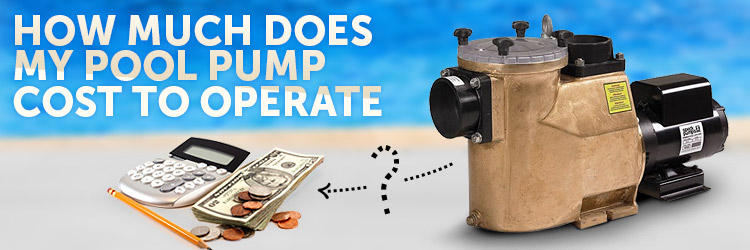
How Much Does a Pool Pump Cost to Run

Did you know that your pool pump running costs are one of the largest contributors to your skyrocketing electricity bill? In this articl,e we discuss how to make your pool pump schedule more efficient. Here is a simple 4 step process to help you determine how much your pool pump costs to operate. Check out the second section we added, showing the savings which can be obtained by upgrading to a variable speed pool pump.

Step 1 – Energy Consumption

First, you will need to determine the energy consumption of your pool pump. Here are the kWh consumptions for the most common pool pumps.

¾ HP = 1.26 kWh
1 HP = 1.72 kWh
1-½ HP = 2.14 kWh
2 HP = 2.25 kWh
2-½ HP = 2.62 kWh
3 HP = 3.17 kWh

The equation used above to determine kWh is Multiply the pool pumps volts x amps to get watts then divide by 1000.
Pool Pump Running Costs: How Much You’ll Pay
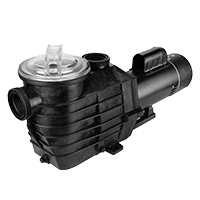
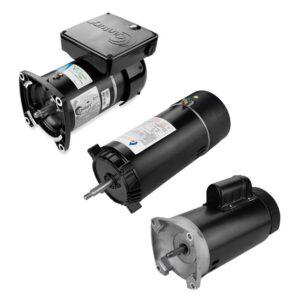
Variable Speed Dual Speed Single Speed Pool Pump Motors

Step 2 – Daily Energy Consumption

Multiply your pumps kWh by the number of hours per day you run your pump. Here is an example using a 1-½ HP Pool Pump running 8 hrs. per day (Use kWh from step 1)

2.14 kWh x 8 hrs = 17.12 kWh per day

Step 3 – Energy cost?

View The Cost of Electricity for All 50 States to determine your cost of electricity. In the example below, we are using California. FYI the national average is 12.29 cents per kWh.

17.12 kWh x .17 cents (cost of energy in California) = Daily pool pump running costs of $2.91

Step 4 – Determine annual cost

Take daily cost and multiply by how many days per year you operate your pump.

$2.91 cost per day x 365 days = $1,062.15 per year to operate your 1-½ HP pool pump.

How to Reduce cost from $1,062 to $496

A variable speed pump is a pump that can run at a full range of horse power’s. This means you can dial the pump in to run at 1-½ HP or dial it all the way down to a ¼ of HP. When dialing the pump down to the lower HP the cost of operation can drop by as much as 80%. Using the process above let’s see how much it will cost to operate a 1-½ HP variable speed pump vs. the 1-½ HP single speed pump.

Step 1 – Energy Consumption

On average Variable Speed Pool Pumps draw about 4.35 amps this means the pump consumes 1.0 kWh

Step 2 – Daily Energy Consumption

1.0 kWh x 8 hrs = 8.0 kWh per day

Step 3 – Pool Pump Running Costs

View The Cost of Electricity for All 50 States to determine what you are paying for electricity. In the example below, we are using California.

8.0 kWh x .17 cents (cost of energy in California) = Daily pool pump running costs $1.36

Step 4 – Determine annual cost

$1.36 per day x 365 days = $496 per year to Operate a 1-½ HP Variable Speed Pump.

Cost to Operate 1-½ HP Single Speed Pool Pump $1,062 / yr Vs. Cost of Variable Speed Pump $496 / year.

Variable Speed Pool Pump Resources

If you think a variable speed pool pump makes sense for you then check out our Variable Speed Pool Pumps or our Variable Speed Pool Pump Buying Guide. If you have any questions on determining the correct pump for your pool then leave a comment below or give us a call at 1-877-372-6038

author avatar
Patrick Paroline

Related Videos

56 responses to “Pool Pump Running Costs: How to Save Money”

  1. dave Avatar

    (david)

  2. dave Avatar

    how much volts dose a 2500 gallon above ground pool take daveid im 11

  3. […] take the average lifespan of 10 years in this case and look at the total cost that you will spend to buy and run these pumps. See below for the […]

  4. Newtopools Avatar

    I have currently have an A.O. Smith 1202SQ Single speed 2HP pump model number K48N2PA105C4 running with 230v. I am looking to move to a variable speed pump. What are my options?

    1. Matthew Simmons Avatar

      The SQ1202 and K48N2PA105C4 are model and catalog numbers for the standard efficiency motor; the variable speed replacement motor for it is the ECM27SQU. If you want a whole pump replacement, we will need the model number from your pump housing’s sticker.

      pool pump housing

  5. […] to 3HP, using 1.26 to 3.17kWh. If your pool has a 1.5HP pool pump running eight hours a day, the annual cost is $1,062. Sense customers have reduced their pool’s operating costs substantially by replacing […]

  6. Rus Avatar

    All I know is that my 1hp heyward pump is using 6. 5 amps when running. I have 3 ac split systems that are off My 3 year old 2ton air conditioner uses 6.3 amps when running as per test. again it is off My electric bill is twice what all the neighbors are. They have a $189 dollar electric bill mine is $400 I have checked every appliance in the house and can’t seem to figure out why. At tis point of the year we are not using Ac or heat much at al here in central FL. I have ben monitoring my Kilowatts on the meter. We seem to be using 40 kilowatts per day (24 hour period) with the pump. Without the pool pump we are at 23 kilowatts per day (24 hour period). I left a reply here and was told too many bends in the system. A variable speed pump won’t work. what do I do? I would like to be more efficient with the electric bill. This sucks.

    1. Matthew Simmons Avatar

      We’re in Central Florida as well and considering how cool it is, you shouldn’t have to run the pump but a few hours a day. When the outside temp is lower than 60 degrees, algae growth pretty much stops. I would consider lowering your run time. What is the voltage the motor is pulling?

  7.  Avatar

    That’s right folks. Save money on electricity and spend more money on chemicals! The average consumer thinks that turning their new 3hp variable speed pump the local retailer talked them into down to 600rpms and then running it 2 hours a day, in Florida, all year long is a great way to make that expensive vs pump pay for itself. There is so much tripe out there regarding how great variable speed pumps are. Even if you ran your fancy 3Hp vs pump at 600rpms (like a 1/4HP pump) all day long, the water level in your filter will only run through 1/5 of your filter. Do yourself a favor and edjumicate yourself on the importance of turn over rate, circulation, filtration as it relates to water quality and chemical demand because the companies who are pushing this technology are making it all about energy savings when in reality its all about selling you a supposedly technically superior product that in fact will cost you more to repair or replace than the good old fashioned, and unfairly maligned, single speed pump. Now you have a digital control interface and/or drive assembly that can break which may cost more than the motor it sits on. Many companies don’t even want to mess with replacing just the unit, even if the motor is just fine, and you’ll end up buying a whole new unit. When a single speed dies you only have to replace the motor. But hey! You saved up enough money on your power bill with the old variable speed motor to pay for half of a new variable speed motor and brain box.

    1. Matthew Simmons Avatar

      I can only speak to my experience but I have never heard of a pool technician (or anybody for that matter) suggest running a pump at 600 RPM for 2 hours a day. Even at full speed a pump could have trouble turning over the pool in 2 hours, depending on the pool size and feet of head. This is kind of a strawman argument you have made. Also, I am not sure where you are getting the 1/5 of your filter number.

      Every manual I have seen from a manufacturer, and all the articles provided on this blog and our how-to guides, specify you need to lengthen runtime to accommodate for lower RPMs. There are also my previous replies on this article’s comments above that explain and show pump performance curves.

      If you would like more info on how you would be saving money by using a variable speed then have a look at this the following video: How to Save Money with Variable Speed

      I will agree, that the controllers for the variable speed pumps can be costly, if not prohibitive to repair. But designs for these controllers are improving each year. A variable speed motor that has a great quality and price combination, are the Century V-Green motors. A replacement V-Green motor comes in about $350 to $650 dollars. That is cheaper than most big brands replacement controllers while having solid, durable performance.

      1. Fred Avatar

        Per the ohmmeter (not a guide from the salesman) my average 25k gallon pool with 1.5HP runs at about 1.4 kwh and about 1500 hours a year, nobody in the desert is paying .17c per KWH so at a overestimation of $.30 that is about $630/yr. I have seen early “pamphlets” from the manufacturers claiming ~$900/yr savings for average residential…hard to save $900 if, at the most, you only spent $650. If a civil engineering firm constantly monitors your vs pump to maximize rpm to your, very personalized and constantly changing, dynamic head you might be able to achieve a 35% increase in efficiency (easily achievable by built in software that nobody offers?). For most people and pool professionals achieving 20% should make you proud. That is $126/year and would take 6 years plus to make your money back (much longer if you pay less than $.30/kwh year round)…how long do they last?
        Commercial pools have to run 24hr/day while open per most health dept. rules. Pools were designed, and pumps were selected to turn over a certain amount of water per day based on pool size (even though most do not need to). Installing a VS pump does make things much more efficient because you now have a 1HP pump in a 3HP pump’s clothing to bypass regulations through a loophole, not so much the efficiency of the pumps, as the manufacturers claim.
        That being said, I would certainly install one for a new pool or commercial pool but would probably not replace a residential pump with the current prices.

        1. Daniel-san Avatar

          LOL! In the Phoenix area with srp, our average off peak rate is 08 cents per kwh! And that’s 23hours a day. So funny. And it’s too easy to not run ac/poolpump/waterheater for a measly 2or3 hours in the middle of the day peak rate.
          And for those that live in California or places with insane electric rates, get solar and do it right or move. Educate yourself. People who argue against solar are straight up ignorant and idiots. Facts are facts. And solar has been and will be the future. Sorry, but the entire country could be basically powered by solar EASILY. We have so much desert “wasteland”.

    2.  Avatar

      Every doubling of pump speed is an 8-fold increase in power consumption.

      Running at 1200 RPM for 12 hours will move the same volume of water as 3450 RPM does in just over 4 hours at 5% the cost. 100%/(3450/1200)^3 = 4.2%

      I’ve done this for years with no detrimental issues and huge energy savings.

  8. Marcos Avatar

    what about if we add solar panels to run this pump?

    1. Matthew Simmons Avatar

      If the pump is running off of solar panels completely, then it would be free to run your pump, after the initial cost of the solar panels. If the panels only account for a percentage of the power sent to the pump, then you would subtract that percentage from the sum.

    2. Joe Avatar

      Then get a DC motor. All DC pumps are VS and you can hook it straight to the panels for maximum efficiency, and economy. They are hiding DC motors from the public though…they were much more common before the energy efficient business came along with all its subsidies.

  9. Will Avatar

    Instead of all this conjecture, why not just measure it? I did. My 1.5HP (1.1kW as per nampelate) pool pump is hooked up to calibrated power meter, and consumes about 1.3kVA which is what you’re billed on, not output kW. This gives a PF of about 0.85 which is ballpark for a simple DOL motor.

    So …. unless the motor and/or pump in your original example is extremely inefficient, or running wayyy above FLC, something is wrong. Even if you were quoting output (not input) power, something is still wrong

  10. Annie Avatar

    This is a great compilation of information and helpful links. Thank you!

Leave a Reply

Your email address will not be published. Required fields are marked *