Home / Articles / Installing an Above Ground Pool on Concrete

Installing an Above Ground Pool on Concrete

Installing an Above Ground Pool on Concrete

The vast majority of above ground swimming pools are built directly on the ground. In some areas of the country the ground is too hard as it is mostly rock or hard clay. These areas have to be dug up and/or chipped away into a flat area and then sand or limestone is brought in for leveling. In these areas, the price to have the pool installed is considerably more because machinery and materials are needed to get the ground level and the pool’s bottom flat and smooth.

Here in Central Florida (yeah, that’s where I am), installations are easier because our earth is mostly sand. I use a skid-steer machine to level the ground, because I’m now older and smarter, but most installers don’t use a machine. I always state that when you are installing an above ground pool, preparing the ground is half of the job. Preparing the ground and pool’s bottom requires most of the craftsmanship.

It is truly an art form when it comes to getting an above ground pool’s bottom flat and smooth using just the earth and/or added material. After about 25 installations, most new installers have learned to build an above ground pool’s structure pretty well and can even get the liner somewhat free of wrinkles too. Making a smooth and flat bottom is a different story. I have to say it probably takes an installer who values quality a couple hundred installations before he becomes somewhat proficient at making a nice flat pool bottom.

A flat, smooth pool bottom isn’t a must-have, but it does make your pool much nicer to use and keep clean. Above ground pool bottoms with sharp objects pointing up, and bumps and dips and footprints usually won’t cause any issues. It will only feel different to your feet and be more challenging to vacuum. Simply using an OK installer instead of one with twenty-nine years of experience (shameless self-promotion) will make all the difference if you want to have a nice pool bottom.

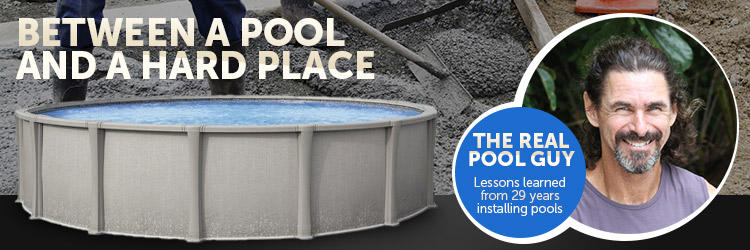
So why all this talk of earth-based pool bottoms when the title of this blog post is about installing on concrete? Well, I’m just getting you prepped for why you would consider putting your above ground on concrete. It’s really rare for people to decide to install their pool on concrete mainly because of the cost. There are advantages to doing this so if you are thinking about it and have the money, then here are some things you need to know.

Five Reasons Why You May Want to Install Your Pool on Concrete

Let’s start with why most people elect NOT to install their pool on concrete. The reason is – money. Concrete is expensive! It is really expensive. How much you ask? Well, it’s hard to say exactly as it depends on the size of the pool, what town you live in, and what your earth consists of and how much leveling is required. Keep in mind that you still have to prepare the ground by making it level to within at least a couple of inches or less so whatever that takes will add to the price. The price of concrete and concrete work varies. It depends on where you live. So, to find out a ballpark figure, call a couple of concrete guys and ask about the price for about a 500 sq ft level slab (that’s good for about a 24’ round pool). When you are done shrieking, remember I told you it’s pricey.

1. A Concrete Pool Bottom Is Nicer Than an Earth Bottom

If you only read the headlines of this blog post, then go back and read the beginning. I am an artist at making an earth or sand bottom clean and smooth and flat, but even I am no match for concrete. Concrete starts out like liquid and then slowly gets harder and harder. This is why you can get it really flat and smooth.

2. Nutgrass Cannot Grow Through Concrete

In a lot of areas, nutgrass or nutsedge (look it up) is an issue for above ground pools. I’ve seen nutgrass grow through heavy-duty tarps, gorilla pads, high-density foam boards, and then of course, pool liners. Some products boast that they can prevent nutgrass from damaging pool liners and maybe some can. Who knows? There is one thing I know for sure and that is nutgrass cannot grow through concrete. Period.

3. Moles Cannot Cause Ruts in Concrete

Moles don’t pose a huge problem for above ground pools, but for some they are a destructive pain in the bottom. They can burrow under a pool and cause trails and ruts everywhere messing up that beautifully smooth bottom I made. It’s rare, but over the years I’ve had a few pool owners have no choice but to pour concrete for their pool bottom because of their extreme mole problem. It’s an expensive fix, but works 100% of the time.

4. The Shifting of the Earth, Decomposing Roots, Horned Nosed Beetles, Termites, and Ants Can’t Affect a Concrete Bottom

This is a general reason. The earth is a dynamic place that has movement and living things that move and eat and destroy. A concrete barrier between the liner and this environment blocks all of earth’s drama.

5. Concrete Doesn’t Wash Away

Above ground pools usually don’t have many issues with leaks until the liner gets old and brittle. At that point it’s time for a new liner so it’s OK for the leaking water to wash some of the smooth earth away as the bottom can get resmoothed when you change the liner. Leaks can happen earlier than that though and they can cause divots in the pool’s earth bottom. It’s not a big deal but it does take away that nice flat bottom you started with in some areas. Concrete doesn’t wash away. No matter how much the pool leaks, a concrete bottom will never change and will always be as flat and smooth as it was on day one.

Getting a Concrete Bottom for Your Above Ground?

Here is some information you’ll need.

  1. It doesn’t matter whether you get a brushed or smooth concrete bottom. You are going to need foam coves and a liner guard/gorilla pad. Liners that sit directly on concrete are problematic and cause leaks.
  2. Planning on using an existing slab? Remember it’s got to be level. Outdoor concrete slabs all have slopes for rainwater to drain away. If the slab has a slope that is greater than an inch, you’ll somehow have to make it level.
  3. Pour the concrete slab first and then build the pool on it. Don’t build the pool and then pour concrete inside the pool’s wall. Why not? Ask me at notagoodidea.com.
  4. Make your slab level and at least a foot bigger all around than the dimension of your pool’s size. Example: A 24’ round pool should have a 26’ round concrete slab.
  5. Planning on putting an oval-shaped pool on concrete? Don’t bother. It is too much of a pain.
  6. You’ll absolutely need to have a lot of cash or credit.

author avatar
Dan Dougher

Related Videos

129 responses to “Installing an Above Ground Pool on Concrete”

  1. Jack Avatar

    The area we want to install our pool is half concrete and the other half is grass. If we remove the grass..can we put a layer of topsoil over the concrete to level it and then cover with sand?

    1. Dan Dougher Avatar

      Yes that’ll be fine. I don’t think you need both sand and top soil though. I’d leave the concrete exposed and then bring the earth side up to match with sand or top soil. You could make the earth side bottom an inch or so higher to allow for the weight of the water to push it down some. Make sure and use foam coving and a liner pad.

  2. Paul Avatar

    What would you suggest to use for leveling the wall (shims) on the sloped side of the concrete, Approximately 1 to 1-1/2″ slope ?
    And then use cove base for the sides and just have a deep end bottom from 0 to 1-1/2″ ?

    1. Dan Dougher Avatar

      Something that won’t quickly rust or rot. Pieces of gavanized steel as shims under each bottom connector (on the low side) would work well. And then, yes adjust the foam coving accordingly. Don’t forget a liner guard.

  3. Chet Avatar

    Can you level slightly uneven ground with crushed limestone and use it to shim up patio blocks?

    1. Dan Dougher Avatar

      You can for the bottom but I probably wouldn’t use it as shim material under the bottom connector plates(patio blocks). You don’t want anything that might be able to wash away.

  4. Michele Avatar

    I wanted your advice , if we put a large oval pool on a level concrete slab, could you possibly put padding, foam under the pool liner to compensate for the difference in the track and the buttresses?

  5. Patrick McCrary Avatar

    I have a Legacy soft side 18’×52″ pool with a 50mil liner. I was thinking of installing it on an existing slab instead of building a sand box for it. My current slab is 16×18 so I’m going to have to expand it somewhat.
    I have 2 questions.
    1. Do I need a liner between the pool and the slab?
    2. Do I really need to pour a 4″ thick slab?

  6. Donna Avatar

    I have a question, we have built the concrete slab to put our pool, but how do we install a pole pool on it. Do we need to use pavers for the braces, and how do we attach the tall poles that came with our pool. Thanks a bunch for your information.

  7. Linda Avatar

    I have a question. Last summer my 24 foot round above ground pool collapsed. I have just gotten a 27 foot round pool. The old pad of dirt from the old pool is packed hard with a few cracks in it. We were planning to set the new one up ourselves. One of the main friends we have to help wants to just add sand to make up the difference for the bugger pool. My concern is when the added sand to make it for a 27 foot settles that it may cause issues and cause the walls to collapse. Should we dig up all the dirt and start over or is this man correct in just adding the difference to make up for the 27 foot pool? Also his first thoughts were to pour Sakrete to accommodate the 27 foot pool. I didn’t think the weight would hold with Sakrete. But now after reading this thread I’m thinking I may check into this. But if it’s too expensive should we redig the entire old pad and start fresh or pack sand around the old pad to make up the difference. Thank you so much for any help. I’ve been searching all over the Internet until I found you. Please and thank you.

  8. Steve Z. Avatar

    My ground settled on one side after leveling, and my Intex pool would ’empty’ when it rained, by about a foot or so. I want to put in a concrete slab to help level the area for the pool this year…is there a tolerance level for leveling the ground before concrete and how thick would be sufficient to hold a 20′ diameter pool 4’deep?

    1. Dan Dougher Avatar

      For the cost of the concrete, I would say to see how much it would be to buy a real above ground and install it properly on level ground. If you are set on dealing with an Intex pool though, I don’t think you have to worry about ground tolerances before the concrete. And unless your yard is a swamp or there was a mild earthquake, your earth didn’t settle that much. More than likely, you did a poor job leveling the earth before the install. You are going to have to level the earth really well before pouring the concrete though so maybe after that, you don’t need the concrete after all. Know what I’m saying here? And 2″ thick is probably all you need as the slab will probably crack anyway.

  9. Cindy Avatar

    We had a 16′ x 32′ in ground pool with a deep end that we filled in with sand 20 years ago. It has concrete totally around the pool. My question is. Can I install a 15′ x 30′ pool buttress free on top of the old in ground pool? I need some advice on what I can or should not do. Thank you kindly.

    1. Dan Dougher Avatar

      Yes you can but it’s gonna be a tough install. You’ll need to make room for the new pool’s buttress structures which will more then likely run into the old pool structure. This means cutting out just the areas of the old pool that you need the extra room for. Honestly, that sounds like more fun than I would want to have.

  10. Rob Avatar

    I am getting a pool that is 18ftx9ftx52 inches. We are placing it on our patio as we have a very small backyard. My concern is the patio is sloped, about 3/4 to 1 inch across 9 feet (the patio is 16 feet wide). I was considering building a frame and leveling it with crushed gravel. Is this the only way to do it? Will the supports of the pool eventually sink into the gravel? Would I need to secure the frame to the patio? The hope is to not have to drill into the concrete.

    1. Dan Dougher Avatar

      The easiest way to put the pool where you want it is to build a big sand box with about 4-6 inches deep of sand. Build the pool on that. It won’t move as long as the sandbox doesn’t come apart years from now.

      1. Emmette Avatar

        Dan, I have a similar situation to Rob above except trying to install an inexpensive Coleman 18′ round pool on existing 18×18 patio section which has a fair amount of pea gravel floating on surface (not smooth concrete). My biggest concern is the existing slope for drainage: how much slope is considered too much and why?

        I like the sand box idea, both for leveling and smoothing out the rough pea gravel concrete surface…

        1. Dan Dougher Avatar

          The pool being off anything more than an inch can give you issues. At one inch off, your eye begins to see the off level. At two inches off, a soft sided pool starts to slowly lose its shape towards the low spot. At three inches off, the pool will lose its shape enough to start spilling over the low side.

          1. Jim Avatar

            I had this problem last year, a rectangular soft sided intex pool. There was always spillover, the pool couldn’t hold its shape. Circular pools on a patio that has minimal sloping seems ideal. So, I’m considering doing the above ground pool thing again. What would be the best solution for creating a level surface on a sloped patio? Thinking plywood and shims. My patio is 10′ deep by 20′ wide. No idea how much of a slope I’m dealing with, but it should be whatever is code in my area.

Leave a Reply

Your email address will not be published. Required fields are marked *