
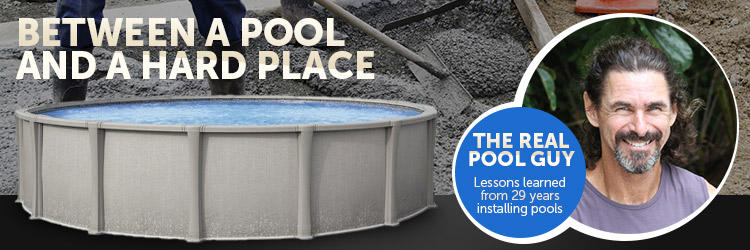
The vast majority of above ground swimming pools are built directly on the ground. In some areas of the country the ground is too hard as it is mostly rock or hard clay. These areas have to be dug up and/or chipped away into a flat area and then sand or limestone is brought in for leveling. In these areas, the price to have the pool installed is considerably more because machinery and materials are needed to get the ground level and the pool’s bottom flat and smooth.
Here in Central Florida (yeah, that’s where I am), installations are easier because our earth is mostly sand. I use a skid-steer machine to level the ground, because I’m now older and smarter, but most installers don’t use a machine. I always state that when you are installing an above ground pool, preparing the ground is half of the job. Preparing the ground and pool’s bottom requires most of the craftsmanship.
It is truly an art form when it comes to getting an above ground pool’s bottom flat and smooth using just the earth and/or added material. After about 25 installations, most new installers have learned to build an above ground pool’s structure pretty well and can even get the liner somewhat free of wrinkles too. Making a smooth and flat bottom is a different story. I have to say it probably takes an installer who values quality a couple hundred installations before he becomes somewhat proficient at making a nice flat pool bottom.
A flat, smooth pool bottom isn’t a must-have, but it does make your pool much nicer to use and keep clean. Above ground pool bottoms with sharp objects pointing up, and bumps and dips and footprints usually won’t cause any issues. It will only feel different to your feet and be more challenging to vacuum. Simply using an OK installer instead of one with twenty-nine years of experience (shameless self-promotion) will make all the difference if you want to have a nice pool bottom.
So why all this talk of earth-based pool bottoms when the title of this blog post is about installing on concrete? Well, I’m just getting you prepped for why you would consider putting your above ground on concrete. It’s really rare for people to decide to install their pool on concrete mainly because of the cost. There are advantages to doing this so if you are thinking about it and have the money, then here are some things you need to know.
Five Reasons Why You May Want to Install Your Pool on Concrete
Let’s start with why most people elect NOT to install their pool on concrete. The reason is – money. Concrete is expensive! It is really expensive. How much you ask? Well, it’s hard to say exactly as it depends on the size of the pool, what town you live in, and what your earth consists of and how much leveling is required. Keep in mind that you still have to prepare the ground by making it level to within at least a couple of inches or less so whatever that takes will add to the price. The price of concrete and concrete work varies. It depends on where you live. So, to find out a ballpark figure, call a couple of concrete guys and ask about the price for about a 500 sq ft level slab (that’s good for about a 24’ round pool). When you are done shrieking, remember I told you it’s pricey.
1. A Concrete Pool Bottom Is Nicer Than an Earth Bottom
If you only read the headlines of this blog post, then go back and read the beginning. I am an artist at making an earth or sand bottom clean and smooth and flat, but even I am no match for concrete. Concrete starts out like liquid and then slowly gets harder and harder. This is why you can get it really flat and smooth.
2. Nutgrass Cannot Grow Through Concrete
In a lot of areas, nutgrass or nutsedge (look it up) is an issue for above ground pools. I’ve seen nutgrass grow through heavy-duty tarps, gorilla pads, high-density foam boards, and then of course, pool liners. Some products boast that they can prevent nutgrass from damaging pool liners and maybe some can. Who knows? There is one thing I know for sure and that is nutgrass cannot grow through concrete. Period.
3. Moles Cannot Cause Ruts in Concrete
Moles don’t pose a huge problem for above ground pools, but for some they are a destructive pain in the bottom. They can burrow under a pool and cause trails and ruts everywhere messing up that beautifully smooth bottom I made. It’s rare, but over the years I’ve had a few pool owners have no choice but to pour concrete for their pool bottom because of their extreme mole problem. It’s an expensive fix, but works 100% of the time.
4. The Shifting of the Earth, Decomposing Roots, Horned Nosed Beetles, Termites, and Ants Can’t Affect a Concrete Bottom
This is a general reason. The earth is a dynamic place that has movement and living things that move and eat and destroy. A concrete barrier between the liner and this environment blocks all of earth’s drama.
5. Concrete Doesn’t Wash Away
Above ground pools usually don’t have many issues with leaks until the liner gets old and brittle. At that point it’s time for a new liner so it’s OK for the leaking water to wash some of the smooth earth away as the bottom can get resmoothed when you change the liner. Leaks can happen earlier than that though and they can cause divots in the pool’s earth bottom. It’s not a big deal but it does take away that nice flat bottom you started with in some areas. Concrete doesn’t wash away. No matter how much the pool leaks, a concrete bottom will never change and will always be as flat and smooth as it was on day one.
Getting a Concrete Bottom for Your Above Ground?
Here is some information you’ll need.
- It doesn’t matter whether you get a brushed or smooth concrete bottom. You are going to need foam coves and a liner guard/gorilla pad. Liners that sit directly on concrete are problematic and cause leaks.
- Planning on using an existing slab? Remember it’s got to be level. Outdoor concrete slabs all have slopes for rainwater to drain away. If the slab has a slope that is greater than an inch, you’ll somehow have to make it level.
- Pour the concrete slab first and then build the pool on it. Don’t build the pool and then pour concrete inside the pool’s wall. Why not? Ask me at notagoodidea.com.
- Make your slab level and at least a foot bigger all around than the dimension of your pool’s size. Example: A 24’ round pool should have a 26’ round concrete slab.
- Planning on putting an oval-shaped pool on concrete? Don’t bother. It is too much of a pain.
- You’ll absolutely need to have a lot of cash or credit.






Leave a Reply