
In-ground swimming pools have become super expensive. Here in Central Florida where concrete type in-grounds are the most popular, their price has gone through the roof. These pools usually start with a price tag of $30 000, but then go way up from there. It’s not at all uncommon to pay more than $50 000 for an average size concrete in-ground and that’s not even a very big or fancy one.
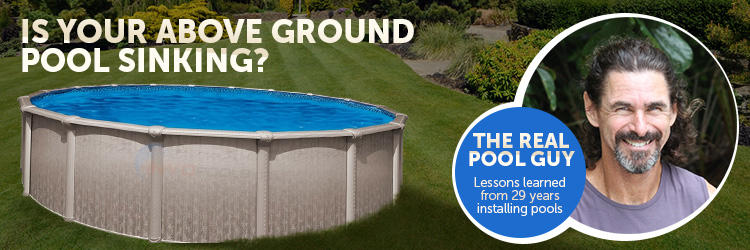
Because of this crazy cost of in-grounds, homeowners are finding a less expensive option by getting an above ground pool and sinking it in the ground. I have seen above grounds in the ground for many years and it’s nothing new, but it has certainly become much more popular in the last 10 years or so. It seems like at least one person asks me about this every day. So, if you are considering sinking an above ground swimming pool in the ground, you’ve found the right blog post.
Sinking an Above Ground Pool 101
Here’s a list of the basics of placing an above ground pool in the ground. Follow these basics and things will probably go well and you’ll be happy. If you don’t follow them, you might still come out happy. Who knows?
I. Only go down about halfway
These pools aren’t called “above grounds” just ’cause it’s catchy. Above ground swimming pools are not designed for inward pressure. So, when you put them in the ground, they can cave in from the weight of the earth, but only when they are empty. By sinking the pool down only halfway (2-2.5 ft), the pool has a much less likelihood of caving in when the time comes to drain the pool while installing a replacement liner.
If your ground is super firm, it won’t matter much how far down you go. In Central Florida it’s mostly sand-based so that’s an issue, but if you have rocky, rooty, or earth with a lot of clay, you may be fine to go down further. Some will go with the extra cost of building a retaining wall all the way around the pool. If you do that then you’re also good, but that adds to the cost of the job and aren’t you wanting a much cheaper alternative to an in-ground?
Also, most who sink their pool will have a wood deck built around it. Wood decks require some height off the ground so its structure can be built and that’s another good reason to go only halfway down.
II. The hole has to be bigger than the size of the pool
Above ground pools are assembled on site. They can’t be “pre-built” somewhere cool and then helicoptered in and set down into a hole perfectly. The thing has to be built in the hole so more room is needed. As a guideline, if the pool is going two or more feet down, make the hole 1.5’ bigger than the size of the pool all the way around. EXAMPLE: A 24’ round pool should have a hole that is at least 27’ in diameter.
Make sure the bottom of the hole is the desired size and not the top. I know that sounds stupid, but it’s not. A lot of times, holes get dug with a starting top dimension of 27’ round and by the time the hole is two feet down, its dimension has tilted in and it ends up being a 26’ hole at the bottom. Additionally, if your earth is really sandy and loose, it may be a good idea to make the hole even bigger. There’s little more frustrating than building one of these pools in a hole and it caves in on you halfway through with loose earth.
III.Leave piles of earth right next to the hole
After the pool is built and full of water, you’ll want to backfill some dirt around the pool. Remember the hole was bigger than the pool? Leaving some earth close to the hole will make backfilling much easier. Warning: Backfilling before the pool is full of water will result in the wall caving in! Don’t start backfilling too early. Let the pool fill with water so the water’s outward pressure will keep the pool wall in place. I know this sounds like a “duh” statement, but believe me it’s happened more often than I want to admit.
IV. Above ground pool pumps have to stay below the waterline
There are a few differences between in-ground pool pumps and above ground pumps. The biggest one is that an above ground pool pump cannot draw water up. This means that the above ground pump has to be at a level lower than the pool’s water level in order to work properly. If you are placing your above ground in the earth, make sure your pump stays below the pool. You can have your equipment well above the pool, but you’ll have to buy the more expensive in-ground pump to do so. Just another reason to go only halfway down (add this to the first guideline).
V. Check for local safety guidelines
For some towns or counties, an above ground swimming pool is considered safe because they are so high off the ground. With a safety ladder, above ground pools can be pretty safe for any small children wandering along the countryside unsupervised. Though, when you sink the pool that changes. If you don’t have a fence around your yard or if wandering two-year-olds are a problem in your area, then consider this safety issue.
Honorable Mention
So many people ask me if an above ground pool will last as long when it is buried in the ground. Some feel that sinking one in the earth will make it rust out faster or something. It makes logical sense to think that is what will happen, but there is one thing that is more accurate than logical sense and that’s long-term observation. In my 30 years of working on these pools, I have seen no evidence that placing them in the ground takes any life out of them. Of course there are instances where that can be true, but I’m talking as a general rule. Now some disagree with me on this and that’s OK. It’s healthy to be wrong sometimes. Most of them haven’t observed above grounds apart from their own or maybe an uncle’s or neighbor’s or something.
Go ahead and install an above ground in the ground. You may enjoy it more as it won’t be located so high up in your yard.






Leave a Reply