Home / Articles / Sizing Your Pool Heater

Sizing Your Pool Heater

how to size a pool heater

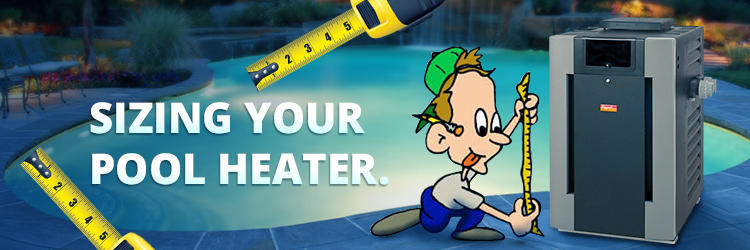
When I first started working in the pool industry, one of the areas I always tried to avoid was helping customers size their pool heaters. I’m not sure what made me uncomfortable about sizing heaters but I avoided it like the plague. One thing I did know was that when it came down to heaters and heat pumps, the bigger the better. Although true, I learned that some pool owners actually prefer efficiency over size. Eventually, I realized that my “bigger is better” line wasn’t always the best advice for every pool set up and sooner, rather than later, I’d have to learn how to size a heater for a pool owner.

So, exactly how do you size a heater for your pool? Let’s do this together. 

Sizing Your Pool Heater

There are a lot of decisions pool owners make during the heater buying process. Besides the norm like choosing a manufacturer and if you’re using natural gas or propane, pool owners also must know how big or how small their heater needs to be. From experience, this is the area where most pool owners have tons of questions. And I don’t blame them.

Back to my original, “bigger is better” statement. It is true that larger heaters heat your pool faster than smaller ones. A 400k BTU heater will roughly heat your pool twice as fast as a 200k BTU heater, but it also burns gas twice as fast.  Heating up a pool versus a pool and spa combination requires less BTU power. Usually, if you have a pool and spa combination, we recommend purchasing the largest BTU size available because you’re not just heating up a single body of water. But, even if you want to perform the calculations for sizing your heater, you can do that as well.

Calculations

Step 1: Calculate your Surface Area (Pool Length x Pool Width)

When you are determining which size pool heater to buy, the first step is calculating your pool’s surface area. A lot of pool owners assume that you use your pool’s gallon size to determine your heater size. In fact, there are some websites that DO use the number of gallons. I mean, the gallon size is important, just in a roundabout way. Let’s think about it this way. If you have a pool with a large surface area, the heat has more space to escape and subsequently, more water to heat. As a result, the heater needs to be large enough to compensate for surface area and the pool size.

To calculate the surface area of your pool, multiply the length times the width.

For example, if your pool is 15 x 30, then your surface area is 450 square feet.

Step 2: Divide your Surface Area by 3 (Surface area/ 3)

Once you determine your pool’s surface area, divide it by three. This answer is the minimal BTU size recommended for that particular surface area.  Continuing the example above with the 15 x 30 pool, after dividing by 3, you get 150. Therefore, the minimum size heater that is recommended for a 15 x 30 pool is 150,000 BTUs.

Keep in mind, this is simply the recommended minimum size. Meaning, I wouldn’t go lower but I might need to go a little higher. When it comes to gas heaters, you always want to oversize the unit. The job of a pool heater is to replenish the heat loss at the surface of your pool. Most heat loss happens over night. Without a solar cover, there is no way to make up for the loss. That’s when having a higher BTU size comes in handy.

Step 3: Consider Your Variables

Now that you have the absolute smallest BTU size recommended for you pool, next, you have to determine if you need to go larger. And if so, how much larger? Before making a decision, consider all the variables that may affect the efficiency of your heater such as owning a solar cover, wind speed, and how often you swim.

For a 15 x 30 pool without a solar cover, I might recommend the 250 k or 300 k BTU model, depending on the customer’s preferences. That way it accounts for heat loss, evaporation, and unexpected windy conditions. It also accounts for pool owners who prefer to swim at night.

By adding a solar cover, you’re changing the game. Using a solar blanket in conjunction with your heater is the best tag team in terms of providing the best heat in the shortest amount of time. With a solar blanket, you might not need a 300 K BTU heater.  You might settle on the 200K or 250k heater. Sometimes, it’s cheaper to simply invest in a solar blanket than paying for a larger heater.

Raypak Residential Gas Heater Sizing

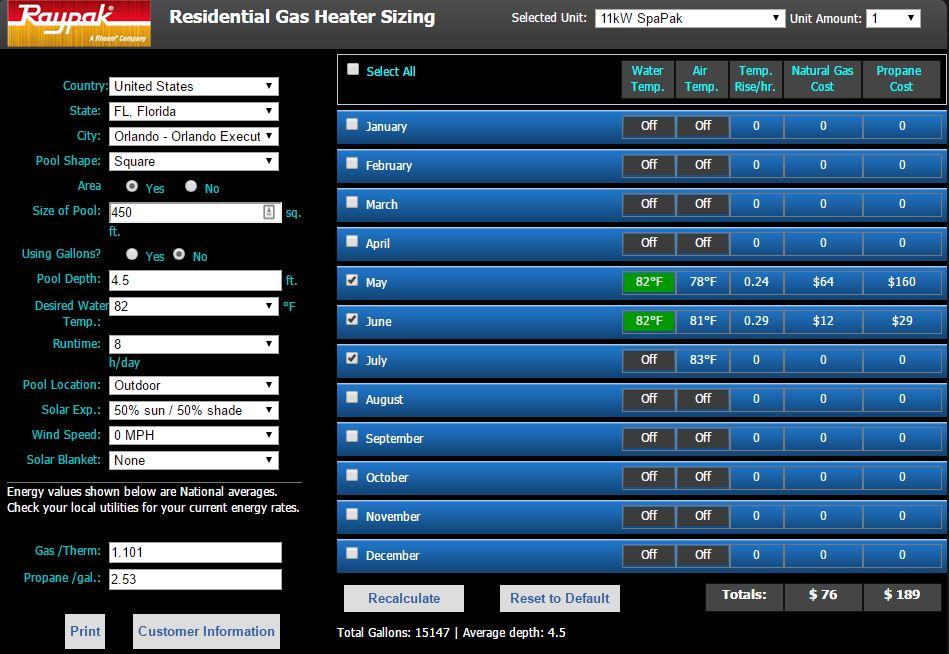
The really cool thing about technology is that it makes all of our lives easier. Raypak has a handy-dandy gas heater calculator that configures your city and state with your desired water temperature, average air temperature, and desired temperature rise. This online calculator allows pool owners to input really specific information about their pool and location and configure what size heater is best, not only for their pool but taking your physical location into consideration as well.
RaypakResidential

The calculator also has the ability to calculate the cost of natural gas and propane. This tool allows customers to compare energy costs and discover which unit is truly right for them. It goes much further than I could ever tell you, that’s for sure.

You can use the Raypak Residential Gas Heater Sizing Calculator here.

Check out our one stop- spot for the heater-related content we’ve already covered.

author avatar
Charlie Ramirez
Writer at InyoPools.com, brings a wealth of knowledge and expertise in pool care and equipment, helping pool owners make informed decisions for over a decade.

Related Videos

54 responses to “Sizing Your Pool Heater”

  1. Ony Avatar

    Will an electric heat pump 400k btu be enough to heat a 40k gallons pool?

    1. Matthew Simmons Avatar

      That I know of, there are no 400 k BTU pool heat pumps available on the market today. If there is one, yes, it would be enough; but if you want a heater with that many BTUs, you will need a gas heater.

  2. paula b. Avatar

    Matthew —
    Your information here is great, and it sounds like you really know your stuff… So, I have a question on the same subject of pipe size/length and btus. We are in an older home that had gas heater removed prior to our moving here a few years ago. In deciding which heater to buy as a replacement, as our northern CA weather is great in the summer but very cool at night (and in winter months) I wanted to go with the “bigger is better” concept primarily for efficiency. Also, I’m thinking we should go with 400 btus as we don’t have a cover (the pool is kidney shaped). It measures approx 25 x 40, and we’ve tried a solar cover but that’s a real pain.

    Contractor A said that for a 400 BTU Jandy and a gas line run of approx. 90ft, we would need to upgrade the existing 3/4″ line to 1/1/4″ pipe — same as what the Jandy chart above (and our brochure) states. So we upgraded the pipe, re-ran the line, etc. and now have a 1/1/4″ line — but we haven’t yet pulled the trigger on which heater we want.

    When I learned that our regular pool service provider also installs pool heaters (which I didn’t realize until recently), I requested a bit from them as well. They/Contractor B carry Raypak and Pentair — not Jandy. And in working up a bid, they said they would need to put on a line reducer, as both Raypak & Pentair take a 3/4″ gas line!!! Imagine that! Something just doesn’t make sense to me…

    I haven’t yet received Contractor B’s bid, but I don’t recall them measuring the long distance for the gas line, and wonder if they simply don’t factor that into the equation. To me, this would mean that a 400btu heater would be starving for gas…

    I would very much appreciate your input, as my knowledge of pool heaters and gas lines is very new and very limited — but my sense of logic tells me that Contractor A has done his homework.

    Thanks so much!
    pfb

  3. Guy Lerner Avatar

    I have a 36×20 pool in NY surrounded by trees and shade. I don’t have gas line and want to use a heat pump.
    Which size do you recommend?

  4. Barbara Simons Avatar

    Live in SC & have inground pool, 34’ by 15’. Shallow end is 3ft & deep end is 6ft 7 in. Would like to heat to 85 degrees & want to use April – October. Have a poly gal roof over it. What brand heat pump do you recommend & how many btu’s? Don’t want to urs propane or gas heat. Thx for feedback.

    1. Barbara Simons Avatar

      email address for response re: 34 by 15 foot pool in SC is bjsimons50@yahoo.com

  5. […] ground pools can vary in size and volume. Like any equipment you purchase, you have to buy the correct heater output to guarantee it is adequate. If you purchase a swimming pool heater that does not have a high […]

  6. Joel Avatar

    Will a heat pump type pool heater be a viable choice for a 15 by 40 ft pool in Clark county NV?

    1. Matthew Simmons Avatar

      What water temp are you wanting to maintain? Also, what time of year do you plan on using it?

  7. Rob Avatar

    I have a 27’x54” above ground that I was wanting to know what size heat pump heater to purchase

  8. Lin Avatar

    I forgot to mention that my pool also has a sloped- “dished-out” deep end that is about 6 1/2 ft.

    1. rspar Avatar

      Don’t see an answer so I will as a poolman I’d install a Starite 333 or 400. In my experience the Starite’s are the longest lasting heater.

      1. Matthew Simmons Avatar

        In our experience, Sta-Rite is the most costly to repair and tend to be overdesigned. There are a lot of moving parts in a Sta-Rite heater; a la, a lot that could go wrong. I generally prefer Raypak because their heaters are relatively simple, and they are a company that specializes in heaters. Because the parent company is Rheem, when you call Raypak you ae guaranteed to get someone who knows their way around a heater and can tell you how to troubleshoot any problem. With the larger pool companies like Hayward or Pentair, you may call about a heater issue, but you are on the line that is more familiar with pumps or filters and can only go through basic troubleshoot handbook.

  9. Lin Avatar

    Hello. I have a 18 x 33 ft above ground pool that I use for exercise. Due to my medical conditions I can’t tolerate water temp less than 85-86 but in southern PA, (in the summer) I am lucky to be able to get in the pool more than 10 days. I will be using propane as can’t afford connection gas fee. In order to be able to swim all summer (and end of spring plus beginning of fall would be wonderful!) I would need anywhere from 5 to 15 degree increase, depending on the day/night. Can you tell me what btu heater and also, any recommendations of what heater. Unfortunately, being a disabled widow, cost is a concern for me, so if any ideas of heater with that in mind. Thank you very much for any help you can give me!

  10. Chris Avatar

    Hi,

    I have a 31 x 31 x 5 pool (in ground)
    Windy conditions
    Ambient temp of 65 F
    My pump runs 6 hours a day
    2 ppt of salinity
    My target temp is at least 86 F

    How many BTUs should I be looking for ?

    Thanks

    1. Matthew Simmons Avatar

      I see you have most of the info we asked for in the article to get the BTU size. I do not see the area of the country you live in, the seasons you’ll be operating the unit or the cost of utilities.

      If you can provide that information, I can try to calculate the answer. You may also use the Raypak Sizing Calculator we have linked in the article.

Leave a Reply

Your email address will not be published. Required fields are marked *