
Home / Articles / The 5 Worst Pool Advice We Have Ever Heard

The 5 Worst Pool Advice We Have Ever Heard

Worst pool advice ever

Let’s face it, with access to the internet, a lot of jobs and skills that were once sought out and paid for have become jobs you can do yourself. With a little advice and a Youtube video, you can almost build anything on your own. Still, not all advice given is created equal nor should be treated equally. Unfortunately, in the pool industry, bad advice can sometimes mean hundreds of dollars out of your pocket and a lot of missed time out of your pool. Throughout the years we have encountered a lot of customers who have taken their share of bad advice. We wanted to share the top 5 with you in hopes you won’t make those same mistakes. Caveat Emptor!

“I was told I could just put the chlorine tablets in the skimmer or pump basket.”

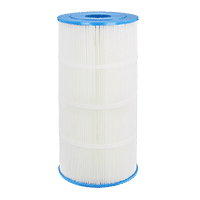
I’m saddened to say that we encounter this issue at least five times every season and our response is always the same, “Please do NOT put your chlorine tablets into your skimmer or pump.” Your pump and filter are the two driving forces that keep your pool clean and healthy. Let’s say you decide to put your chlorine tablets, or “hockey pucks” as a lot of people like to call them, into your skimmer. Once your pump and filter turns off, the tablets keep dissolving in your skimmer, forming highly acidic water. Once the pump is turned back on, this same acidic water goes straight into the filter. This can compromise the internal parts of your filter – cartridges, o-rings, and gaskets – forcing you to replace them earlier than normally necessary.

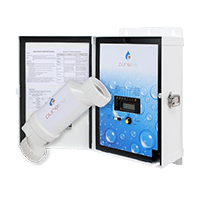
Instead of putting chlorine tablets in your skimmer or pump, we recommend using a chlorinator. A chlorinator will automatically disperse chlorine into your pool according to an adjustable setting on the unit. Chlorinators work with your existing pump and filter and are usually very easy to install. Another option is a floating chlorinator which is just a plastic vessel that holds tablets and floats in the pool. Floating chlorinators are super cheap and can usually be found in local stores like Walmart. Whatever you do, though,  please do not put chlorine tablets into your skimmer or pump!

“My pool guy told me I could run my pump a few hours a day…. but now my pool is green.”

Pool pumps should run on average between 8-10 hours a day. As a basic rule of thumb, you should be able to filter your entire pool within an 8-hour time frame. In other words, your entire pool (in gallons) should pass through the filter in this 8 hour period. If you are not giving your pump and filter enough time to properly clean the pool and keep the chemicals in flow, your pool will turn green. Not to mention, it might be unsafe for even recreational purposes.

As a pool owner, you need to become comfortable with certain pool calculations. If not for yourself, definitely as a means of double checking pool “professionals” who may steer you in the wrong direction. Here’s how you can calculate the minimum time you need to operate your pump

  1. Determine how many gallons of water is in your pool.  (Pool’s length x Pool’s width x Pool’s average depth x 7.5)
  2. Figure out the pump’s gallon per minute (GPM) This information is typically listed on the pump label. Once you find this number, multiply that by 60 to get the gallons per hour.
  3. Divide the gallons per hour into the total gallons in your pool.
  4. This answer gives you the minimum hours needed to run your pump so that your entire pool is filtered properly.

So the next time someone recommends that you run your pump for “insert # of hours”, always refer back to the GPM of your pump. No one likes to swim in a dirty pool and no pool owner likes to spend additional money to fix something that was preventable from the start.

“My pool guy sold me a bigger pump than I had on before because he said the bigger the pump, the less I’ll have to run it.”

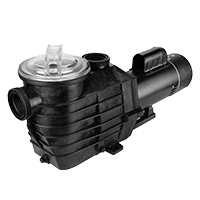
When it comes to pumps, bigger is not always better. A pump is limited by the plumbing size set up at your home and the maximum capacity your pool filter can handle. A higher horsepower (HP) means more power and energy is being used to pump the same amount of water, thus causing your energy bill to skyrocket. A higher horsepower draws more amps but does not move the water faster through your circulation system. Instead of reaping the benefits you thought you were getting by increasing your HP, you end up with a higher energy bill, a burnt-out motor, and an oversized pump you spent more money on than you wish you had.

If you need help trying to properly size your pool pump or want to verify if your current HP is accurate, then please check out our how to guide labeled How To Size A Pool Pump.

If you’re looking to save money, our advice is to switch to a dual speed or variable speed pump. By switching to one of these, you are able to operate your pump using less energy. You can operate your pump at the lower speeds during normal circulation and on high speed whenever you clean your pool. And who doesn’t like saving money, right? In short, bigger is not better when determining the horsepower for your pool pump. Over sizing is very common, but very easy to fix. We are always available to verify if your pump is oversized and if you are overspending.

“You can determine if your pool is clean by the smell of chemicals.”

If someone ever tells you this, take a step back, and go in the opposite direction. The smell of chemicals is not an indication of a clean pool, but just the opposite. A properly disinfected pool has no strong chemical smell. The strong smell common to many pools, especially public, is due to something called chloramines. Chloramines are the byproducts of chlorine’s reaction to contaminants brought into the pool by swimmers. These contaminants include perspiration, urine, body oils, and cosmetics.

Therefore, a strong chemical odor is actually an indication that the chlorine in the pool is working overtime due to the excess amount of contaminants and not an indication of it being clean.

“My pool guy told me I could use Vaseline (petroleum jelly) to lubricate my o-rings.”

You should never, ever use Vaseline or any petroleum-based lubricants for any of your o-rings. Most manufacturers recommend a silicone or a Teflon-based lubricant for all o-rings and gaskets. The oil composites of the petroleum jelly will cause the rubber to break down and will completely eat away your o-ring. Although o-rings range in size from really small to very large, never underestimate their power or the importance of their job. Using the wrong type of lubricant can cause leaks and ruin your system.

author avatar
Charlie Ramirez
Writer at InyoPools.com, brings a wealth of knowledge and expertise in pool care and equipment, helping pool owners make informed decisions for over a decade.

Related Videos

156 responses to “The 5 Worst Pool Advice We Have Ever Heard”

  1. Megan Avatar

    I just bought a 15ft 5k gallon intex vinyl pool I set it up 2 days ago to begin with even though it’s new fresh water it has a greenish tone already.. I just bought the chloride tablet and put it in the floating dispenser inside pool. I also bought algicide 50% and shock plus.. can you tell me when do I start using those chemicals? and put them in like at night leave the pump on and can I put them both together?

    1.  Avatar

      Need to shock it once a week… Put about 4bags of shock and let it sit. You’ll be fine

      1. Joe Miller Avatar

        Also check that the green is not due to metals in hard water used to fill the pool versus algae.

        1. Matthew Simmons Avatar

          A high copper content will cause a green hew. More info: Why is my pool green after filling with fresh water?

  2. H. J. Averink, Avatar

    The real case for not using the skimmer as a chlorinator is that the chlorine hits the dirty filter first and is used up before it sanitizes the pool. Chlorine belongs in the pool not in the filter.

  3. braunyman Avatar

    I do not agree with the advice to run the pump 8 to 10 hours per day. I did so the first year I had my pool and then I gradually cut back each year. Now I run it maybe 3 to 4 hours per WEEK and I have had zero problems. I keep on top of the water chemistry and everything is fine.

    1. Gus Avatar

      It really depends on the pool, a 10.000 gallon pool will take a lot less time for all of the water to run through the filter, than a 200.000 gallon pool.

  4. snap Avatar

    I just replaced my salt cell and it continues to read 4000. Any ideas why?

    1. Matthew Simmons Avatar

      Have you gotten the water tested to determine if the salinity truly is 4000 ppm? That would have been my first step.

      What is the make and model of the salt system?

  5. AndyP Avatar

    Forgive me if this has been said above. I suspect it has but there’s a lot to search through to check!

    1. Just don’t even USE pucks (in the great majority of cases)

    2. Pumping for 8-10 hours is as arbitrary as a FREE chlorine level of 3 ppm. Excessive for a small pool (not harmful though except to an electric bill). Possibly insufficient for a larger pool.
    How many hours? Enough to be sure to turn over the whole pool volume each day. Check tfp’s PoolMath calculator for an easy volume figure then apply that volume to your pump’s gallons-per-minute (gpm) rating.

    3. Chemical smell is not required for a pool in good order, but is NOT a curse. It’s a sign of somethin you need to respond to by way of a SLAM (*Shock *Level *And *Maintain – tfp explains). It’s the smell of combined chloramines, from chlorine doing tge second part of its job – combining with contaminants to eradicate them.

  6. James Nunya Avatar

    It totally baffles me how many pool owners here have no clue to how to care for something they paid hundreds if not thousands of dollars for something without investing a little time to educate themselves on pool care. People spend some time learning about things that require maintenance and as well how to do it, BEFORE making a big investment in something that can be dangerous for you or your children if not handled properly.
    There are many websites on the web to assist you in your journey. Take the time to educate yourself and save both a great deal of time and money. By doing so, you may even enjoy your investment instead of it causing you frustration..

  7. Nisha Avatar

    New to this
    Got a above ground pool. A week after I shocked it added the floating pucks but then the pump went out it came with after I applied the shock. I got a sand filter pump but now have the shock residue bottom of pool. What to do ? I tried running the brush through the water stirring it up but it settled.

    1. Matthew Simmons Avatar

      Get an above ground pool pump that works and start vacuuming the leftovers. Because you have a sand filter, the shock residue can be vacuumed to waste pretty easily.

  8. Becky Avatar

    I have a new 10×18 42” intex pool and I purchased a saltwater system and started w salt. The bags are so heavy I decided to try regular chemicals and I’ve tested my water at home and the store with no problems. Will it hurt my salt water pump to not being using salt? Thanks! Becky

  9. Kathi Avatar

    I’m a new owner of an Intex 18’x48″ above ground…. I have so many questions…
    * First I know I need to get my water tested but haven’t yet.
    * The pump that came with it barley circulates any water at all. Is this normal? I can’t find the HP any where on the pump. Do I need a stronger HP?
    * Can you use a sand pump with a chlorine pool?
    * Which vacuum (brand) to purchase that’s the least complicated to use but does the job?
    * I haven’t bought a skimmer yet because it has to be one that hangs over the pool as I don’t want to cut the liner.
    * My water is cloudy but it’s probably because it hasn’t been maintained. When I purchase the right products hopefully that will take care of my issues.
    Also….
    When the guy installed it he said to:
    Initially put in 5 bags of the hth supper shock treatment. After that put 1 bag in every month.
    Put one whole 1 qt bottle hth Super Algae 60. Then another bottle every 6 months.
    Put 1…. 3″ tablet in the floater but didn’t say how often.
    I’m sorry for so many questions. Hopefully you can help me.
    Thanks much

    1. Matthew Simmons Avatar

      1) Get your pool water tested, and purchase a water testing kit.
      2) It is usual for Intex pump and filters to be substandard. For a pool that size, a 1 HP pump would be a proper size. Inyo’s pool pump and filter combinations.
      3) Yes, you can use sand, cartridge or DE.
      4) Get a suction cleaner, like the Baracuda or Pureline models.

  10. Charles Avatar

    Is it ok to put chlorine into the skimmer if the filter is run all the time? The filter I currently own is on the lower-end and doesn’t cycle all of the water in the specified 8 hours. I understand thaf if it is off, the tablets continue to dissolve, but I don’t believe that will be that big of a problem with a constantly running filter.

    1. Matthew Simmons Avatar

      No, pouring chlorine directly into the skimmer will ruin your skimmer and pump’s internal parts. Chlorine is a very caustic material, so it needs to be diluted. That is why we pour chlorine into the pool, or use tablet feeders that float or are plumbed last on the return line. So by the time the chlorine works its way back to the skimmer and pump it has been diluted to safe levels.

      But if you want to buy new skimmer and pump baskets yearly, have at it.

      1.  Avatar

        Yearly is exagerated, might replace baskets every few years and pumps shaft seal also. Most severe damage is the skimmer pipe will construct over the next 15 years and lose flow by as much as half.

Leave a Reply

Your email address will not be published. Required fields are marked *