Home / Articles / What is the Difference Between Pool Shocks?

What is the Difference Between Pool Shocks?

Pool Shocks

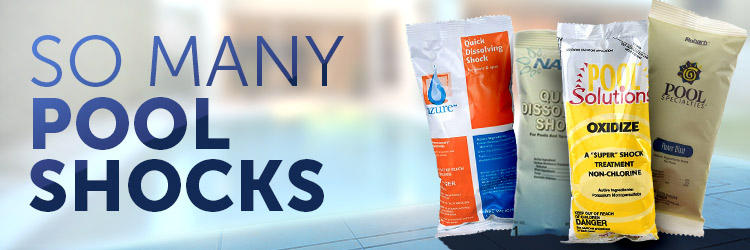
Well first, what is pool shock?  Shock is a concentrated chemical formula used to increase available or free chlorine when your standard sanitizer (regular chlorine tabs, a salt chlorinator, Nature2, etc) gets behind in its duties.  Sanitizers work to oxidize or break down organics and destroy bacteria.  But they can become overwhelmed by higher levels of these compounds which rise after an increased bather load (pool party!) or heavy debris from inclement weather.

Organics come from many sources – dead skin cells, sweat, sunscreen, dirt, and leaves, to name a few.  These not only muck up your pool but also provide a veritable all-you-can-eat buffet for bacteria and can set the stage for an algae bloom.  This is when pool shock comes in to save the day by giving a boost to your sanitizer.  Here are the three main types of pool shock, which vary by their chemical composition.

Cal-HypoBlog Image - Cal Hypo (200 x 200)
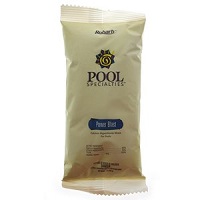
Its full name and main ingredient is calcium hypochlorite.  Cal-Hypo contains chlorine and is available in different concentrations; we carry 68% and 73% which is typical of the ranges you’ll find.  It will boost your free chlorine level without increasing cyanuric acid (CYA).  However, since CYA acts as sunscreen for chlorine, you will want to add Cal-Hypo shock in the evening to give it a chance to work without getting hammered by full sun.

Cal-Hypo will add calcium along with the chlorine.  If the calcium hardness level is already high in your pool, consider an alternate shock.  Use with extra care on pool surfaces prone to bleaching, especially vinyl liners.

Di-ChlorBlog Image - Di-Chlor (200 x 200)
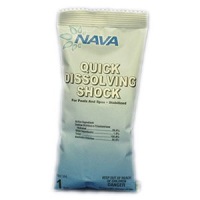
Also known as sodium dichloro-s-triazinetrione, Di-Chlor is another chlorine-based shock.  This is typically recommended for vinyl liner pools as it dissolves rapidly and will not bleach or stain the liner.  It is also safer for fiberglass or painted surfaces for the same reason.

Di-Chlor does not add calcium so it’s a good option over Cal-Hypo if you want to use a chlorine shock without increasing hardness.

Oxidizer (Non-Chlorine)Blog Image - Oxidizer (200 x 200)
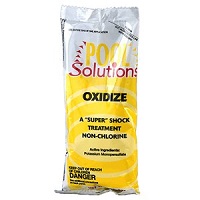
Potassium monopersulfate is an oxidizer comprised of potassium salt.  There is no chlorine in this type of shock and it does not kill bacteria.  So what’s the point?  When there is a high level of organic waste in the pool, the available chlorine is used up attacking that, giving bacteria free reign to grow.  Non-chlorine shock oxidizes the organics and helps clarify pool water.  This allows the free chlorine to do its job of attacking bacteria and algae instead.

Some people prefer to limit the use of chlorine due to health concerns.  Non-chlorine shock is not as powerful as Cal-Hypo or Di-Chlor but provides an effective alternative.

Whatever type of pool shock you decide to use, be sure to carefully follow the manufacturer’s instructions to protect yourself and your pool.  And if you can’t get enough of the joy of pool maintenance, then check out our many How To Guides on this very subject.

author avatar
Matthew Simmons Technical Writer & Pool Product Expert
Swimming pool expert at InyoPools and host of Poolside Chat, brings over a decade of experience in the pool industry.

Related Videos

44 responses to “What is the Difference Between Pool Shocks?”

  1. Sandy Avatar

    My pool is 16 by 36 and it is clear but I can not get a free chlorine reading.Total is 3 free is 0 cya is150 and total alt. Is 120 ph is 7.2 and the grandchildren are wanting to swim and I will not let them.The water looks great!It is clear.

    1. Matthew Simmons Avatar

      First, your CYA is too high, refer to the chart below. I suggest using non-chlorine shock to get your combined chlorine in check; or you can also use liquid pool shick to clear the chloramines.

      pool cya chart

  2. Nick Avatar

    Hey Matthew,

    I have a little pool for my kids. I did everything indicated for set up. Added algecide shocked with chlorine shock and added prescribed amount of tablets to a floater. I took parameters and everything seemed fine there was a bit much chlorine, ph was high and alkalinity. Later on during the next day i took a test and there was no chlorine. I added more shock and it seemed to bring it back and today i added a ph dropping chemical which seemed to bring the ph and alkaline back to acceptable levels and now again no free chlorine? Any idea what im doing wrong? Did i not add enough shock for the chlorine tablets to do their job?

    1. Nick Avatar

      The water is quite cloudy also

    2. Matthew Simmons Avatar

      Before adding chlorine, level the pH, alkalinity, and Cya levels first; those three levels help the chlorine be as efficient as it can be at cleaning your water. Shock spikes the chlorine level, it is not meant to raise and maintain. So if you only added shock but no stabilized chlorine (tablets), your free chlorine (FC) would not maintain a suitable level.

      Review this guide for more information: How To Maintain A Swimming Pool Part 1 (Chemicals)

  3. Rob Avatar

    Hello, thank you for your website.
    I have recently moved to a new house with an in ground pool which has an active oxygen/UV system installed. I recently opened up for the season and was wondering if it is safe to (and if I should) shock this type of pool?

    When we moved in and the pool was open, the active oxygen wasn’t connected and just chlorine tablets were used.

    Just double checking as I don’t want to cause a chemical problem.

    1. Matthew Simmons Avatar

      Yes, you can still use pool shock with a UV system. I would only do it if you have recently filled the pool with freshwater, after a pool party or if there is a pending algae issue.

      1. Rob Avatar

        Thank you. I reopened it recently and it has mostly been cleaned but a bit of lingering algae.

        Thank you for your quick advice, great site!

  4. Ava Avatar

    Hello,

    I’ve been using regular chlorine bleach to sanitize my 20,000 gallon above ground pool for about 3 years and have had great results. Now that coronavirus is here there is no chlorine bleach to be found. since I will probably need an alternative now, should I use di-chlor or tri-chlor and why. Thanks

    1. Matthew Simmons Avatar

      Trichlor would be my choice. Dichlor contains too much stabilizer for my liking.

  5. Steve Avatar

    recently I ordered 58% cal-hypo for shock in stead of the usual 68% . What multiplier should I use for break point?
    I have been using 2 for the 68% as that is what rasies 1 ppm for 10,000. I cant seem to find on the 58% cal-hypo how much in ounces to raise 1 ppm per 10,000.

    Thanks

    1. Matthew Simmons Avatar

      To get the rise of 1 ppm number you could contact the manufacturer of the chemical or possibly the seller. I may try an extra bag to get it to rise that 1 ppm when using 58% pool shock.

  6. Jen Avatar

    I have a 27,000 gallon pool that just got a new vinyl liner. Water delivery was not an option, so we started off with ground water. We had copper and iron in the water and used metal out, which got rid of the copper. After the metal out, we shocked with 2 lbs. sodium dichlor two days in a row. We have gone through a range of colors, but as of now the water is a murky yellowish/green color. My most recent water test after takingthe above steps was:
    free chlorine-0.17
    total chlorine-0.17
    combined chlorine-0
    ph-7.3
    hardness-71
    alkalinity (w/stabilizer correction)-33
    cyanuric acid-9
    copper-0
    iron-0.2
    Following these results we added 30 lbs of sodium bicarbonate, and have been told to shock again with 5-6 lbs. of shock. We have been using sodium dichlor because we don’t want to damage the new liner. Are these the correct steps to take or should I be using cal-hypo shock?
    Help!! I am new to all of this and trying to help my parents get their pool in order.

    1. Steve Avatar

      Calcium hardness needs to be stable between 200-400 ppm, once that is achieved TA (total alkalinity ) needs to be 80-100 ppm. After those numbers have been achieved your PH (7.4 – 7.6 is ideal range) will be stable and you can adjust your chlorine levels, .17 is way to low for free chlorine. You need at least 1 ppm in chlorine; 3 ppm being ideal. Once all that is achieved you can then shock the pool to kill what sounds like organic material or algae, this could also be caused by a filtration issue, but your water is very out of balance with the readings you posted. Balance your water, check the filtration system and shock only after that is done.

  7. Ben g. Avatar

    Hello,

    I have a 20,000 gallon vinyl chlorine pool. I’m wondering why tri-chlor is not mentioned. I have also heard that tri-chlor may not be good for vinyl pools. Can you explain what the difference is between di and tri and if I can use tri in my pool?

    Thanks!

    1. Ben g. Avatar

      Sorry one last part to that , I wouldn’t be using it to shock as much as for 3” pucks.

      Thanks!

  8. David Avatar

    Hello. I have a 38000 gallon vinyl lined in ground pool. I normally had 8 gallons of liquid sanitizer to open it and everything is good. This year however, after doing that total chlorine is 10ppm and free is 0ppm. Everything else is balanced (slightly sort). I added non chlorine shock (4 bags) last night.
    This morning total chlorine is 5 and free is still 0.
    What do I do?

    Thanks!

    1. Matthew Simmons Avatar

      Can you provide the results of your latest water chemistry test including pH, Alkalinity, and CYA? Is your water green, hazy or clear?

      1. David Avatar

        Water is a bit hazy. Dead algea in bottom with cleaner going.
        Hardness 250
        Total chlorine 3
        Free chlorine 0
        PH 7,2
        TA 90
        CYA 35

        1. Matthew Simmons Avatar

          The free chlorine is nonexistent because it has been used up killing the algae. Remove the dead algae, add clarifier, pool shock, and begin your regimen of normal chlorination. The chlorine levels should stabilize once all the dead matter is gone.

          1. David Avatar

            Thanks!

Leave a Reply

Your email address will not be published. Required fields are marked *