Home / Articles / Why Your Pool Has No Chlorine: Common Causes & Easy Fixes

Why Your Pool Has No Chlorine: Common Causes & Easy Fixes

Have you ever tested your swimming pool water and couldn’t get a chlorine reading? Figuring you must have done something wrong, you retest your water. Still no reading. So what do you do? Add chlorine, right? After days of adding chlorine and testing chemical levels, you still have no chlorine reading. At this point, your attitude turns from curious to annoyed.

Are your chemical levels imbalanced?

Are you using a reliable pool water test kit?

These are just two questions that need addressing before you can get to the real question, why does my pool have no chlorine? 

Determining Why My Pool Has No Chlorine Reading

Balance Your Pool Water

Excluding chlorine, are the remaining chemicals in your pool balanced? Balancing your water is an important step that pool owners sometimes forget. The very first thing you want to do is get an accurate reading of your chemical levels.

If you don’t have a home testing kit, we recommend either purchasing one or taking a water sample to a local pool store and testing it there. Getting the most recent and the most accurate chemical readings is imperative before adding any additional chemicals.

High Chlorine Demand: What Is It and How Is It Caused?

If you test your pool water and can’t get a chlorine reading, it may be due to your pool’s high demand for chlorine. A high chlorine demand (sometimes referred as chlorine lock), simply means that although your water may appear clear and balanced, the chlorine in your pool is ineffective. But why?

If you need guidance on balancing your pool, check out our blog here.

Too Much Organic Material In Your Pool

One of the causes of a high chlorine demand is an excessive buildup of algae and phosphates. Although you’re adding chlorine to your water, bacteria or algae are overpowering the chemicals causing it not to show up on tests strips or in water kits.

It’s like when you overdraft $200 from your bank account but only add $100 back. You’re still less $100 from the original overdraft. The chlorine in your pool acts the same way.

Keep in mind, organic materials like algae, leaves, sunscreen, lotions, pee, poop, and etc., consume chlorine. As chlorine does its job, it is depleted in the process. To prevent the demand for chlorine from happening, help remove the organic material from your pool water by brushing the algae from the pool walls, cleaning your filter, and removing leaves and debris from the water.

Chemical Imbalances

One of the ways phosphates get into your pool is through household cleaners. There are certain household cleaners that weren’t designed for the pool. Cleaner manufacturers add additional components to the composition such as phosphates or nitrates. The extra phosphates interfere with the pool’s current sanitizer and can cause a demand for chlorine.

Having too much cyanuric acid in your pool is another way to create a high demand for chlorine. Sometimes, it’s just a simple case of pool owners adding too much stabilizer to the water. Sometimes, this occurs when you aren’t partially draining and refilling your pool periodically.

Adversely, very little or zero stabilizer also creates a demand for chlorine. Cyanuric acid, in a sense, acts like sunscreen for the pool. If you’ve ever worn sunscreen in the hot sun, you know that you have to consistently re-apply. Our pools are the same way. If your CYA levels are really low, the sun can burn through the chlorine in your pool rather quickly.

You can learn more about the relationship between chlorine and cyanuric acid here.

Rainstorms or Excessive Rain

Other ways that can potentially cause a chlorine demand in your pool is excessive rain. When it rains, air pockets form in the raindrops and allows oxygen into the water. When this happens, your pool’s chemistry offsets, resulting in the demand for chlorine.

Determining If Your Pool Has a High Demand For Chlorine

The quickest way to determine if your pool is experiencing a high demand for chlorine is to perform a test for free and total chlorine.

Free chlorine shows the level of disinfecting chlorine available to sanitize your pool. Free chlorine isn’t interacting with contaminants yet. Total chlorine is the amount of chlorine, used or not, in your water.

In the test, if your free chlorine reading matches your total chlorine reading, your pool is NOT experiencing a high demand for chlorine. This is a normal reading.

However, if your free chlorine reading is different than your total chlorine reading, then there’s a problem. You shouldn’t have a free chlorine reading of 3 and a total chlorine reading of 7.
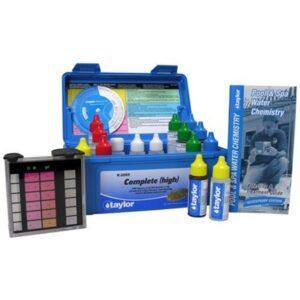
Pool Chemistry Test Kit

Breaking Your Chlorine Lock

While there are many ways to solve this issue, we will only be covering a few of them. Please select the option you are most comfortable with.

Partially Draining Your Pool

One of the simplest methods to breaking chlorine demand is by partially draining your pool. The severity of the chlorine lock determines how long this method takes. Unfortunately, there’s no exact science to this. Simply drain your pool little by little, refill it, test it, and repeat if necessary.

Shock Your Pool

Another method of breaking chlorine lock is shocking your pool. Bring your chlorine levels to 20ppm or three times higher than the current levels. We recommend using a non-chlorine oxidizing shock until your free and total chlorine reads the same.

We typically see more pools with a high demand for chlorine during the spring opening season. A lot of the times, pools sit for months, accumulating a ton of different contaminants. This is one of the reasons we always recommend balancing your pool before you close it. You don’t want to compile pool issues or push them to the side. Although high chlorine demand is more common than you might suspect, it is something pool owners can handle themselves.

Give us a call if you think your pool is experiencing this same issue. Make sure you have your most recent chemical readings before we can offer any help.

author avatar
Charlie Ramirez
Writer at InyoPools.com, brings a wealth of knowledge and expertise in pool care and equipment, helping pool owners make informed decisions for over a decade.

Related Videos

167 responses to “Why Your Pool Has No Chlorine: Common Causes & Easy Fixes”

  1. Kara Avatar

    All my pool chemicals are balanced. I shock the pool and my free and total chlorine appear on my reading to be the same. After a few hours my pool reads 0 for both chlorine levels. What do I do?

    1. Matthew Simmons Avatar

      Shock can dissipate quickly depending on the state of the water and time of day. Chlorine can get burned off on hot sunny days. The most common type of shock Cal-hypo should generally only be used in the evening for maximum effect. If you are using the shock in the evening and it is still getting gobbled up then you need to shock it again. The chlorine is disappearing because it is being used to fight something in the water. You may also have some organic material using the chlorine, so a product like Pool First Aid

  2. Hannah Avatar

    I just barely finished filling up our above ground pool. 18Ă—20 and I already added 3 gallons of chlorine and still get no reading of it added. Help!

  3. Cristiano Avatar

    Free chlorine does not go up! I’ve been struggling with my pool this year. We open the pool about 45 days ago (15,000 gallons), and added about 20 gallons of liquid chlorine and about 15 pounds of granular chlorine (super shock), but there is basically no free chlorine in the pool. PH, alkalinity, and CYA are within normal ranges. Last week, I treated for phosphates, but still no change in free chlorine. I’ve also replaced about 1/3 of the water in the pool. I have an in-ground pool with an automatic cover, so the pool stays covered for most of the day. Any help will be appreciated. I replaced the filters this year, before opening the pool.

  4. Jayme Avatar

    I have a 24,000 gallon pool. I was out of town on work and it ran out of chlorine in the chlorinator. Shocked the pool and it it now clear as can be. Turned chlorinator all the way up but I am still getting no free chlorine in my test strips. Pool store ran my water. FAC .3 TAC .7 CC .4 PH 7.3 Hard 160 ALK 79 CYA 34 Copper .2 Iron .1. they told me to add 3 gallons liquid chlorine. After doing this my test strips still show no FAC . Any advice. Thanks

  5. Ashley S Avatar

    I shocked my pool with a gallon of liquid shock waited 24 hours tested the water, no chlorine. Added 2 chlorine tablets into the floater tested the next day with a strip, no chlorine. My alkalinity is low, but the ph is okay. My free chlorine matches my total chlorine and that’s zero. My pool is crystal clear, what should I do ?

    1. Matthew Simmons Avatar

      I would get my water tested by a local pool store. Those test strips can get fouled easily, making their readings worthless. Get the water tested to verify the strips are correct. You may end just needing to buy a new set of test strips.

      1. Ashley S Avatar

        I have 2 different brand strips and a test kit with the drops.. all reading the same, no chlorine.. should I shock it again?

        1. SMC Avatar

          I have the same problem. Above ground pool. Opened and shocked it. Ran the sand filter for about 25 hours over 2 days. Water cleaned up but was cloudy. Added more fresh water. Tested and saw no chlorine registered. Shocked it again. Water cleared. Tested 3 hours after shocking and all levels tested well. The next morning water is completely clear but still no chlorine. Have backward filter several times. Should I try a oxidizer shock without the chlorine?

          1. Matthew Simmons Avatar

            Chlorine is not registering the next day because you are adding unstabilized pool shock which dissipates quiclky. In order to maintain a chlorine level, you need to use trichlor, dichlor, or stabilized liquid chlorine. You also need to make sure that your other water water chemistry is blanaced, like the pH, Alkalinity, and CYA.

  6. Mindy Avatar

    I have a 10,000 gallon above ground pool with a sand filter. I can’t get chlorine to register and I’ve put in 6 gallons in the last 2 weeks. We’ve had really bad rain the last few weeks so I drained out as much as we could and added fresh water yesterday. I have been brushing and vacuuming for a week and the water is now blue and very lightly cloudy. My pump for the last week has been running 12-15 hours a day especially at night when we put in whatever chemicals that were needed.

    My test strip readings from this morning :
    – No Chlorine
    – PH: 7.2
    – Alkalinity: 180-240
    – Hardness: 100
    – CYA: 40

    I’m not which of these I need to raise/lower first before I will start to get a chlorine reading.

  7. JET Avatar

    Have a 1,338 gallon in ground plaster pool. Every time I add chlorine it’s gone within a few hours. Last water test results:
    FAC – 0
    TAC – 0
    CH – 200
    CYA – 150
    TA – 80
    pH – 7.4

  8. Debbie Avatar

    Hi, I have an above ground pool 24ft. I too cannot get any thing on the rear strip. Took a sample to one pool store, they said to drain the pool 6inches below the skimmer and fill back up and repeat this process 5 times. Another pool dealer sold me a kit, we had to put a gallon of chlorine in the pool and then put this powder in the pool and then mix this other stuff with 5 gallons of warm water and let it sit for 4 hours then our into skimmer and run for 4 hours. They said we had too much conditioner in the pool. I haven’t even added conditioner in the pool this year yet. Do you know what our problem might be.? We also have a big dark spot on the liner on the bottom of the pool. Please help.

    1. Matthew Simmons Avatar

      First, we would need to know the results of your latest pool chemistry test.

  9. Martha Avatar

    Help it has been over a week of opening inground 17K gallon pool. Pool Store said we have chlorine lock. Per store recommendation we have added 27 bags of Bioguard Burnout and still no reading on Chlorine. Prior to the 27 bags of burnout we drained down the pool about 3 feet and added fresh water. The numbers from the test saying we had chlorine block were:
    PH 8.2 Free Chlorine 0.5 Total Alkanlinity 289 Total Chlorine 8 CYA 38 TSA 300 and Optimizer Plus 28
    Hardness 96 Also said Combined Chlorine 7.5
    We have a DE fliter and have backwashed numerous times at 20lbs torn apart the filter washed down the fins and started all over again. 2 times a day and still no luck. Thoughts, suggestions, please help. Thanks.

    1. Matthew Simmons Avatar

      All your water levels are out of whack, I would have drained more of the pool and started fresh. How to Break Chlorine Lock

  10. Janet Avatar

    Also, forgot to mention it is a 30,000 gal pool

Leave a Reply

Your email address will not be published. Required fields are marked *