

[social_warfare buttons=”Facebook, Twitter”] Whether it is cloudy judgments, cloudy weather, or cloudy pools, ‘cloudy’ isn’t a word that is typically used in a positive manner. So when it comes to a cloudy pool, you want to address the issue ASAP. Failure to address your cloudy water in a timely manner can hurt your pockets and your patience.
When we come across pool owners with cloudy pools, they always want to know three things: Why is my pool cloudy? How do I get rid of my cloudy pool? How can I prevent this from happening again? These three questions present the perfect thought process for clearing up a cloudy pool. Before you can fix the cloudiness, you need to determine what caused your water to become cloudy in the first place. Once you figure out the root to the issue, then you can take action to remedy it. Finally, you have to educate yourself in preventative measures to ensure your pool remains healthy.
Depending on the severity of the cloudiness, returning your pool back to its healthy state can take a couple of days to a few weeks. Let’s figure out the root to your cloudiness.
How Cloudy Is Cloudy?
Before you can treat your pool, you first have to determine why your pool is cloudy. But, how cloudy is cloudy? There are different levels of cloudiness and most often the cause determines the appropriate treatment. Let’s discuss the degrees of cloudiness.
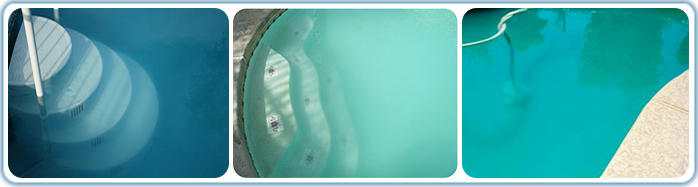
Flat/Dull: The water may be blue, but it doesn’t sparkle. It doesn’t have the shine.
Hazy: The pool water isn’t clear anymore. You can still see the bottom of the pool but not distinctly.
Cloudy: The water has a milky quality. You can see the bottom of your pool towards the shallow end, but you can’t see it towards the deep end.
Opaque: The pool water has become so milky that you cannot see the bottom at all.
Pool Filtration
A lack of proper pool filtration can cause your pool to become cloudy. Ask yourself, are you running your filter long enough? Is your filter clean? Have you backwashed or cleaned it recently? Let’s dig a little further.
Are You Running Your Pool Filter Long Enough?
When we ask how long you are running your filter, what we really mean is, how long do you have your pump running for? It isn’t necessary for you to run your pump 24/7 , assuming you have your pump/filter sized correct, of course. Still, you have to run your pump and filter long enough to at least filter your entire pool once. This normally takes 8 to 10 hours. Proper circulation is key to keeping your pool clear.
In your filter’s manual, the manufacturer provides turn over rates. The turnover rate is the number of gallons a particular filter will clean within a certain time. If you cannot locate the model number of your filter or your turnover rate, let us know and we can assist.
For example. let’s take a look at the Pentair Clean & Clear Plus filter specs.

For the Clean & Clear Plus filter, Pentair provides the model number and its respective flow rate, filter area, and turnover capacity rate. From the chart, you can see that both the CCP420 and the CCP520 turns over 72,000 gallons in 8 hours. Let’s say your pool is roughly 75,000 gallons. Running your filter for 8 hours a day will not properly filter your entire pool. Over time, this can cause your water to become cloudy or even worse. To avoid this from happening, you would have to run your filter for about 9 to 10 hours.
Are you running your pump/filter long enough?
Have You Cleaned Your Filter Recently?
A pool filter is a rather passive piece of equipment. There are no electrical components or moving parts on the filter, unless you include valve handles. The filter is mainly a tank that water flows through. But there is still a complex swirl of activity going on in there, and part of that is pressure. Find the pressure gauge on your filter system to get a reading of your pressure.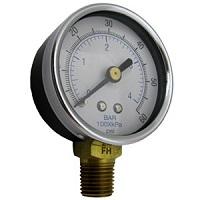
The rule of thumb is that a reading 10 psi over normal on your pressure gauge indicates it is time to clean your filter. A dirty filter will cause your reading to spike . In most cases, the pump is still doing its job, but the dirty filter media is slowing down the return of water to the pool causing your pool to become cloudy.
If you backwashed your D.E. filter, we recommend you check the grids and manifold for cracks. Also, check the O-rings for leaks. A broken part within your filter can allow D.E. powder to enter your pool. This, combined with the lack of filtration, can cause your pool to become cloudy.
Cartridge filters should be replaced every one to two years. If you notice the bands have broken, or the pressure does not go down after cleaning the cartridges, it may be time to replace them.
If you are running your pump/filter long enough to filter your pool properly and your filter is clean and in good condition, then your filter is probably not the cause of your cloudy pool. Still, you want to make sure you continue to check your filter on a regular basis.
Chemical Imbalance
One of the basic foundations of maintaining a clear swimming pool is to ensure your water is properly balanced. A lack of chlorine or an overbearing amount of pH or alkalinity is a sure way to offset the balance and cause your pool to become cloudy. When was the last time you checked your chemical levels? If you haven’t checked your chemicals within the last 24 hours, we recommend you do so. If you do not have a home testing kit, you can take a water sample up to your local pool store, like Leslie’s, and they can test your water for you.
Do You Have Enough Chlorine In Your Pool?
Once you have your water tested, make sure to pay close attention to your chlorine levels. The lack of chlorine is one of the leading causes for a cloudy pool. We use chlorine to sanitize the water from bacteria and other contaminants. Without chlorine, your water isn’t being sanitized and as a result, the contaminants in the water build-up and causes your water to become cloudy.
When your levels of free chlorine diminish, it forms into combined chlorine, or, chlorine that no longer has disinfecting power. If your combined chlorine surpasses the amount of free chlorine in your pool, then really, you’re not adequately disinfecting your pool and you will need to shock your pool. In fact, if your levels of combined chlorine remain higher for long periods of time, a cloudy pool might be the least of your worries. For shocking your pool, we recommend using the SLAM method.
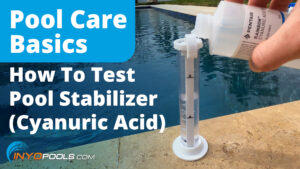
Make sure to check out our other blog post to get a deeper understanding of chlorine and it’s relationship with cyanuric acid.
Did You Recently Shock Your Pool?
If you recently shocked your pool and now it’s cloudy, don’t worry, they’re definitely related. However, how they’re related depends a lot on your pool. In most cases, a cloudy pool after shocking is only temporary and should clear up within 24 hours. Keep filtering your pool, add a little clarifier to help, and your pool should be clear in no time.
If after 24 hours your pool is not clear, then you may need to look a little deeper for the solution.
How High Are Your Calcium Hardness Levels?
Do you live in an area known for having ‘hard’ water? You may not be aware, but depending upon where you reside, your water may already come with a higher than average mineral content. If you live in one of these areas, you may want to avoid using calcium hypochlorite pool shock, which includes most basic brands of shock. Cal- Hypo contains high concentrations of calcium and binders that do not readily dissolve. Shocking your pool with Cal- Hypo can cloud your water in a pool with high levels of calcium hardness.
The recommended range for residential swimming pools is 180-220 ppm.
Environmental Factors
Did you know that a pool can get cloudy simply from environmental factors? Yup, not only are you responsible for the things you put into your pool, you’re responsible for the things Mother Nature puts in, as well.
Dust, Pollen, Leaves, etc.: Sometimes, these particles are invisible to the eye, making it too small for your system to filter out. Over time, if untreated, your pool will turn cloudy.
Insects, Animals, etc.: Regardless of which state you live in, you are bound to see insects, small animals, and other creatures in your pool. Bird droppings and other nasties produce chloramines just as human waste does and can cause your water to cloud up.
Run-off Water: During a storm, nitrates, phosphates, and other miscellaneous chemicals end up in your pool.
Treating Your Cloudy Pool
Hopefully, you’ve determined why your pool is cloudy and you’re ready for treatment. I know you have heard somewhere that there are three ways to treat a cloudy pool: clarifiers, flocculants (floc), or enzymes. But, what are the differences and which treatment is best for your pool?
How Do Clarifiers and Flocculants Work?
Let’s not forget what is happening in your water while it’s cloudy. The particles in your water are very tiny and they repel each other because of their negativity. But, when they are so small, it becomes very difficult to remove them. The way that clarifiers and flocs work is that they neutralize the electric charges so that the particles can bond with each other to become larger. Once they bond, they grow in size and weight and are easy to filter or vacuum. Still, that doesn’t answer which one should you use on your pool.
 Clarifiers: A clarifier is a polymer-based product that is used to coagulate (thicken) tiny particles and oils that form in your pool water. Make sure to check your water levels and adjust if necessary. When using a swimming pool clarifier, always follow the instructions on the bottle. Adding too much clarifier can make your pool cloudier. Also, don’t forget to keep your filter running for at least 24 hours.
Works Best With Sand, Cartridge, and D.E. filters

Flocculants: Flocculants are used to sink tiny particles to the bottom of your pool, allowing them to be easily vacuumed up. Once your pool water is level, you can add flocculant to your pool. Make sure to turn your filter off for about 8 to 12 hours and do not disturb the pool during this time. Afterward, slowly vacuum your pool to waste using a manual vacuum. You cannot use an automatic cleaner for this job. If your pool clouds up during this process, take a small break to allow the particles to settle again. Once your pool is clear, backwash and rinse your filter thoroughly.
Works Best With Sand and D.E. filters
When to Use a Clarifier or a Flocculant
The major difference between a clarifier and a flocculant is time. If you want, or need, your pool clear pretty quickly, we recommend using a flocculant.
Although clarifiers take more time, they also require a lot less work on your part. You also save money on replenishing chemicals because you don’t have to vacuum your pool to waste.
 What Are Enzymes?
An excellent option to eliminate the organic material causing cloudiness in your pool is enzymes. Instead of using harsh chemicals that can be unsafe to store and handle, you can use natural enzymes to do the same thing. By adding enzymes to your pool maintenance, it eats away the dirt and oils that usually accumulate at the water line.
How Do I Prevent My Water From Getting Cloudy Again?
What’s the point of us telling you how to rid your cloudiness if we don’t tell you how to keep it away? It only takes a pool owner once to have a cloudy pool before knowing they never want to encounter it again.
Routinely check your water chemistry. We recommend to most new pool owners to check their water chemistry daily. If you’re always on top of your chlorine, pH, cyanuric acid, and total alkalinity, you’re less likely to have issues with cloudiness again. This will also prevent an algal growth.
Regularly clean your pool filter. Make sure you backwash your sand and D.E. filter regularly. Additionally, not charging enough D.E. powder to your grids can cause cloudy water. Always use the product manual for measurements. If you have a cartridge filter, make sure to inspect all of your cartridges for cracks or damages. Don’t forget to routinely check all O-rings and gaskets for leaks, as well.
Finally, make sure your pump and filter are sized properly and you are running them long enough. An undersized or an underutilized pump and filter are recipes for disaster.








Leave a Reply