Home / Articles / What’s the Best Variable Speed Pool Pump Schedule?

What’s the Best Variable Speed Pool Pump Schedule?

What is the Best Variable Speed Pool Pump Schedule?

For the most part, pool owners understand the concept of variable speed pumps. However, when it comes to the best variable speed pool pump schedule, pool owners are somewhat in the dark. We want to change that.

In this blog article, we provide tips on how to set up your variable speed pool pump to achieve the greatest performance and energy savings. Overall, we want pool owners to feel comfortable purchasing a new pool pump knowing they are capitalizing on the most savings.

How To Save Money Using A Variable Speed Pump

If you are a pool owner and looking to save money on your energy bill, a variable speed pump is the way to go. A variable speed pump allows you to lower the motor’s RPMs to the minimum speed needed to turn the water over or to maintain your pool equipment. Using a modified variable speed pool pump schedule can cut associated energy costs up to 90%. When you run the pump at lower speeds, that means you’re using less kW, or energy, from your power company. This translates to a lower energy bill.

Once you have a variable speed pump on your pool, the goal is to find the lowest RPMs at which you can run the pump yet sustain a clean pool.

Did you know you can upgrade your old single-speed pool pump into a variable speed using a VS conversion kit? Well, now you know; find your upgrade kit using our VS kit compatibility guides: Pentair, Hayward, and Jandy.

Peak Hours Vs. Off-peak Hours

What is the Best Variable Speed Pool Pump Schedule?

Did you know that there are times of the day when electricity is cheaper? Throughout the day, the demand for electricity fluctuates. As a result, so does the price. The cost of generating electricity is highest during peak hours.

Depending on where you live and the power company, peaks hours may change. However, for the most part, peak hours usually fall between 9 am and 9 pm. In order to confirm the peak hours in your area, we recommend calling your power company.

Sometimes, local electric companies have a special program that offers special pricing. The program usually offers discounted rates during off-peak hours, like nights and weekends. However, in many cases, customers have to inquire about the program as they do not offer it as a standard alternative.

Running your pool equipment during off-peak hours can dramatically affect your overall bill. In a good way, too. This applies to your home appliances, as well.

Tip: If possible, operate your pump during your local designated off-peak hours. This is sound advice for a pump of any speed and regular household appliances. Off-peak hours will vary slightly. 

When To Run A Pump On Low And High Speeds

In terms of the best variable speed pool pump schedule, pool owners specifically want to know how long to run their pump at high and low speeds. Unfortunately, every pool is different, making it tricky to provide a template-style formula that fits every pool scenario. However, through trial and error, you can program your variable speed to operate at its highest efficiency for your pool.

The Best Variable Speed Pool Pump Schedule

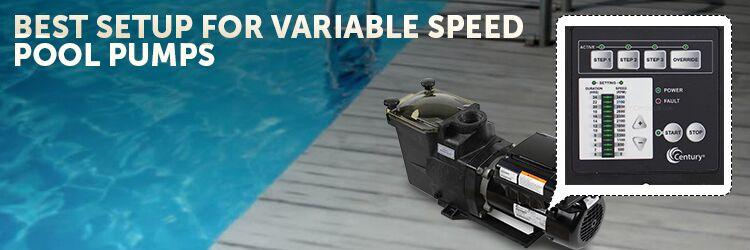
For the first few weeks of owning a variable speed pump, you might be playing with the settings until you find the correct balance between RPM’s and the length of time. First, we do not recommend running your variable speed pump at 3450 RPMs for 24 hours a day. It’s unnecessary, and frankly, it defeats the entire purpose of a variable speed pump. The idea is to try and run your variable speed pump at the lowest RPMs as possible while still filtering your pool water properly. If you are running your pool pump to filter and turn your water over, we recommend using the middle and lower speed settings.

For example, for the first few days, you might run the pump at 2500 RPMs to see what your pool looks like. Next, you might dial it down to 1600 RPMs. If after a few days your pool starts to look cloudy or hazy, you can set the pump to run at 2000 RPMs. Every variable speed pool pump schedule is different. This makes trial and error the easiest way to find your pump’s sweet spot.

Tip: Don’t be afraid to tinker with the RPM settings until you find your pool’s sweet spot. Also, familiarize yourself with your pool equipment and the minimum GPM each unit mandates for operation. 

On the other hand, pool owners use the high-speed settings when the pool needs more flow. This can include when you’re cleaning your pool, operating a salt chlorine generator, or using any water features like jets, in floor cleaners, or waterfalls. It’s important to pay attention to the minimum flow rates required for these items. In many instances, pool owners think their variable speed pump is not strong enough. However, in reality, they’re running their variable speed pump below the minimum RPMs.

Example of Variable Speed Settings

Example 1:

Generally, I run my equipment at 1700 RPMs for 10 hours. I run this with the saltwater generator set at 50% for 10 hours. In my case, 1700 RPM’s is the minimum I can do to reliably activate the saltwater generator and filter the pool. Also, there’s a cleaning mode (on a feature) set to 2500 RPMs. Typically, I run that in conjunction with the filter mode for 2 hours a day to get the crud off the water and into the skimmer. I also have a high speed set to 3100 RPMs that I use when I add chemicals or after the family uses the pool. I only use it when necessary and turn it on manually when needed.

Example 2:

During the off-season, we aim to turn the water over once.

7 – 8 a.m. Low speed (to startup)

8 – 10 a.m. High speed (to sweep and skim)

10 a.m. – 12 p.m. Low speed (to filter)

5 – 8 p.m. Medium speed (to enjoy)

8 p.m – 7 a.m. Off

Example 3:

4 – 4:30 a.m. High speed (3450 RPMs to ensure the pump sufficiently primes- non-peak hours)

4:30 – 12 p.m.  Mid speed (2200 RPMs- non-peak hours)

12 p.m. – 6 p.m. Low speed (1800 RPMS- peak hours)

The total run time is 14 hours. I run my pump this long because I live in Florida and it is consistently hot. In colder states, you probably wouldn’t have to run the pump as long.

General Guidelines

In most scenarios, pool owners establish specific time frames to operate their pump at high speed to correlate with any functions that require more flow. If possible, the time frames correlate to your areas off-peak times. Once you complete those tasks, you can lower the speed settings. Variable speeds take advantage of the pump affinity law. In short, it means that you can run your pump half as fast, twice as long and filter the same amount of water for a fraction of the price. If you cut your RPM’s in half, from 3450 to 1725, you actually get about 75% energy savings. (Spoiler Alert: I am not an engineer! The concept is much more complex.)

When it comes to the best set up for variable speed pool pumps, it depends on the pool and pool equipment. At the end of the day, if you’re consciously spending more money on a variable speed pump, you should reap the long-term benefits. With our general rules, guidelines, and tips, you will. Having a better idea of how to utilize the high and low speeds guarantees you more savings.

If you have questions about your variable speed pump, give us a call. We’re here to help you enjoy your pool and save you money at the same time.

author avatar
Charlie Ramirez
Writer at InyoPools.com, brings a wealth of knowledge and expertise in pool care and equipment, helping pool owners make informed decisions for over a decade.

Related Videos

99 responses to “What’s the Best Variable Speed Pool Pump Schedule?”

  1. Keith Ledig Avatar

    What do you recommend a 10k gallon screened in pool with skimmer and cleaning bot? I was thinking 12 hrs a day 900 rpm and 2 hrs in the middle for the bot to operate efficiently as lower speeds don’t give the bot the adequate suction. Also have a salt system. I’m looking to balance efficiently with effectiveness. Is 2 hrs sufficient for the bot and skimmer to do it’s job? Also curious what speeds and time at speed others run for salt conversation to chlorine?

  2. Gonzalo Avatar

    When going from high speed to low speed or the other way around on a schedule. Is it better to have the pump off for a few minutes before changing the speed? For example from 12pm -2pm I run the pump on high starting at 2pm the schedule changes to low. Would it be better to start the low speed schedule at 2:05pm and have it off for 5 minutes. Thanks for all your help

  3. RSW Jeff Avatar

    I’m new to pool care so I’m busy learning. I have an 18000 gallon pool in southern Florida with a hot tub that flows down to the pool. The pool guy set the variable speed pump at 3200 24/7. My questions:
    1. Can I connect a robotic cleaner to the only skimmer and leave it? (I leave the house for weeks at time.)
    2. Is my #1 concern turning the water over at least once a day?

    Any help and additional advice is greatly appreciated.

    1. Matthew Simmons Avatar

      Suction cleaners require a certain flow rate for them to operate correctly. So, during those times your cleaner should be working, I would set the VS to a speed that allows it to do so.

      Your pump only being set to 3200 RPM completely negates having a variable speed motor, as we cover in this guide. You should take the time to figure out the RPM necessary to keep your pool clean, while also keep energy usage down.

      The water should be turned over at least once to keep the pool properly chlorinated/sanitized.

  4. 1st American Pools Avatar

    Size of pool, bather load and type, temperature and type of pump all effect filtration cycle.
    Generally,
    Filtration 1000 RPM without SWG for X number of hours per day (.25-2 turnovers a day). Example: San Diego in August, 20K gallon, high head pump, would go for 10-12 hours at 1000
    SWG then set a second speed schedule so it kicks up till flow light goes out and run at 100%
    Auto cleaner, 2200 for 30 minutes. Observe cleaner and skimmer for action. Adjust accordingly.

  5. Douglas Avatar

    I love in Florida, have a pool cage so not a lot of debris. I have a Hayward suction auto pool cleaner attached. I have a Hayward variable speed pump and currently run it for about 5 hours during the day at 3000 rpms. The suction/ skimmer valve is about 90% suction to get the correct wheel RPM on the cleaner. This is about a 12000 gal pool. I would like to be able to run the pump at different times and speeds but at lower speeds the cleaner will not operate. Any suggestions?

    1. Matthew Simmons Avatar

      If you want to run the pump at lower speeds then you would need to remove the cleaner from the suction line. The cleaner does not need to be connected all the time for a pool to work and clean itself properly. Use the cleaner when there is enough debris to warrant it.

    2. Kyle Avatar

      Get a VacMate and you can run a high RPM cleaning cycle plus the low RPM cycles as you would like.

    3. iliadz Avatar

      Douglas, I purchased a robotic cleaner and I love it. 12,000 gallon pool, and I’m in Florida as well, with a cage. The robotic cleaner does a really nice job, and there are no hoses to keep connected etc. and runs off your electricity. They claim it’s cheaper than running the cleaner by a pool pump. Dolphin nautilis was the one I chose but there are several on the market.

    4. Jon Avatar

      I, also, leave my pool cleaner attached at all times, except for shocking. But it still works with my pump at 1600rpm and the diverter between the suction line and the skimmer about at the 50% mark.

      I do have the pump kick up to 2200 for 90 minutes starting at 1am for a more thorough cleaning.

      Pool: ~18,000 gallons
      Pump: Pentair Intelliflo 3hp
      Cleaner: “The Poolcleaner”

      So maybe you need to look for a more efficient pool cleaner. Look for one marketed to work with low flow.

  6. BRIAN Avatar

    Variable speed pump love it, on 1700 minimum unless using vac or for a quick boost.
    Anyone have magic stream pentair fountains? If the pump shuts off the fountains keep running and overflow from the base I woke up and the pool was half empty. Cant set up Pentair to automatically shut off fountains before turning off the pump? Unless of course I have them set on the timer, but if I turn them on and forget they don’t shut off when the pump shuts off?? Makes no sense.

    1. Jim C. Avatar

      I agree, Brian. My installers for the Jandy 1.85 hp VS pump with a wireless controller and iAqualink phone app didn’t quite understand why you need a “cut-off” switch before connecting power to the auxiliary relays onboard the pump. In my case, I run usually hours a day at 1700. If I want to automatically start up my Polaris booster pump, I only need to bring the speed up to 1725 and “auxiliary 1″ will fire up the booster pump.” I can turn if off from the iAqualink app in the same way, bringing down the speed to BELOW 1725. But this morning, after heavy rains, I want to backwash the filter at a higher speed…I have to disconnect the Polaris cleaner, manually set the filter function to backwash and then run TWO PUMP motors…the main and the booster! No sense at all. I’m asking a qualified electrician to wire in a cutoff switch that will allow me to run at any speed without having to needlessly power that extra Polaris booster pump.

    2.  Avatar

      Yes

  7. Mike Avatar

    I think this article is great and want to thank the Author for putting it together, I have two Pumps on my System, and has they stated my SWG seems to need about 1800 rpm, to activate, Also the pool builder put my skimmers and my popups on the same pump.
    I need the popups to run for a few hours to push the Dirt down to the main drain but then want my skimmers running the rest of the day at a lower speed, so this article gave me some great jumping off places for adjusting the RPMS, to get constant flow, during my off peak.

    1. Scott Parker Avatar

      Hi! Just upgraded from a 1.5hp single speed to a 2.7hp Jandy VSFlopro. I only got the 2.7 since it was a $300 sweetheart deal. I am struggling a bit because it seems like I should run at ~1/2 of the max RPM (i.e., 1,750 of 3,425) to equate to my old 1.5hp (which moved the water fine). Is this faulty logic?

      My schedule has been 3 hours at 750, 2 hours at 1,750 (clean), and 3 hours at 750. ~15k gallons with 2 skimmers and a small waterfall.

    2. Nikki O. Avatar

      I thought it was very helpful too. We have the Energy Select Program from Gulf Power here in Panama City Beach, FL. It costs twice as much to run the pump during high time. I have the pool pump running low from 6pm-3am (medium time is from 6p-11pm), then crank it to 3200 from 3am-5am (low time is 11pm-6am). I wanted to do some research to make sure I was running it enough. Think I’m going to run it a bit longer in the am’s. This article was so helpful. These people in this thread are ridiculous.. if it’s not helpful to you, then keep it moving. Geez.

  8. doug Avatar

    I call BS! Few of us run our pumps at 3 and 4 different speeds during the day…We find one speed to cover our needs and leave it. You have water features you need x amount of rpm. Unless you retired and bored and you make this a hobby then maybe you have your pump set to play music for you but not here

    1.  Avatar

      Doug, you can set these schedules to automatically run. You don’t have to change the speeds manually everyday. That would be ridiculous.

      1. John gloria Avatar

        I have a vsp and I was wondering what should I run my rpm for my cleaner, water future and pump filter at? And how do I set a high speed for chemicals and after family like you I only have 3 aux slots on my z4

    2. Navi Avatar

      Uh, variable speed pumps are programmable and you can do manual changes as necessary.

    3. Gary Avatar

      The article doesn’t tell you to run your pump at 3 or 4 different speeds during the day (though I do like the idea of general filtering at low speed topped off with a couple of hours of higher speed to help skim the surface better). The concept is to program different pump control buttons at different speeds for different purposes. On my pump, I can set up 4 different functions on 4 buttons: 1. standard low-speed cleaning 2. higher speed cleaning 3. A program I’m going to use for when I add chemicals 4. A program for when I run my robot cleaner.

      And that’s just my setup. You can set up the programs/buttons however you please.

      1. Kerrie Avatar

        Hi Gary, what program do you use when you run your robot cleaner?

        Thanks!

      2. John gloria Avatar

        Do you have a vsp

    4. Mike Avatar

      I disagree the amount of money it cost to run my pumps during peak hours is enough to make me want to adjust the schedule.

    5. Steve Kavanaugh Avatar

      Doug I have 4 different settings a day on my multi-speed speed pump. The speed changes are pre/programmed. The 4 speed pump saves over $75 a month VS running a single speed at 3400 Rpm. My minimum speed is 1000RPM and max is 3250RPM (for cleanup – never has needed to use). The pool cleaner runs at 2600RPM for 6 hours automatically. Then 1500RPM for 8 hours. Then 1000RPM the 10 hours balance.
      My pump runs 24/7 year round. My water stays crystal clear. I have had a salt pool with a variable speed pump for over 8 years.

    6. Jim C. Avatar

      A year later, and a couple weeks into my Variable Speed experience, this post stands out. One speed is pretty much all we need. Then, manually (or via phone app, in my case) we can increase speed to improve surface skimming and pool cleaning.

      I’m retired and, yes, I like to play with the app that runs the pump…but a lot of this seems to be “boys with toys.” But that’s just me! 😉

  9. Patrick Avatar

    Hi-

    All things being equal, is it better to run the pump 24/7 at a speed that will turn the pool over the desired number of times per day, or run the pump at a higher speed to turn it over the same number of times and then have it shut off for a few hours (both from an economic as well as a filtration standpoint)? I’ve had mine in for about three weeks now, and been running it 24/7. I put a flow meter in so I could set it to the desired GPM, with a couple hours at a higher speed, a few hours at a pretty low speed, and 16 hours at a rate that will turn the pool over once. I do have to bump it up a bit if I want to run the heater, but I do that manually as needed.

    As far as filtration goes, the water looks good with the current schedule (though the pump basket doesn’t look “full” when it’s running on low speed – doesn’t seem to be sucking air, so I assume that’s OK).

    Thanks,
    Patrick

  10. Brett Avatar

    What RPM would you suggest for my Pentair Superflo 1.5 HP 115/208-230v pump attached to my 8,000 gallon pool?

    I currently run it at night from midnight to 6 a.m. , yet at 3100 RPM, which I’m sure is extraneous.

    Could you advise me on a more apt flow rate/RPM for my Pentair 1.5 HP VSP?

    Thank you! :)) – Brett

    1. Matthew Simmons Avatar

      Brett, that is basically what the entire article was covering.

      1. Ken Avatar

        I did not find the article particularly helpful.

        We have a Pentair Intelliflo for several years and it is beside an ocean beach in Southern Mexico so warm all year round.

        Winters we may turn it off at night in hopes of keeping the water a bit warmer. Summers we run it on slowest speed as that seems to clean it well enough and run 24 hours a day actually trying to cool the water.

        If pool has a higher load of bathers we do run it at a 2nd set speed.

        3rd higher spped, During daily vacuuming we run it at a speed that vacuums well but does not stick the vacuum to the pool bottom due to excess suction and speed.

        Full speed only used for backflushing the filter. However as lines are 2″ and I read 2″ Max out at about 80 gallons per minute why is pump stated as 140 gallons per minute as the pump connections are 2″ ?

        Given this is the case it seems somewhere about 2500 watts might be the limit or perhaps the maximum capable as per a flow meter which we do not have in place?

        1. Matthew Simmons Avatar

          I’m a little confused, where did wattage come into play in your comment? It just kind of popped up at the end, mentioned with a flowmeter.

          Secondly, your pool sounds great but not everybody lives on the southern coast of Mexico, on the ocean. Different climates make for differing filter demands. That’s why I have repeatedly laid out below the “test and see” method when someone asks how to set up their variable speed schedule.

          Also, 80 GPM is the maximum recommended flow rate, not the absolute max for 2″ PVC. For pool purposes, you want to keep the flow rate lower to reduce strain on the system.

Leave a Reply

Your email address will not be published. Required fields are marked *