
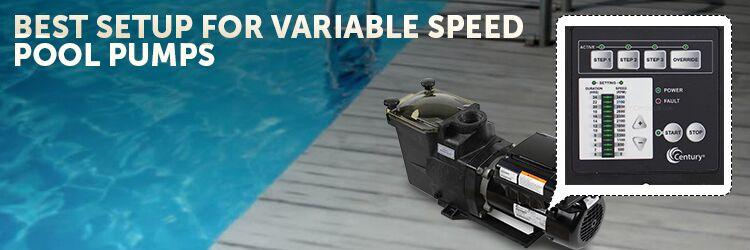
For the most part, pool owners understand the concept of variable speed pumps. However, when it comes to the best variable speed pool pump schedule, pool owners are somewhat in the dark. We want to change that.
In this blog article, we provide tips on how to set up your variable speed pool pump to achieve the greatest performance and energy savings. Overall, we want pool owners to feel comfortable purchasing a new pool pump knowing they are capitalizing on the most savings.
How To Save Money Using A Variable Speed Pump
If you are a pool owner and looking to save money on your energy bill, a variable speed pump is the way to go. A variable speed pump allows you to lower the motor’s RPMs to the minimum speed needed to turn the water over or to maintain your pool equipment. Using a modified variable speed pool pump schedule can cut associated energy costs up to 90%. When you run the pump at lower speeds, that means you’re using less kW, or energy, from your power company. This translates to a lower energy bill.
Once you have a variable speed pump on your pool, the goal is to find the lowest RPMs at which you can run the pump yet sustain a clean pool.
Did you know you can upgrade your old single-speed pool pump into a variable speed using a VS conversion kit? Well, now you know; find your upgrade kit using our VS kit compatibility guides: Pentair, Hayward, and Jandy.
Peak Hours Vs. Off-peak Hours

Did you know that there are times of the day when electricity is cheaper? Throughout the day, the demand for electricity fluctuates. As a result, so does the price. The cost of generating electricity is highest during peak hours.
Depending on where you live and the power company, peaks hours may change. However, for the most part, peak hours usually fall between 9 am and 9 pm. In order to confirm the peak hours in your area, we recommend calling your power company.
Sometimes, local electric companies have a special program that offers special pricing. The program usually offers discounted rates during off-peak hours, like nights and weekends. However, in many cases, customers have to inquire about the program as they do not offer it as a standard alternative.
Running your pool equipment during off-peak hours can dramatically affect your overall bill. In a good way, too. This applies to your home appliances, as well.
Tip: If possible, operate your pump during your local designated off-peak hours. This is sound advice for a pump of any speed and regular household appliances. Off-peak hours will vary slightly.
When To Run A Pump On Low And High Speeds
In terms of the best variable speed pool pump schedule, pool owners specifically want to know how long to run their pump at high and low speeds. Unfortunately, every pool is different, making it tricky to provide a template-style formula that fits every pool scenario. However, through trial and error, you can program your variable speed to operate at its highest efficiency for your pool.
The Best Variable Speed Pool Pump Schedule
For the first few weeks of owning a variable speed pump, you might be playing with the settings until you find the correct balance between RPM’s and the length of time. First, we do not recommend running your variable speed pump at 3450 RPMs for 24 hours a day. It’s unnecessary, and frankly, it defeats the entire purpose of a variable speed pump. The idea is to try and run your variable speed pump at the lowest RPMs as possible while still filtering your pool water properly. If you are running your pool pump to filter and turn your water over, we recommend using the middle and lower speed settings.
For example, for the first few days, you might run the pump at 2500 RPMs to see what your pool looks like. Next, you might dial it down to 1600 RPMs. If after a few days your pool starts to look cloudy or hazy, you can set the pump to run at 2000 RPMs. Every variable speed pool pump schedule is different. This makes trial and error the easiest way to find your pump’s sweet spot.
Tip: Don’t be afraid to tinker with the RPM settings until you find your pool’s sweet spot. Also, familiarize yourself with your pool equipment and the minimum GPM each unit mandates for operation.
On the other hand, pool owners use the high-speed settings when the pool needs more flow. This can include when you’re cleaning your pool, operating a salt chlorine generator, or using any water features like jets, in floor cleaners, or waterfalls. It’s important to pay attention to the minimum flow rates required for these items. In many instances, pool owners think their variable speed pump is not strong enough. However, in reality, they’re running their variable speed pump below the minimum RPMs.
Example of Variable Speed Settings
Example 1:
Generally, I run my equipment at 1700 RPMs for 10 hours. I run this with the saltwater generator set at 50% for 10 hours. In my case, 1700 RPM’s is the minimum I can do to reliably activate the saltwater generator and filter the pool. Also, there’s a cleaning mode (on a feature) set to 2500 RPMs. Typically, I run that in conjunction with the filter mode for 2 hours a day to get the crud off the water and into the skimmer. I also have a high speed set to 3100 RPMs that I use when I add chemicals or after the family uses the pool. I only use it when necessary and turn it on manually when needed.
Example 2:
During the off-season, we aim to turn the water over once.
7 – 8 a.m. Low speed (to startup)
8 – 10 a.m. High speed (to sweep and skim)
10 a.m. – 12 p.m. Low speed (to filter)
5 – 8 p.m. Medium speed (to enjoy)
8 p.m – 7 a.m. Off
Example 3:
4 – 4:30 a.m. High speed (3450 RPMs to ensure the pump sufficiently primes- non-peak hours)
4:30 – 12 p.m. Mid speed (2200 RPMs- non-peak hours)
12 p.m. – 6 p.m. Low speed (1800 RPMS- peak hours)
The total run time is 14 hours. I run my pump this long because I live in Florida and it is consistently hot. In colder states, you probably wouldn’t have to run the pump as long.
General Guidelines
In most scenarios, pool owners establish specific time frames to operate their pump at high speed to correlate with any functions that require more flow. If possible, the time frames correlate to your areas off-peak times. Once you complete those tasks, you can lower the speed settings. Variable speeds take advantage of the pump affinity law. In short, it means that you can run your pump half as fast, twice as long and filter the same amount of water for a fraction of the price. If you cut your RPM’s in half, from 3450 to 1725, you actually get about 75% energy savings. (Spoiler Alert: I am not an engineer! The concept is much more complex.)
When it comes to the best set up for variable speed pool pumps, it depends on the pool and pool equipment. At the end of the day, if you’re consciously spending more money on a variable speed pump, you should reap the long-term benefits. With our general rules, guidelines, and tips, you will. Having a better idea of how to utilize the high and low speeds guarantees you more savings.
If you have questions about your variable speed pump, give us a call. We’re here to help you enjoy your pool and save you money at the same time.






Leave a Reply