Home / Articles / What’s the Best Variable Speed Pool Pump Schedule?

What’s the Best Variable Speed Pool Pump Schedule?

What is the Best Variable Speed Pool Pump Schedule?

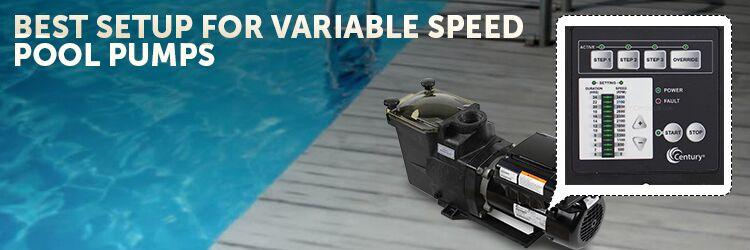
For the most part, pool owners understand the concept of variable speed pumps. However, when it comes to the best variable speed pool pump schedule, pool owners are somewhat in the dark. We want to change that.

In this blog article, we provide tips on how to set up your variable speed pool pump to achieve the greatest performance and energy savings. Overall, we want pool owners to feel comfortable purchasing a new pool pump knowing they are capitalizing on the most savings.

How To Save Money Using A Variable Speed Pump

If you are a pool owner and looking to save money on your energy bill, a variable speed pump is the way to go. A variable speed pump allows you to lower the motor’s RPMs to the minimum speed needed to turn the water over or to maintain your pool equipment. Using a modified variable speed pool pump schedule can cut associated energy costs up to 90%. When you run the pump at lower speeds, that means you’re using less kW, or energy, from your power company. This translates to a lower energy bill.

Once you have a variable speed pump on your pool, the goal is to find the lowest RPMs at which you can run the pump yet sustain a clean pool.

Did you know you can upgrade your old single-speed pool pump into a variable speed using a VS conversion kit? Well, now you know; find your upgrade kit using our VS kit compatibility guides: Pentair, Hayward, and Jandy.

Peak Hours Vs. Off-peak Hours

What is the Best Variable Speed Pool Pump Schedule?

Did you know that there are times of the day when electricity is cheaper? Throughout the day, the demand for electricity fluctuates. As a result, so does the price. The cost of generating electricity is highest during peak hours.

Depending on where you live and the power company, peaks hours may change. However, for the most part, peak hours usually fall between 9 am and 9 pm. In order to confirm the peak hours in your area, we recommend calling your power company.

Sometimes, local electric companies have a special program that offers special pricing. The program usually offers discounted rates during off-peak hours, like nights and weekends. However, in many cases, customers have to inquire about the program as they do not offer it as a standard alternative.

Running your pool equipment during off-peak hours can dramatically affect your overall bill. In a good way, too. This applies to your home appliances, as well.

Tip: If possible, operate your pump during your local designated off-peak hours. This is sound advice for a pump of any speed and regular household appliances. Off-peak hours will vary slightly. 

When To Run A Pump On Low And High Speeds

In terms of the best variable speed pool pump schedule, pool owners specifically want to know how long to run their pump at high and low speeds. Unfortunately, every pool is different, making it tricky to provide a template-style formula that fits every pool scenario. However, through trial and error, you can program your variable speed to operate at its highest efficiency for your pool.

The Best Variable Speed Pool Pump Schedule

For the first few weeks of owning a variable speed pump, you might be playing with the settings until you find the correct balance between RPM’s and the length of time. First, we do not recommend running your variable speed pump at 3450 RPMs for 24 hours a day. It’s unnecessary, and frankly, it defeats the entire purpose of a variable speed pump. The idea is to try and run your variable speed pump at the lowest RPMs as possible while still filtering your pool water properly. If you are running your pool pump to filter and turn your water over, we recommend using the middle and lower speed settings.

For example, for the first few days, you might run the pump at 2500 RPMs to see what your pool looks like. Next, you might dial it down to 1600 RPMs. If after a few days your pool starts to look cloudy or hazy, you can set the pump to run at 2000 RPMs. Every variable speed pool pump schedule is different. This makes trial and error the easiest way to find your pump’s sweet spot.

Tip: Don’t be afraid to tinker with the RPM settings until you find your pool’s sweet spot. Also, familiarize yourself with your pool equipment and the minimum GPM each unit mandates for operation. 

On the other hand, pool owners use the high-speed settings when the pool needs more flow. This can include when you’re cleaning your pool, operating a salt chlorine generator, or using any water features like jets, in floor cleaners, or waterfalls. It’s important to pay attention to the minimum flow rates required for these items. In many instances, pool owners think their variable speed pump is not strong enough. However, in reality, they’re running their variable speed pump below the minimum RPMs.

Example of Variable Speed Settings

Example 1:

Generally, I run my equipment at 1700 RPMs for 10 hours. I run this with the saltwater generator set at 50% for 10 hours. In my case, 1700 RPM’s is the minimum I can do to reliably activate the saltwater generator and filter the pool. Also, there’s a cleaning mode (on a feature) set to 2500 RPMs. Typically, I run that in conjunction with the filter mode for 2 hours a day to get the crud off the water and into the skimmer. I also have a high speed set to 3100 RPMs that I use when I add chemicals or after the family uses the pool. I only use it when necessary and turn it on manually when needed.

Example 2:

During the off-season, we aim to turn the water over once.

7 – 8 a.m. Low speed (to startup)

8 – 10 a.m. High speed (to sweep and skim)

10 a.m. – 12 p.m. Low speed (to filter)

5 – 8 p.m. Medium speed (to enjoy)

8 p.m – 7 a.m. Off

Example 3:

4 – 4:30 a.m. High speed (3450 RPMs to ensure the pump sufficiently primes- non-peak hours)

4:30 – 12 p.m.  Mid speed (2200 RPMs- non-peak hours)

12 p.m. – 6 p.m. Low speed (1800 RPMS- peak hours)

The total run time is 14 hours. I run my pump this long because I live in Florida and it is consistently hot. In colder states, you probably wouldn’t have to run the pump as long.

General Guidelines

In most scenarios, pool owners establish specific time frames to operate their pump at high speed to correlate with any functions that require more flow. If possible, the time frames correlate to your areas off-peak times. Once you complete those tasks, you can lower the speed settings. Variable speeds take advantage of the pump affinity law. In short, it means that you can run your pump half as fast, twice as long and filter the same amount of water for a fraction of the price. If you cut your RPM’s in half, from 3450 to 1725, you actually get about 75% energy savings. (Spoiler Alert: I am not an engineer! The concept is much more complex.)

When it comes to the best set up for variable speed pool pumps, it depends on the pool and pool equipment. At the end of the day, if you’re consciously spending more money on a variable speed pump, you should reap the long-term benefits. With our general rules, guidelines, and tips, you will. Having a better idea of how to utilize the high and low speeds guarantees you more savings.

If you have questions about your variable speed pump, give us a call. We’re here to help you enjoy your pool and save you money at the same time.

author avatar
Charlie Ramirez
Writer at InyoPools.com, brings a wealth of knowledge and expertise in pool care and equipment, helping pool owners make informed decisions for over a decade.

Related Videos

99 responses to “What’s the Best Variable Speed Pool Pump Schedule?”

  1. Ty Avatar

    I live in Washington state and have a 13000 gallon in ground pool. The previous pump just went out and I am looking to replace it. The inlet is 1 1/2″ from the pool and 1 1/2″ to the sand filter. Which pump would you recommend?

  2. Jurgen C. Avatar

    Does anyone have any advice? I’m all ears.

    1. Matthew Simmons Avatar

      Sure do. All we need is what your pool scenario is, and for you to narrow down what type of advice you need and we’ll let it rip.

      1. Jurgen C. Avatar

        What I’m really needing to know is if the RPM’s are good for the size of pool and the length of time I’m running each function. My family and I usually use the pool between 12:00pm and 5:30 most days. We enjoy a “good, clean pool”.
        Are these good speeds from your perspective?

        1. Matthew Simmons Avatar

          Sure, I could say yes but that would be a complete guess. My answer to the similar comments about overall scheduling still applies to this slimmed-down time period. There are pools in every state, which have varying climates, plantlife/fauna that could affect the chlorine demand. No one is going to be able to tell you “this is right, this is wrong” for your pool based solely on some numbers.

          In short: Run it, test it, adjust it (if necessary) – there is no way around it.

      2. Tom A Avatar

        I’d love some schedule/rpm advice: 40x30x17 “L” shaped with 9’ Deep end. About 28,000 gallons, 2” lines. 4 supply, 2 jets, 2 skimmers and a center drain. Aqua-rite Salt water chlorination, H300 gas heater and 300lb sand filter. Hayward Tri-Start VS 1.85HP pump. Live in NJ. Can someone provide a typical schedule? New to variable speed pump.

      3. Tom A Avatar

        I’d love some schedule/rpm advice: 40x30x17 “L” shaped with 9’ Deep end. About 28,000 gallons, 2” lines. 4 supply, 2 jets, 2 skimmers and a center drain. Aqua-rite Salt water chlorination, H300 gas heater and 300lb sand filter. Hayward Tri-Start VS 1.85HP pump. Live in NJ. Can someone provide a typical schedule? New to variable speed pump.

    2.  Avatar

      I kept my Pentaire pump and bolted a variable speed motor to it. $400 on Amazon. So if you have a 4-bolt pump now by any manufacturer you can buy a inexpensive variable pump in the $400 range and save big $$$

  3. Jurgen C. Avatar

    Hello all. I’m new to pool ownership so I Just need to know if my settings are “optimal” or whether I need to adjust them. Here’s what I have with regards to pool size, and equipment:

    Pool = 8,000 gallons
    Filter Pump = Pentair IntelliPro 4 160 (set for 7:30am-3:30pm @ 1,500 RPM)
    Cleaner = Zodiac Baracuda MX8 (set for 6:00am-12:00pm A-N-D @ 6:00-8:00pm @ 2,200 RPM
    Solar panel(s): Heliocol (set for 7:30am-3:30pm @ 1,500 RPM

    Additional question: does my filter pump need to be running in order for my cleaner to be operating?

    1. Matthew Simmons Avatar

      Unfortunately, we’re not going to able to tell you if that is good or not based solely on numbers. Two similarly sized pools in the same neighborhood could have different chlorine demands and foibles the homeowner needs to deal with. Just make sure you are testing your water regularly to ensure levels are correct. If you start to see dips in chlorine production, you either lengthen the run time during the day or raise the RPMs to allow for a higher turnover rate.

      1. Jurgen C. Avatar

        Matthew,
        Thank you for the prompt responses. I appreciate this a lot.

        Being that my pool is small in comparison to other pools, the deepest part of the pool is only 5ft. The previous owner did not seem to be a big swimmer, but she actually did us a favor. The pool was custom-built to our particular specifications as my wife doesn’t swim very well so there’s no way she’ll drown; however, she does enjoy using it frequently, but it has to be warm (no lower than 85 degrees).

        Having said this, are the RPM’s (1.5K) on my solar function at an optimal speed?

        Finally, getting back to one of my original questions, does the filter pump need to be operating (“on) when I’m running my Zodiac cleaner?

  4. Greg Avatar

    Fwiw – I live in southern CA and my Electric bill would be through the roof if I even ran the variable pump for 14 hours at a high rate rpm. The good thing is with my pool and having a variable pump, its not needed.

    I have a 35,000 gallon pool and I set my pump to start at 3am and stops at 11am. I set the pump to run at 2350rpm for 4 hours and drops to 2000rpms for the remaining 4 hours.

    I have Pine’s and other trees in my backyard and leaves and pine needles are a constant problem getting in the pool (mainly on the surface water). With my settings, making sure I have the right amount of chlorine tablets, and adding Perfect Weekly once a week and my pool looks like the Bahamas.

    My pool is a decent size and it keeps clean even with running the pump at lower RPMs.

  5. Alastair Allan Avatar

    Thank you Matthew. Yeah, “trickle” was an intentional exaggeration, but I get your meaning. I might dial my pump speed down a bit. Thanks again for taking the time to answer.

  6. Alastair Allan Avatar

    I have a Hayward VS900, SWG and a Heliocol solar system on a small 5850 gal pool.
    In general, what speed should I be aiming for to get the most out of my solar system? I live in sunny Arizona but during the spring/fall months the solar sometimes can’t keep up. The pump runs usually 9 hrs/day. I keep the speed low (2933 and 2070) in the mornings and evenings mainly for “quiet time”. The pump now runs at 3450 during the time the solar diverter valve is on. These are just shot-in-the-dark speeds for me. Is it more efficient to run a lot of water fast thru the solar panels or less water at a slower “trickle”?

    1. Alastair Allan Avatar

      Nothing?

    2. Matthew Simmons Avatar

      You want the water to flow to be on the slower side, so the water has time to absorb heat. You don’t want a trickle because then you will not have the volume of heated water to change the temp. It is a delicate balancing act. If you want to find a more efficient speed, you will need to do the old trial and error method.

  7. Debbie Stinson Avatar

    My husband and I moved to a new home in the Sacramento area with a 25K gallon lagoon pool with a waterfall. We’ve never owned a pool before. It doesn’t have a heater, so we don’t use it in the winter. The previous owner didn’t run the waterfall much, so it caused some problems with the skimmer and we had to prime the skimmer. So my husband usually runs the waterfall for a few minutes every day. My questions is, does it matter if the waterfall runs when the filter is running? I saw a comment above mentioning a fountain losing water. We do have a leak in our pool and we have to keep filling it so the skimmer doesn’t stop working. Could the loss of water have anything to do with the waterfall being run when the filter is off?

    1. Matthew Simmons Avatar

      If the leak is due to a crack in the waterfall pump’s plumbing then yes it could be the cause of water loss. Is the waterfall pump and plumbing completely independent of the pump filter system?

      We also have guides on how to find water leaks, see the following: Dye Test For Swimming Pool Leaks My Pool Is Only Losing Water When My Pump Is Running

    2. R P Avatar

      Debbie: Trying to find the water leak might take some trial and error. If you don’t see an obvious leak it may need a professional’s opinion (costs big bucks). I did some trial and error. I ran my waterfall by itself for 1 hour and noticed a big leak behind waterfall rock formations. So i shunted water away from that waterfall to other areas of waterfall and it reduced my leak. I then ran just the pool and not the waterfall and realized I barely lost water. Past few winters with the freeze guard both my pool pump and waterfall pump would go off at 37 and were on all the time so I was out there filling water everyday to keep level above skimers. It was painful. This year I had pool company winterize the waterfall and shut it down and set freeze guard to 35 ( I live in Dallas so sufficient here). My pool pump is set for few hours at night on medium rpms and I barely ever step out to fill my pool. Rainfall every 2 weeks fills the pool up for me. If you find your waterfall is the issue…then you might be able to get it winterized and just leave the pool pump running. Check with a local reliable pool company. Good luck.

  8. Scott Parker Avatar

    Hi! Just upgraded from a 1.5hp single speed to a 2.7hp Jandy VSFlopro. I only got the 2.7 since it was a $300 sweetheart deal. I am struggling a bit because it seems like I should run at ~1/2 of the max RPM (i.e., 1,750 of 3,425) to equate to my old 1.5hp (which moved the water fine). Is this faulty logic?

    My schedule has been 3 hours at 750, 2 hours at 1,750 (clean), and 3 hours at 750. ~15k gallons with 2 skimmers and a small waterfall.

    1. Matthew Simmons Avatar

      The RPM and flow rate are not in lockstep with one another. A pump that pushes 90gallons per minute at max speed (3450 RPM) may only push 15-20 GPM on low speed (1725 RPM).

      Run times also are adjusted for chlorine need. In the winter, you may be able to run the pool a couple of hours a day, whereas you need to run it for 8-12 hours in summer. No one will be able to prescribe a specific run schedule for your specific pool. The process of finding the right schedule for your pool is usually done with a test and see method. Let your pump run for 8 hours on 1725 RPM (or the setting of your choice) for a couple of days, test that the water chemistry levels are in their proper ranges. If the chemical levels look good, either go down in RPMs or run time. then repeat the process.

      If the chemistry looks bad after a scheduled test, adjust either the RPMs or run time.

  9. DNS Avatar

    Hi. Can I get recommendations for how many rpm I should be running when heating the pool? I have a gas heater.

    1. Matthew Simmons Avatar

      It is as simple as setting the heater/heat pump to come on, then starting your pump at a low RPM, scaling up the motor until the heating unit kicks on. It is the exact same process for figuring the salt chlorine system minimum flowrate.

      There’s not much of a trick to it; find the minimum RPM then work from there. I would suggest finding the minimum RPM, then adding a few hundred RPM to compensate for the filter as it gets dirtier restricting flow.

      1. Scott Parker Avatar

        Hi! Just upgraded from a 1.5hp single speed to a 2.7hp Jandy VSFlopro. I only got the 2.7 since it was a $300 sweetheart deal. I am struggling a bit because it seems like I should run at ~1/2 of the max RPM (i.e., 1,750 of 3,425) to equate to my old 1.5hp (which moved the water fine). Is this faulty logic?

        My schedule has been 3 hours at 750, 2 hours at 1,750 (clean), and 3 hours at 750. ~15k gallons with 2 skimmers and a small waterfall.

  10. John from Henderson, NV Avatar

    I read different comments about running a pool pump at night. My pool people always tell me that you run a pump during the daylight hours because the circulation of the water works best with the sun shining on the water. I have about a 19000 gallon inground pool and my pump runs at 1700 RPM for 8 hours a day. Does a good job keeping the water looking good.
    The only time Irun my pump at night is when the temperature gets down to freezing during the winter.

    1. DaddyO75 Avatar

      The only issue I see is you not getting a full circulation of that 19000 gallons. A pool should cycle all 19000 gallons per day. Amount of Gallons in the pool – 19000 for you and divide by pump speed 1700 and you get 11.176 I’ll round up to 11 1/2 hours at 1700 gets you a full cycle.

      I have a variable with 3 timer modes on it. I always prefer more, not less water circulation so I go 1700 for 5 hours then I ramp it up to 2000 for 4 hours then I bring it back down to 1700 for 2 more hours. I still run it the 11 hours but get more circulation of the water.

Leave a Reply

Your email address will not be published. Required fields are marked *