
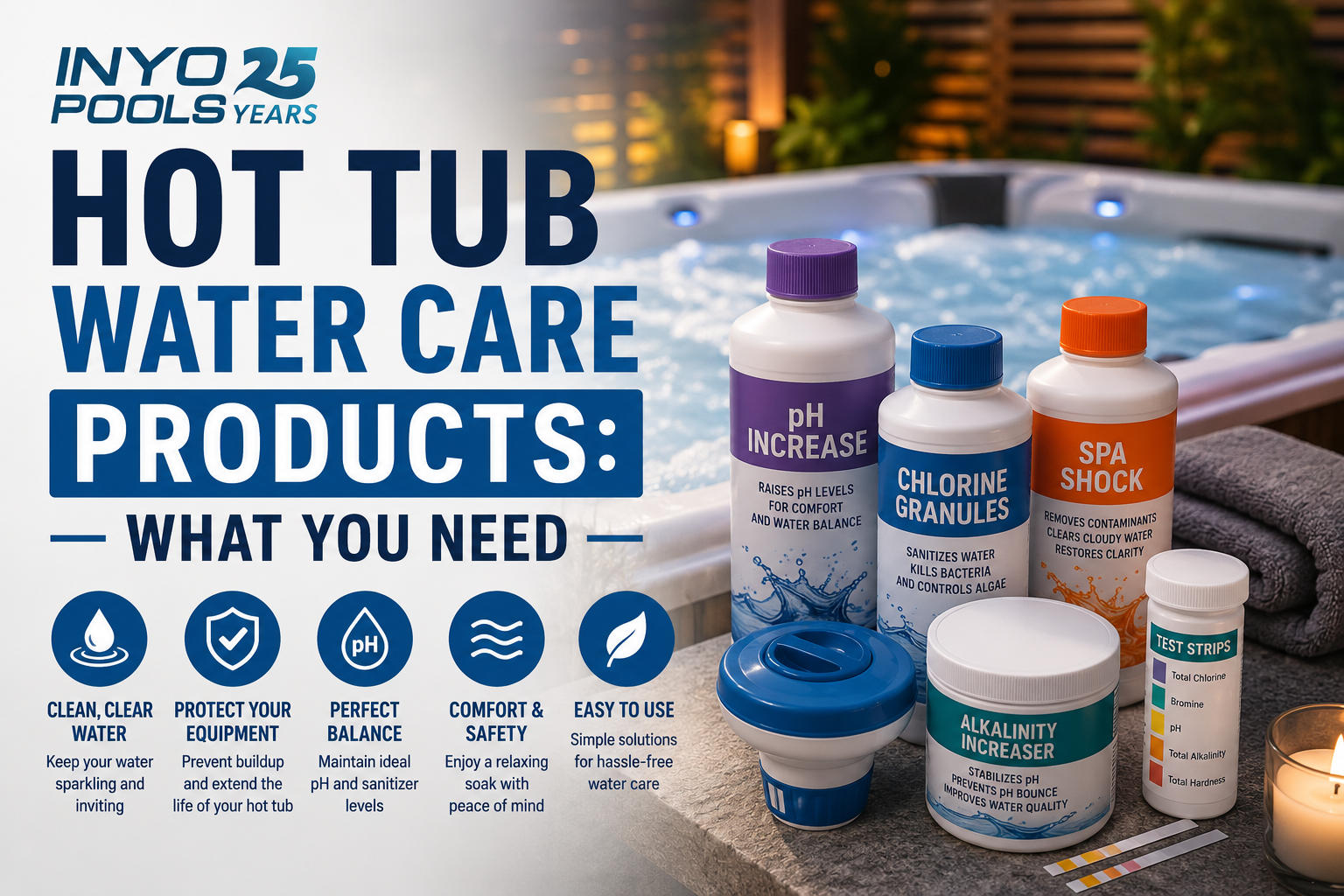
Hot tub water care is more demanding than pool water care in several ways: smaller water volume, higher temperatures, heavy use relative to size, and jets that aerate the water constantly. All of that means chemistry swings faster and the right products matter more. Here’s a complete breakdown:
Why Hot Tub Chemistry Is Different from Pool Chemistry
Before diving into products, it helps to understand what makes hot tubs uniquely challenging:
- Small water volume (250–500 gallons typically) means a single bather adds significant organic load relative to total water
- High temperature (100–104°F) accelerates chemical reactions, speeds up chlorine consumption, and promotes bacterial growth
- Jets and aeration drive off sanitizer faster and contribute to pH rise
- Heavy bather load relative to volume two people in a hot tub vs. a pool is a completely different ratio
- Foam and scum from body oils, lotions, and cosmetics are constant issues
- More frequent water changes hot tub water should be fully replaced every 3–4 months regardless of how well maintained it is
The Core Categories of Hot Tub Water Care Products
1. Sanitizers
The foundation of water care kills bacteria, viruses, and other pathogens.
Chlorine (Dichlor) The most common hot tub sanitizer. Dichlor (sodium dichloro-s-triazinetrione) is the preferred form for hot tubs because:
- It dissolves quickly and completely
- It’s pH-neutral, so it doesn’t throw off the balance as dramatically as trichlor
- It’s available in granular form, easy to dose accurately
- It contains cyanuric acid (stabilizer) built in
Watch out: Because dichlor contains CYA, frequent use builds up stabilizer levels over time. High CYA weakens chlorine effectiveness, the same problem outdoor pools face. Many hot tub owners use a “dichlor-then-bleach” method: use dichlor until CYA reaches 30–50 ppm, then switch to liquid chlorine (sodium hypochlorite) for ongoing maintenance.
Maintain free chlorine at 3–5 ppm in a hot tub (higher than a pool because of the temperature and bather load).
Bromine is the second most popular hot tub sanitizer and is genuinely preferred by many hot tub owners over chlorine.
Advantages over chlorine in hot tubs:
- More stable at high temperatures chlorine gasses off faster in hot water, bromine holds up better
- Less odor bromamines (the combined form) are far less irritating and smelly than chloramines
- Works effectively across a wider pH range
- Gentler on skin and eyes for many users
How it works: Bromine tablets are used in a floating feeder or inline brominator to maintain a bromine bank (sodium bromide reserve) in the water. You then use an oxidizer (non-chlorine shock or a small amount of chlorine) to activate the bromine bank. This two-part system is more involved but very effective.
Maintain bromine at 3–5 ppm.
Watch out: Bromine can’t be stabilized against UV it breaks down in sunlight. Fine for covered indoor or outdoor hot tubs that stay covered; less ideal for uncovered outdoor spas in direct sun.
Saltwater systems, hot tub salt systems use electrolysis to generate chlorine from salt similar to pool salt systems but scaled for hot tub volume.
- Pros: Softer feeling water, less chemical handling, continuous low-level sanitizer generation
- Cons: Higher upfront cost, salt is corrosive to some hot tub components (check manufacturer compatibility), still requires chemistry monitoring
- Popular brands: Freshwater Salt System (Hot Spring), Silk Balance compatible systems
Biguanide (PHMB) is marketed under the brand name Baquaspa. A chlorine-free and bromine-free sanitizer system using polyhexamethylene biguanide.
- Pros: Very gentle on skin, no chlorine odor, stable at high temperatures
- Cons: Expensive, requires a completely separate product line (incompatible with chlorine or bromine you cannot mix systems), can cause filter fouling over time, requires specific shock and algaecide products
- Best for: People with genuine chlorine/bromine sensitivity who have exhausted other options
Mineral Systems Mineral cartridges (silver and copper ions) reduce the amount of sanitizer needed by providing additional antimicrobial action. They don’t replace sanitizer entirely but allow you to maintain lower chlorine or bromine levels.
- Popular brands: Nature2, Spa Frog Mineral Cartridge
- Best used as a complement to a primary sanitizer, not a standalone system
2. Shock / Oxidizers
Shock breaks down combined sanitizer (chloramines/bromamines), destroys organic waste, and refreshes water clarity. Hot tubs should be shocked after every heavy use session and at least weekly, regardless.
Chlorine Shock (Potassium Monopersulfate MPS) The most popular hot tub shock. Non-chlorine oxidizer that:
- Works fast water is usable again in 15–20 minutes
- Doesn’t raise chlorine levels or CYA
- Effectively destroys organic waste and combined chlorine
- Compatible with bromine systems (actually activates the bromine bank)
Brands: Leisure Time Renew, Natural Chemistry Spa Shock, In The Swim Non-Chlorine Shock
Chlorine Shock (Sodium Dichlor) A granular chlorine shock that simultaneously sanitizes and oxidizes. Takes longer to dissipate (wait 30 minutes to 1 hour before soaking). Better for recovering a neglected or contaminated hot tub than routine maintenance shocking.
Liquid Chlorine Fast-acting, no residue, useful for a quick sanitizer boost. Doesn’t add CYA. Works well as the ongoing sanitizer in the dichlor-then-bleach method.
3. pH and Alkalinity Balancers
Hot tub pH and alkalinity drift constantly, mostly upward due to aeration from the jets. Staying on top of balance is essential because pH affects both sanitizer effectiveness and bather comfort.
Target ranges for hot tubs:
- Total alkalinity: 80–120 ppm (some manufacturers recommend 100–150; check your manual)
- pH: 7.4–7.6
- Calcium hardness: 150–250 ppm (lower than pools acrylic shells are sensitive to scale)
pH Increaser (Soda Ash / Sodium Carbonate) raises pH when it drops below 7.4. Pre-dissolve in a bucket of water before adding to avoid localized high-pH spots on the shell.
pH Decreaser (Sodium Bisulfate or Muriatic Acid) lowers pH when it rises above 7.6. Sodium bisulfate (dry acid) is safer to handle and store than muriatic acid preferred for hot tub use.
Alkalinity Increaser (Sodium Bicarbonate) raises total alkalinity. Adjust alkalinity before pH same principle as pools.
Calcium Hardness Increaser (Calcium Chloride) raises calcium hardness. Low calcium causes water to become aggressive and leach calcium from surfaces and equipment. High calcium causes scale on jets, heater elements, and the shell.
4. Specialty Products
Foam Remover / Defoamer Foam is one of the most common hot tub complaints. It’s caused by body oils, lotions, cosmetics, detergent residue in swimsuits, and low calcium hardness. Defoamers knock foam down quickly but are a temporary fix; address the underlying cause for a permanent solution.
Foam prevention tips:
- Shower before soaking
- Wash swimsuits without detergent or rinse thoroughly
- Use an enzyme product regularly to break down oils
Enzyme Products Enzymes break down non-living organic waste oils, lotions, cosmetics that accumulate in hot tub water and contribute to foam, scum lines, filter fouling, and odor. One of the most useful ongoing maintenance products for hot tubs.
Popular products: Natural Chemistry Spa Perfect, Leisure Time Enzyme
Use weekly as a maintenance dose; these work best as preventive products rather than reactive treatments.
Scum Absorbers Floating sponge-like products (often called “Scum Bugs” or similar) that absorb oils and lotions from the water surface. Inexpensive, reusable, and surprisingly effective at reducing the load on your filter and sanitizer.
Scale and Stain Inhibitors (Sequestering Agents) Prevent calcium and mineral scale from forming on jets, the heater element, and the shell surface. Particularly important in areas with hard water. Use monthly as a maintenance dose.
Popular: Natural Chemistry Spa Scale Free, Leisure Time Scale Free
Clarifiers Same coagulation principle as pool clarifiers but formulated for hot tub volume and temperature. Use after shock treatments or when water becomes dull. A chitosan-based clarifier works well in hot tubs.
Filter Cleaner Hot tub filters accumulate oils and debris much faster than pool filters. A dedicated filter cleaning soak (not just a rinse) should be done every 4–6 weeks and a deep clean with filter degreaser should be done every time you drain and refill.
Popular: Natural Chemistry Filter Perfect, Leisure Time Filter Clean
Pipe Purge / Line Flush One of the most overlooked hot tub products. Biofilm a slimy bacterial colony, accumulates inside the jets and plumbing where sanitizer doesn’t reach effectively. Every time you drain your hot tub (every 3–4 months), add a line flush product, run the jets for 30 minutes, then drain. This purges the biofilm before it has a chance to re-contaminate your fresh fill.
Popular: Natural Chemistry Spa Purge, AquaFinesse Hot Tub Cleaner Tablet
This step makes a dramatic difference in ongoing water quality and is skipped by most hot tub owners.
Water Softeners / Silk Balance Products like Silk Balance are proprietary water treatment systems that buffer pH, reduce chemical demand, and produce notably soft-feeling water. Popular among hot tub owners who want a simplified maintenance routine. More expensive than traditional chemical programs but genuinely effective and easier to manage.
5. Testing Products
You can’t manage what you don’t measure, and hot tub chemistry moves fast enough that weekly testing is the minimum.
Test Strips Convenient for quick daily or post-use checks. Hot tub-specific strips test for sanitizer, pH, alkalinity, and sometimes calcium hardness and CYA. Accuracy is adequate for routine monitoring.
Liquid Reagent Test Kits More accurate than strips. For weekly formal testing and whenever you’re troubleshooting a problem, a liquid test kit gives you numbers you can trust. Taylor Technologies makes reliable kits with bromine and chlorine options.
Digital Testers Photometric testers (like the LaMotte ColorQ) give lab-quality readings without color-matching subjectivity. A good investment for serious hot tub owners.
Recommended Basic Maintenance Schedule
After every use:
- Add a small dose of sanitizer if needed
- Shock with non-chlorine oxidizer after heavy use (2+ people)
- Rinse the underside of the cover
Weekly:
- Test all parameters
- Adjust alkalinity, pH as needed
- Check and adjust sanitizer level
- Add enzyme product
- Add scale inhibitor (or at least monthly)
- Rinse filter with hose
Monthly:
- Deep clean filter with soak
- Add clarifier if needed
- Check calcium hardness
Every 3–4 months:
- Line flush / pipe purge
- Drain and refill completely
- Deep clean shell and jets
- Inspect O-rings, gaskets, and equipment
The Most Important Things to Remember
Drain and refill every 3–4 months no amount of chemistry fully compensates for total dissolved solids (TDS) that accumulate over time. Fresh water is the reset button your hot tub needs regularly.
Purge the lines before every drain biofilm in the plumbing is the hidden cause of many chronic water quality issues.
Clean the filter properly and often a fouled filter is the most common reason hot tub water stays cloudy or foamy despite correct chemistry.
Shower before soaking the single most effective thing bathers can do to reduce chemical demand and extend water life.
Keep the cover on heat retention, chemical retention, and contamination prevention all depend on a good-fitting, well-maintained cover.
Hot tub water care has a steeper learning curve than pool care for most people but once you find a routine that works for your specific tub, usage patterns, and local water, it becomes second nature. The key is consistency and not letting problems develop before addressing them.







Leave a Reply