
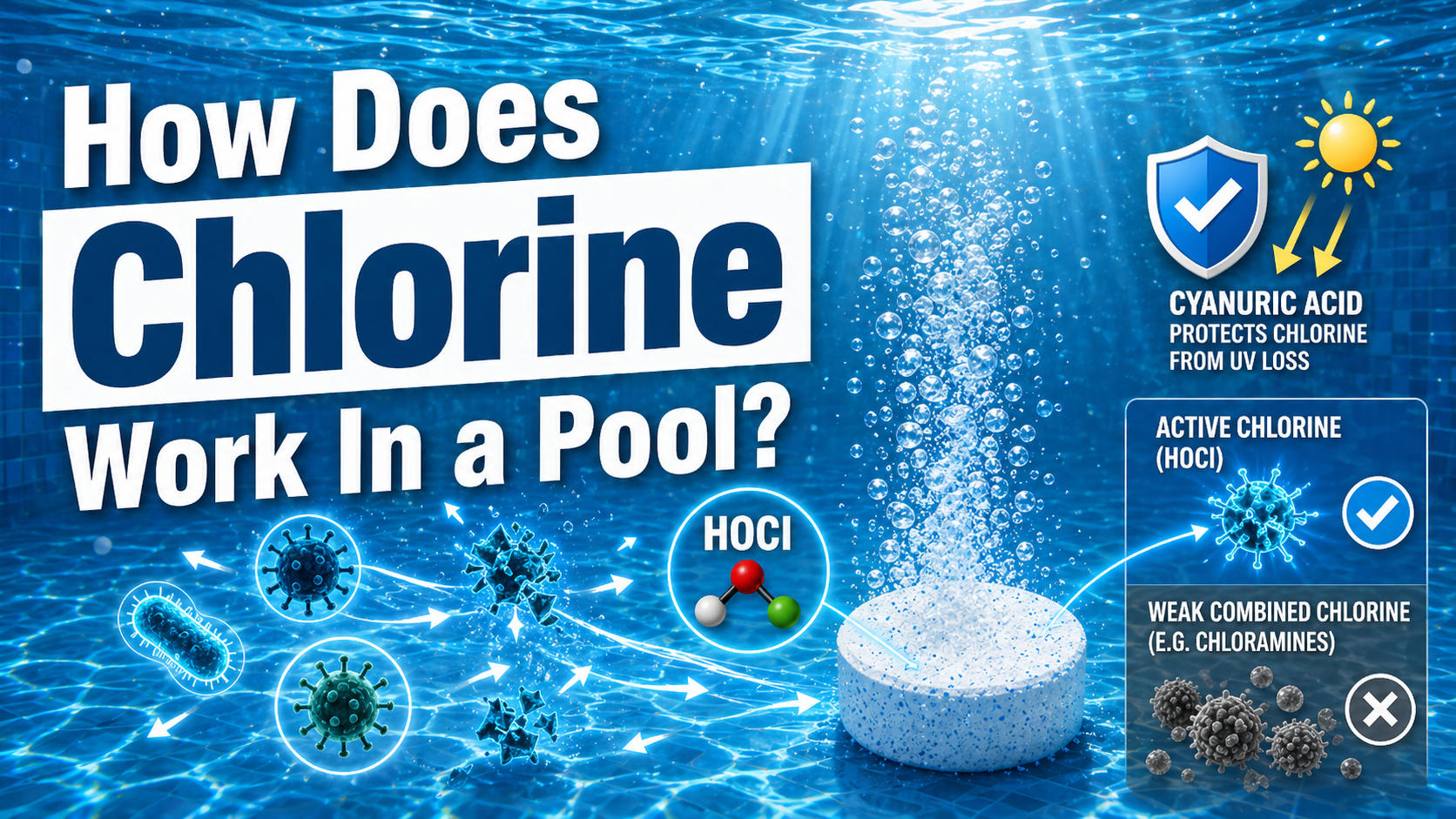
Chlorine works by releasing hypochlorous acid (HOCl) when it dissolves in water; that’s the active sanitizing molecule that actually does the killing. Here’s the full picture:
The Chemistry
When chlorine (in any form, liquid, tablet, or granular) hits your pool water, it reacts to form two compounds: hypochlorous acid (HOCl) and hypochlorite ion (OCl⁻). HOCl is the powerful one; it penetrates the cell walls of bacteria, viruses, and algae and destroys them from the inside. The hypochlorite ion is much weaker (up to 80x less effective), which is why pH matters so much: higher pH pushes the balance toward the weaker OCl⁻ form, making your chlorine far less effective even when levels look fine on a test.
Free vs. Combined chlorine
- Free chlorine is the active, unused chlorine ready to sanitize.
- Combined chlorine (chloramines) is chlorine that’s already bonded to nitrogen from sweat, urine, and other organics. Chloramines are mostly ineffective as sanitizers and are actually what causes that strong “pool smell” and eye irritation, not chlorine itself. Shocking the pool breaks up chloramines and restores free chlorine.
- Total chlorine is the sum of both.
The role of cyanuric acid (stabilizer)
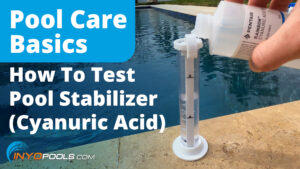
Outdoor pools add cyanuric acid (CYA) to shield chlorine from UV sunlight, which destroys unprotected chlorine rapidly, sometimes within hours on a sunny day. CYA essentially “holds onto” the chlorine molecule and releases it slowly. The tradeoff is that high CYA weakens chlorine’s effectiveness, so balance matters (30–50 ppm is the general sweet spot).
Chlorine lock is when your pool tests as having adequate chlorine, but the chlorine isn’t actually doing its job; it’s chemically “locked up” and largely ineffective as a sanitizer.
The main cause: high cyanuric acid (CYA)
This is the most common culprit. CYA (stabilizer) protects chlorine from UV sunlight by bonding to it, but that same bond that shields chlorine from the sun also makes it slower to react with contaminants. At normal CYA levels (30–50 ppm), this is a manageable tradeoff. But when CYA climbs above 80–100 ppm, so much of your chlorine is bound up that very little is actually “free” to sanitize, even if your free chlorine reading looks fine on a test.
Think of it like this: your test measures chlorine that’s present, not chlorine that’s available to work.
How to fix it
Unfortunately, CYA doesn’t break down on its own and can’t be chemically removed. Your main options are:
- Partial drain and refill – diluting the pool water with fresh water is the most common fix
- Reverse osmosis filtration – a more thorough option that doesn’t require draining
What chlorine doesn’t do
Chlorine is a sanitizer, not a clarifier or algaecide on its own (though it does kill algae at high doses). It doesn’t remove phosphates, metals, or organic debris; that’s the filter’s job. And it can’t work well if your pH, alkalinity, or CYA are out of range, which is why water balance always comes first.
The short version: chlorine works great when the rest of your chemistry supports it. Get the balance right, and you need a lot less of it.




Leave a Reply