
Losing water in your pool? Before you assume the worst, here’s how to figure out exactly what’s happening and how to fix many common leaks yourself.
Every pool loses some water. Evaporation is real, splashing happens, and swimmers carry water out on their bodies every time they get out. But there’s a big difference between normal water loss and an actual leak, and knowing how to tell them apart is the first skill every pool owner should have.
The good news is that many pool leaks are minor, fixable without draining the pool, and well within reach of an attentive homeowner. The key is catching them early. A small leak that loses a quarter-inch of water a day doesn’t sound like much, but over a month, that adds up to hundreds of gallons and a meaningfully higher water bill, not to mention the chemical imbalance that follows.
Let’s walk through how to find a leak, figure out where it’s coming from, and fix the most common ones yourself.
Step One: Confirm You Actually Have a Leak
Before you go hunting for a crack or a failing fitting, you need to confirm that what you’re seeing is actually a leak and not just evaporation. In Florida, especially, evaporation rates can be surprisingly high. Warm water, lots of sun, and afternoon breezes all pull moisture out of the pool.
The Bucket Test
This is the standard method, and it’s dead simple.
Fill a 5-gallon bucket with pool water about two-thirds full. Place it on a step inside the pool (so it’s partially submerged and experiencing the same temperature and sun exposure as the pool water). Mark the water level inside the bucket with a piece of tape or a marker. Then mark the pool’s water level on the bucket’s exterior, or note it against a tile line or skimmer opening.
Let the pool run normally for 24 hours. Come back and compare:
- If both levels dropped by the same amount: You’re losing water to evaporation, not a leak. Normal evaporation in Florida can run a quarter-inch to half an inch per day in hot, breezy conditions.
- If the pool level dropped more than the bucket, you leak, and the difference tells you roughly how much water you’re losing beyond normal evaporation.
Run the test twice, once with the pump running, once with it off. If you lose more water with the pump running, the leak is likely in the plumbing or equipment. If you lose the same amount either way, the leak is probably in the pool shell itself.
Step Two: Narrow Down the Location
Once you’ve confirmed a leak, the next job is figuring out where it’s coming from. Pool leaks tend to fall into a few general categories:
Equipment and Plumbing Leaks
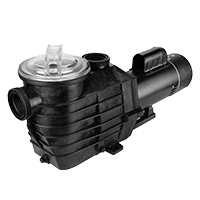
These are the easiest to find because the equipment is right there in front of you. Walk around your pump, filter, heater, and any valves or unions while the system is running. Look for:
- Wet spots on the ground beneath the equipment
- Mineral deposits or white staining around fittings (a sign of a slow, long-term drip)
- Dripping from union connections or valve stems
- Moisture around the pump lid or filter tank
Also, check the backwash line. If water is trickling out of the backwash line continuously while the pump runs, the multiport valve’s internal gasket may be worn, causing water to bleed through.
Plumbing Line Leaks
Underground plumbing leaks are trickier to find, but there are signs. If you notice a patch of grass near the equipment pad or along the pipe run that stays unusually green or soggy, that’s worth paying attention to. A soil depression or a soft, spongy area of ground can also point to a buried line that’s slowly saturating the soil.
A simple pressure test can confirm whether your underground lines are holding: close all valves, plug the returns and skimmers, and use a pressure testing kit to pressurize the pipes with air or water. If the pressure drops, water is escaping somewhere in the lines.
Shell Leaks (Cracks and Gaps)
Leaks in the pool shell itself, whether it’s gunite, plaster, fiberglass, or vinyl, usually show up in predictable places:
- Around fittings (skimmer, return jets, main drain, lights)
- At the waterline where tiles meet plaster
- In corners and transitions (steps, benches, the floor-to-wall joint)
- In any area of the pool that has been repaired before
The water level gives you a helpful clue here. If the pool loses water and then stops dropping at a particular level, the leak is probably right at that waterline. Whatever fitting or crack is at that depth is likely your culprit.
Step Three: Find the Exact Leak with Dye Testing
Once you’ve narrowed down the area, dye testing lets you pinpoint the exact source. This is genuinely one of the most satisfying moments in pool troubleshooting.
You can buy leak detection dye at any pool supply store. It usually comes in a small squeeze bottle and is available in bright colors like red, blue, or fluorescent yellow. Turn off the pump so the water is completely still.
Get into the water (or use a long syringe or turkey baster if you’d rather stay dry) and squeeze a small stream of dye near the area you suspect. The dye will float in still water. If there’s a leak nearby, you’ll see the dye get pulled toward it sometimes dramatically, sometimes in a slow, lazy drift. Follow the current, and it will lead you right to the hole, crack, or failing gasket.
Test around every fitting systematically: skimmer throat, return jet fittings, light conduits, and main drain covers. Take your time, the dye doesn’t lie.
Step Four: Fix It (Here’s What You Can Handle Yourself)
Once you know what you’re dealing with, many minor leaks are surprisingly fixable without draining the pool or calling a professional.
Fixing Leaks Around Return Jets and Fittings
Return jets are held in place by a fitting and a gasket that sits behind the pool wall. Over time, that gasket degrades, the fitting loosens, or the plaster around it cracks.
If dye is being pulled into the space around the jet fitting, the fix is often straightforward. There are two approaches:
Underwater epoxy putty works well for small gaps around fittings. Knead the two-part putty together according to the instructions (it will start to harden quickly, so work fast), press it firmly around the leaking area, and smooth it flat. Most underwater epoxies are fully cured within 24 hours and are compatible with plaster, fiberglass, and concrete. You can apply this without draining the pool, which is a huge advantage.
A fitting replacement is necessary if the fitting itself is cracked or if the gasket is clearly failing. You’ll need to shut off the pump, drain the pool below the fitting, unscrew the old fitting (usually a simple ring that threads from inside the pool), swap the gasket, and reinstall. The parts are cheap, usually $5–$15, and it’s a 30-minute job once the water level is where you need it.
Fixing Skimmer Leaks
The skimmer is one of the most common leak locations in any pool. It’s a plastic fixture that’s been bonded to the pool shell, and over time, especially in climates with temperature swings or soil movement, that bond can crack or separate.
Run your dye test around the entire perimeter where the skimmer body meets the pool wall. If you see dye being sucked into that joint, you’re looking at a classic skimmer-to-wall separation.
For minor separation leaks, two-part pool putty or underwater sealant applied into the gap works well. Clean the area as best you can, pack the sealant into the crack, smooth it, and let it cure. This isn’t a forever fix if the joint is moving or if the separation is significant, the skimmer may eventually need to be fully reseated, but it buys real time and often solves the problem for years.
If the skimmer body itself is cracked (you’ll see it clearly once you look), a skimmer repair kit with a plastic bonding compound can patch hairline cracks. More significant cracks usually mean skimmer replacement is coming.
Fixing Hairline Cracks in Plaster
Small hairline cracks in plaster are common, especially in older pools and pools in areas with shifting soil. Many hairline cracks are cosmetic and don’t leak, but if your dye test shows water being pulled into one, it needs attention.
For active cracks that are leaking, hydraulic cement or pool putty can seal them without draining. Chip the crack open slightly with a cold chisel to give the patch material something to grip. A crack with some width holds a repair much better than a hairline. Press the putty firmly into the crack, overfill it slightly, and smooth it flat. The material hardens underwater in minutes.
For cracks at the waterline or above, you have more options: pool plaster patch compounds can be applied to a dry surface and give a cleaner, more durable result. If the crack is part of a larger pattern of crazing (a web of fine cracks across a broad area), that’s a sign the plaster is aging out and may need a full replaster in the coming seasons, but individual cracks can still be patched in the meantime.
Fixing Pool Light Leaks
Pool lights are notorious for leaking, and the mechanism is a little counterintuitive: it’s usually not the light fixture itself but the conduit or pipe that carries the electrical cord from the light to the junction box on the deck.
Water can travel up through the conduit (following the cord) and then out through any gap at the deck end. Sealing the conduit at the fixture end with a waterproof conduit sealant, or at the junction box end with a cord grip fitting, usually stops this path.
If the leak is actually around the light lens or gasket, the fix is a gasket replacement. Turn off the power to the light at the breaker (not just the switch, the breaker), remove the light fixture from the niche, and replace the rubber gasket that seals the lens to the housing. Replacement gaskets are available for most major light brands and cost $15–$30. This is a moderately involved DIY repair, but it doesn’t require draining the pool.
Fixing Leaks at Pipe Unions and Valves
Back at the equipment pad, unions and valves are common drip points. Unions are designed to be hand-tightened and then snugged up. They have O-rings that do the actual sealing. If a union is dripping, try tightening it by hand first. If it keeps dripping, the O-ring needs to be replaced.
Close the valves on either side of the union, unscrew it, pop out the old O-ring, and install a new one with a thin coat of silicone lubricant. This takes about 10 minutes and costs less than $5 in parts.
Valve stem leaks where water seeps around the handle shaft can sometimes be fixed by tightening the packing nut slightly. If that doesn’t work, the valve packing material needs to be replaced or the valve replaced entirely.
When to Stop DIYing and Call a Pro
If you’ve tried the steps above and still can’t find the leak or if you suspect something underground, it might be time to bring in a professional. Pressure testing and advanced detection tools can locate hidden issues without tearing up your yard.
You can’t find the leak. If you’ve done the bucket test, narrowed it down to the shell or plumbing, and dye tested every fitting without finding the source, the leak may be in an underground line or an area you can’t access. Professional leak detection uses specialized listening equipment and pressure testing to pinpoint buried leaks without guesswork.
The pool is losing water fast. A leak that drops the water level more than an inch per day is serious. At that rate, you risk exposing the pump to running dry, destabilizing the soil around the pool structure, and causing secondary damage that’s much more expensive to fix.
The crack is structural. A crack that runs across a wall, follows a straight line (instead of a curved, random path), or is wider than a pencil tip may be a structural issue. Patching the surface won’t address what’s happening underneath. A pool professional or structural engineer should take a look.
The skimmer or main drain needs full replacement. These are bigger jobs involving concrete work and proper bonding. The DIY patches are good for buying time, but a professional replacement done right will last decades.
Staying Ahead of Leaks
The best leak is the one you catch before it becomes a real problem. A few habits make a big difference:
Watch your water level weekly. You don’t need to be obsessive about it; notice if you’re topping off the pool more than usual. Any time you’re adding more than an inch of water per week in normal weather, something is worth investigating.
Check the equipment pad every time you’re out there. Stains, drips, and wet spots are much easier to deal with when they’re fresh than after months of slow leaking.
Do the bucket test at the start of each swim season. It takes five minutes and gives you a baseline. If something changes mid-season, you’ll have a reference point.
Pay attention after heavy rain. Significant soil movement from saturation can open cracks or shift plumbing, so it’s worth a quick look around after big storms.
The Bottom Line
Pool leaks feel stressful because water is disappearing, and the cause isn’t obvious. But most minor leaks, fittings, skimmer joints, hairline cracks, and valve O-rings are genuinely fixable by an attentive homeowner with a bottle of dye, some pool putty, and an afternoon. The secret is being methodical: confirm you have a leak, narrow down the zone, find the exact spot, and then match the repair to what you actually found.
Catch them early, fix them right, and your pool will be doing its job instead of slowly draining away.
Always turn off and lock out power to pool lights at the breaker before working on or near light fixtures. When in doubt about any electrical component, call a licensed electrician.




Leave a Reply