Home / Articles / Got Sand In Your Pool? Common Causes And Easy Fixes

Got Sand In Your Pool? Common Causes And Easy Fixes

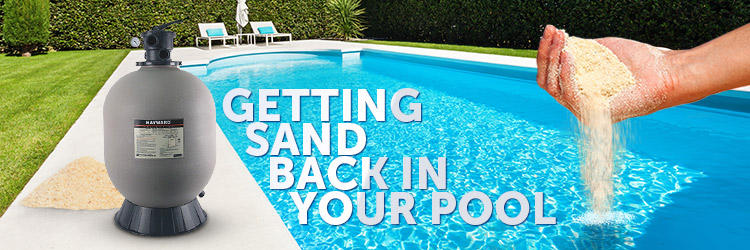
Getting Sand Back in your Pool?

The Sandbar is open!

If you’re reading this then there may be a sand berm big enough to threaten shipping lines at the bottom of your pool. Ok, maybe that was a little dramatic, but a dusting of sand around a return line can cause a panic in any pool owner’s mind. Sadly, this is an all too common problem with sand filters but luckily there are some usual culprits that are easy fixes.

Cracked Lateral

If you ask a pool tech about a sandy pool bottom, his first question to you will be, “Did you check for a cracked lateral?” There is a good chance you did not and there are two main reasons why. First, laterals are a pain in the neck to get to, and second most homeowners don’t even know what they are.

Located at the bottom of your filter, this array of 6 – 8 perforated tubes are the last line of defense keeping sand from pouring into your pool. In a sand filter tank, water pours into the sand from the top where it filters its way down through the couple hundred pounds of sand to the bottom of your filter. This is where the little laterals come in. The now filtered water is collected by the laterals and is rushed through the center pipe and and back to the pool. The perforated holes are just big enough to allow water but prevent sand from seeping through.

If there is a crack in one of these laterals sand will find the gap and shoot happily to your pool, to ruin your day. Or at least that’s what it will feel like when you see it pouring into your pool.

The hard part is figuring out it was the laterals, the easy part is actually fixing the problem. For step by step by step instruction, review our guide How To Replace a Lateral in a Pool Sand Filter.

Did You Know?

Sand will leave a telltale streak pattern on the pool floor around the return line.  If your pool has a wide dispersal of sand then it may be getting in your pool from an outside source.

Spider Gasket

A multiport valve is like a highway interchange for your water as it routes and diverts the flow to achieve your desired setting. If water is flowing from the waste line when it is not supposed to be then the spider gasket has likely gone bad. Shaped like a wagon wheel, this gasket seals the diverter to the base of the valve preventing leaks into unselected portholes. If the water is allowed to leak into unintended ports then it may accidentally backwash debris and sand into your return.

The spider gasket wears out depending on use and water chemistry. Hard water is hard on rubber. Also, always turn your multiport’s selector handle in the same direction, whether it is clockwise or counterclockwise. If the handle is turned both ways it is more likely to warp the gasket or unseat it from its groove.

For step by step by step instructions, review our guide How To Replace a Spider Gasket on  a Multiport Valve.

Don’t Be Dense, Please Rinse.

Would you take a shower by soaping up, then lathering your hair with shampoo just to turn off the water and walk out before rinsing it off?  No, I did not think so. The same principle goes for washing out your sand filter. When a filter is backwashed, it is an absolute must that it be rinsed before returning to normal filtering mode.

During backwashing the water’s normal flow is reversed to flush out or loosen heavy dirt particles that clog the filter. Once the backwash is done those particles are deposited in the lines of the filter for the Rinse.  If the rinse step is skipped  after the backwash all that dirt and nasty stuff goes right back into your pool. Don’t be dense, please rinse.

Can’t Teach Old Sand New Tricks

If you take sand down to its singular property, it is just tiny grains of sediment and when enough is clumped together, it makes one heck of a filtering media. The bad thing is that, just like the three month old milk in the fridge, it has an expiration date. Sand can last approximately 3-5 years in a filter before it needs to be changed.  A sign of sand turning is usually high pressure  that does not subside even after a repeated backwashes. A signifier that goes along with that symptom is fine sand at the bottom of the pool.

Like water does to large rocks in a river, it smooths and wears down the size of the sand granules.  Eventually this wearing gets the sand down to a size where it small enough to fit through the perforated holes in the laterals. Next stop is the bottom of your pool. If your sand has been filtering for a few years and there is returning sand to your pool in congruence with high pressure, this may be the cause.

As usual our pool techs have a guide covering the steps to replacing your sand. If there are some steps you’re fuzzy on, check our How To Change Sand In a Sand Filter guide.

author avatar
Matthew Simmons Technical Writer & Pool Product Expert
Swimming pool expert at InyoPools and host of Poolside Chat, brings over a decade of experience in the pool industry.

Related Videos

77 responses to “Got Sand In Your Pool? Common Causes And Easy Fixes”

  1.  Avatar

    Also cartridge filter NOT sand.

  2.  Avatar

    Forgot to add this is a saltwater in ground pool. Thanks Debby

  3.  Avatar

    Hello Mathew, new pool everything coated in sand can’t power wash off. Goggles left in pool covered with sand or salt grit which sticks to everything! HELP they are coming next week to resurface but that will not fix problem. They have already installed new pump as it went out within two weeks. HELP! Debby

    1. Matthew Simmons Avatar

      Debby, there is a whole list of things I mention to check in the article. First question, did you check those things?

  4. Erin Avatar

    After opening our in ground pool this year I noticed when I hooked up the vacuum sand would come out from the returns. When we unhook the vacuum, it doesn’t seem to noticeably blow out. We have backwashes and rinsed. Could it be a cracked lateral? We inherited the pool when we bought the house last summer so I’m not sure how old the sand is either. Our water isnt cloudy but here is sand all over the bottom. Not sure if I should try to replace the sand and check the laterals?

    1. Matthew Simmons Avatar

      If sand is only visible after you start vacuuming; I would presume the problem is not the laterals but old sand. When sand gets gunky, it begins to clump together, which can create channels through which fine silt can slip past the filter media, penetrate the laterals and back to the pool. There is a point where not even backwashing can clean the sand adequately enough. Before switching out the sand, you can try different sand filter cleaners which try to degunk the sand. If those chemicals don’t work, then you need to change the sand.

      1. Bob Chelva Avatar

        Hi Matthew.
        I have been getting deposits of sand across the bottom of my pool and not just at specific channels/positions in the pool. Would this indicate external sand being blown into the pool or is it a symptom of leaking out of the sand filter ?
        Is it true that sand that hasn’t been refreshed for sometime can become rounded and smooth making it able to pass through the filter lateral system and into the pool ?

  5. TJ B. Avatar

    So I have very fine sand in the bottom of my vinyl lined inground pool but have a cartridge filter. Have a bad feeling that I have a leaking return line. Any thoughts?

    1. Matthew Simmons Avatar

      Have you tried a clarifier, then vacuuming it to see if any sand returns?

  6. Cc_rider_147 Avatar

    My problem is fine silt coming from the water feature (waterfall), made of sandstone. Vacuuming stirs it up and makes it cloudy.

    Sand filter, about 5 years old. Some of it could be old sand, but the worst silt accumulation is under the water feature.
    I am considering a bypass filter with a 5-10 micron filter cartridge, similar to whole-house sediment filters. Flow rate depends on cartridge size and micron rating, but 10-20 gpm is typical for the largest cartridges (4″ dia x 20″ long). Plumb it in parallel with the sand filter inlet pipe, so it would filter some of the water. Theoretically, over time it would remove the finest silt.

    Thoughts?

  7. Kirby Avatar

    I keep getting sand in my above ground pool ,not a large amount but after I vacuumed and backwash and rinse I get sand directly under the jet .it is in a straight line looks like it’s being sprayed out from the jet.its a Hayward sand filter ,it’s only a couple years old I’ve had this problem from the beginning .

  8. Robert Avatar

    We just moved and my sand filter got kicked over during the move and now we got it all hooked back up and it spits out sand.

    1. Matthew Simmons Avatar

      As we cover in the article, it could be broken laterals, or it could be that sand spilled into the standpipe during the toppling, or thereafter while attempting to reerect.

  9. Chris Avatar

    Hi Mathew , i have been getting a little sand in my pool, its what we call a sand filter but using the glass media, backwashed and filtered to watste still comes back?

    1. Matthew Simmons Avatar

      It could be as simple by using some clarifier, checking for channeling, or something more serious like broken lateral allowing dirt through

  10. George Avatar

    Hello Mathew.
    I don’t have a sand probem. Yet.
    But was going to stir up the sand today and noticed the vertical pipe connecting to the valve was loose and ultimately broke off.
    So, left with the daunting task if digging out the sand and fixing it back to the hub etc.
    Question is if the valve in “bypass” mode will ACTUALLY bypass and not flush loose sand into the pool.
    Reason, is it’s HOT and needs to get some circulation before I can get to this task.
    Just thought I’d ask here.

    Thanks!

    1. George Avatar

      I think I’m good my vari flow has a recirculate setting. So, it seems to work. Not looking forward to the job ahead tho.

    2. Matthew Simmons Avatar

      You are correct, the recirculate/bypass function on the multiport valve means the water never makes it into the filter tank. The setting will allow you to circulate the water without flushing 300 pounds of sand into your pool.

Leave a Reply

Your email address will not be published. Required fields are marked *