
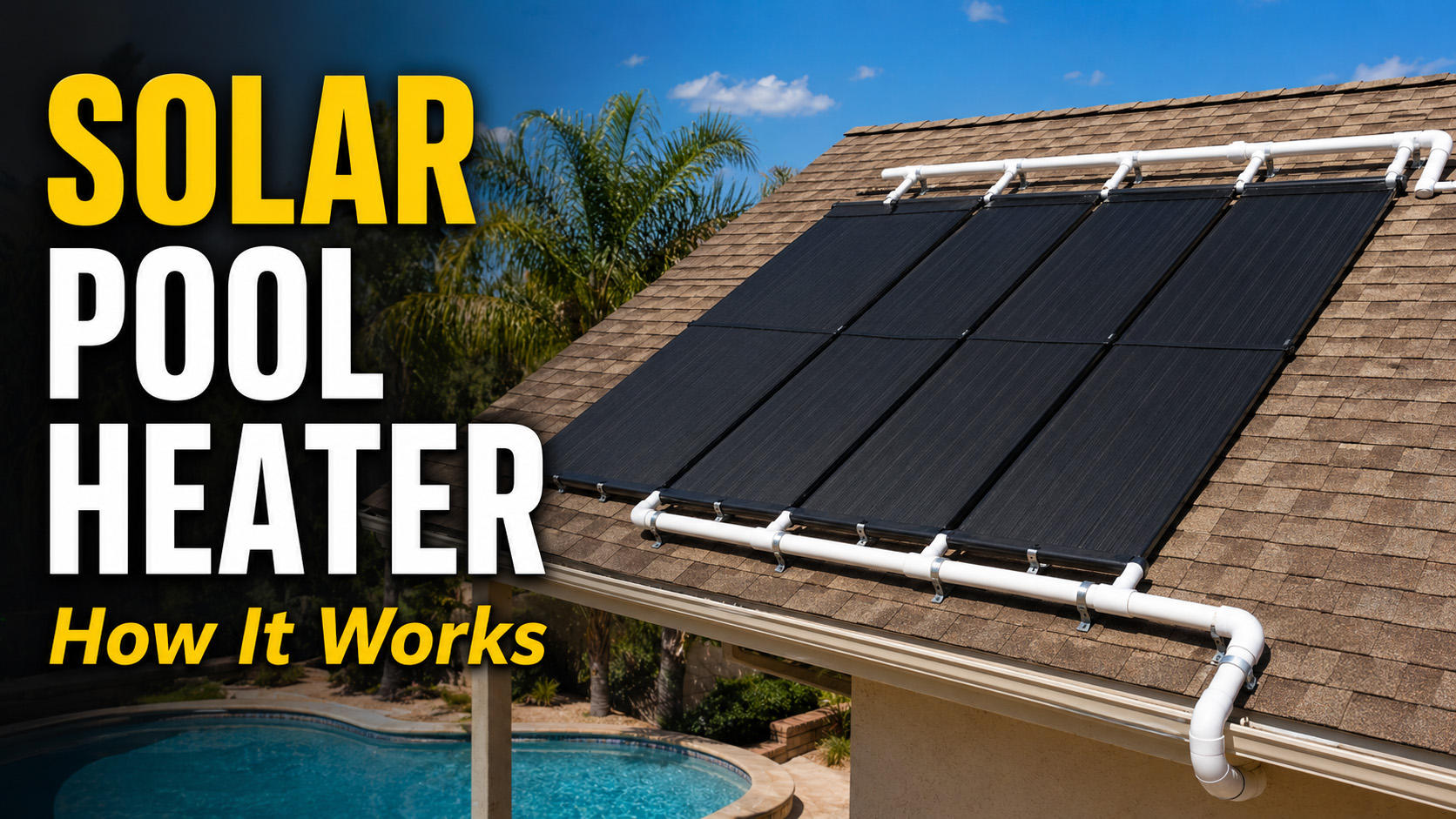
Solar pool heaters are one of the best long-term investments a pool owner can make low operating costs, long lifespan, and free energy from the sun. But there’s more to buying and installing one than just picking a panel and putting it on the roof. Here’s everything worth thinking through before you commit:
1. Is Your Climate and Location Right for Solar?
Solar heating works best where you have:
- High annual sun hours – the more direct sunlight your location receives, the better the system performs
- Mild to warm ambient temperatures – solar panels lose efficiency in very cold weather, and in genuinely cold climates you may not get enough heat gain to justify the investment
- Low wind exposure – wind increases heat loss from the panels and reduces efficiency
Solar pool heaters work exceptionally well in the Sun Belt states (Florida, Texas, Arizona, California). In northern states they can still work, but typically extend your season rather than providing year-round heating.
Check your location’s solar resource map before buying — the National Renewable Energy Laboratory (NREL) provides free tools that show average solar radiation by region.
2. Sizing the System Correctly
This is where most DIY solar installations go wrong. Undersizing means disappointment; oversizing means unnecessary expense.
The general rule: Your solar collector area should equal 50–100% of your pool’s surface area.
- In sunny, warm climates: 50–75% is often sufficient
- In cooler climates or for year-round use: aim for 100% or more
- If you want to significantly extend your season: err toward the larger end
Example: A 15 x 30 foot pool (450 sq ft surface area) in Florida would typically need 225–350 sq ft of solar collector.
Other factors that affect sizing:
- Desired temperature increase – every extra degree you want requires more collector area
- Wind and shade exposure – shaded or windy pools lose heat faster and need more collector area to compensate
- Pool cover usage – a pool cover dramatically reduces heat loss overnight and effectively makes your solar system more efficient
- Orientation and tilt of mounting surface – optimal orientation maximizes output
3. Types of Solar Collectors
Unglazed Collectors
The most common type for pool heating. Made from heavy-duty rubber or polypropylene, they’re designed specifically for pool water temperatures (not hot water systems).
- Pros: Less expensive, durable, performs well in warm climates, long lifespan (10–20 years)
- Cons: Less efficient in cold or windy conditions, not ideal for year-round use in northern climates
- Best for: Warm to moderate climates, seasonal pool heating
Glazed Collectors
Covered with tempered glass and typically use copper tubing with an aluminum frame. More commonly associated with domestic hot water systems but can be used for pools.
- Pros: More efficient in cold weather, retains heat better in wind, better for year-round or cold-climate use
- Cons: Significantly more expensive, heavier, more complex installation
- Best for: Cold climates, year-round heating goals, situations where fewer panels need to do more work
For most residential pool owners in warm to moderate climates, unglazed collectors are the right choice — they’re cost-effective, durable, and purpose-built for pool temperatures.
4. Roof and Mounting Surface Assessment
Before purchasing, evaluate where you’ll mount the panels:
Roof orientation:
- South-facing is ideal in the Northern Hemisphere — maximum daily sun exposure
- Southeast or southwest facing works well too, with modest efficiency reduction
- East or west facing reduces output noticeably
- North-facing is generally not viable for solar pool heating
Roof pitch/tilt:
- Optimal tilt angle is roughly equal to your latitude (so in Florida at ~25–28° latitude, a 25–28° pitch is ideal)
- Flat roofs can work with tilt mounts
- Steep roofs reduce output and complicate installation
Roof condition and load capacity:
- Have your roof inspected before installation — adding panels to a roof that needs replacement soon is poor planning
- Solar pool panels are relatively lightweight compared to photovoltaic panels, but your roof structure still needs to support the added weight plus wind load
- Check your local building codes — some areas require structural engineering approval
Alternative mounting locations:
- Ground-mounted systems work well if roof mounting isn’t practical
- Pool fences, pergolas, and sheds are used in some installations
- The closer to the pool the better — longer pipe runs mean more heat loss and higher installation cost
5. Plumbing Considerations
Solar pool heating integrates with your existing pool plumbing — the pool pump pushes water up to the collectors and gravity returns it to the pool.
Key plumbing factors:
Head pressure and pump compatibility:
- Water must be pumped up to the roof or mounting location
- The height of the panels above the pump creates “head pressure” that your pump must overcome
- Many existing pumps can handle a typical residential solar installation, but very high roofs or long runs may require a pump upgrade or booster pump
- This is worth calculating before you buy a solar installer or the manufacturer can help
Pipe routing:
- Plan the route from your equipment pad to the panels and back before purchasing — this determines how much pipe you need and where penetrations will be made
- Minimize pipe length where possible every extra foot of pipe is a potential heat loss and installation cost
- Use CPVC or approved flexible solar tubing rated for outdoor UV exposure standard PVC degrades in direct sunlight over time
Bypass and diverter valves:
- A proper installation includes a diverter valve that routes water to the panels when heating is needed and bypasses them when it’s not
- Manual diverter valves work but require you to physically adjust them
- Automatic diverter valves tied to a controller are far more convenient
6. Control Systems and Automation
A basic solar pool heater can be operated manually, but an automatic controller makes the system dramatically more useful and efficient.
What a solar controller does:
- Monitors pool water temperature and collector temperature
- Automatically diverts water to the panels when the collectors are warmer than the pool
- Shuts off flow when the collectors cool down (at night or on cloudy days)
- Prevents overheating in very hot climates by running the system at night to cool the pool if needed
Types of controllers:
- Basic differential controllers: Compare collector temp to pool temp and open/close the diverter valve automatically. Reliable and affordable ($100–$300)
- Advanced controllers: Integrate with pool automation systems, offer scheduling, remote monitoring, and more sophisticated logic
- Smart/WiFi controllers: Allow monitoring and control from a smartphone app
For most homeowners, a basic differential controller with an automatic actuator valve is the sweet spot — simple, reliable, and a significant upgrade over manual operation.
7. Integration with Existing Heating Systems
Many pool owners pair solar with a gas or heat pump heater:
- Solar as primary, gas/heat pump as backup: The most common setup. Solar does the heavy lifting on sunny days; the backup heater fills in during cold snaps, cloudy stretches, or when you need rapid temperature increase
- Controller integration: Good controllers can be set up to hand off to a backup heater when solar alone can’t reach the target temperature
- Overheating protection: In very hot climates, solar can overheat your pool in summer. Running the system at night or using an automatic bypass prevents this
8. Pool Cover — Your Biggest Efficiency Multiplier
A solar pool cover (bubble cover) used overnight and on cloudy days can reduce heat loss by 50–70%. This means your solar system maintains temperature far more easily and you get more usable swimming days out of the same collector area.
If you’re investing in solar heating, a pool cover is essentially mandatory for maximizing the return on that investment. It’s also one of the highest-value, lowest-cost pool investments in general.
9. Permits and HOA Approvals
Building permits: Most jurisdictions require a permit for solar pool heater installation, particularly for roof-mounted systems. Requirements vary — some areas have streamlined solar permitting, others are more involved. Check with your local building department before starting work.
HOA restrictions: Many HOAs have rules about roof-mounted equipment visibility. However, in many states (including Florida, California, and others), solar access laws limit HOA authority to prohibit solar installations outright. Know your rights and your HOA’s specific rules before purchasing.
Utility rebates and incentives: Solar pool heaters may qualify for state or local rebates. The federal solar tax credit (ITC) has historically applied to solar thermal systems — check current IRS guidance or consult a tax professional for the most current status.
10. Installation: DIY vs. Professional
Professional installation advantages:
- Proper roof penetration and waterproofing
- Correct pipe sizing and routing
- Permit handling and inspection compliance
- Warranty protection (some manufacturers void warranties on DIY installs)
- Typically includes system startup and optimization
DIY considerations:
- Many unglazed solar pool heating systems are sold as DIY-friendly kits
- The plumbing work is within reach of a confident DIYer familiar with pool plumbing
- Roof work is where most DIYers should think carefully — improper flashing causes leaks
- Electrical work for the controller and actuator valve should meet local code
A middle path: Some homeowners do the ground-level plumbing themselves and hire a roofer just for the panel mounting and flashing — getting the best of both worlds.
11. Costs and Payback
Typical system costs:
- Basic DIY unglazed system (panels + basic controller): $1,500–$3,000
- Professionally installed unglazed system: $3,000–$5,000
- Glazed collector system (professional): $5,000–$10,000+
Operating costs:
- Nearly zero — no fuel cost, minimal electricity (your existing pump does most of the work)
- Occasional valve actuator or controller replacement over the system’s life
Payback period:
- Compared to gas heating: typically 2–5 years
- Compared to heat pump: typically 5–7 years
- After payback, the system is essentially free heating for its remaining lifespan
Lifespan:
- Quality unglazed collectors: 10–20 years
- Glazed collectors: 15–25 years
Quick Checklist Before You Buy
- [ ] Calculated your pool surface area and target collector size
- [ ] Assessed roof orientation, pitch, and condition
- [ ] Confirmed pump can handle the head pressure to your roof
- [ ] Planned pipe routing from equipment pad to panels
- [ ] Decided on manual vs. automatic controller
- [ ] Checked local permit requirements
- [ ] Checked HOA rules if applicable
- [ ] Investigated available rebates or tax incentives
- [ ] Decided on DIY vs. professional installation
- [ ] Considered whether you’ll use a pool cover to maximize efficiency
Solar pool heating has one of the best return-on-investment profiles of any pool upgrade you can make. The upfront work of planning it correctly pays dividends for 15–20 years of nearly free, clean pool heating. Take the time to size it right and install it properly — the math works out very well when you do.





Leave a Reply