Home / Articles / How to Use a Pool Filter Pressure Gauge and Air Relief

How to Use a Pool Filter Pressure Gauge and Air Relief

How to use a Pool Filter Pressure Gauge & Air Relief

A pool filter is a rather passive piece of equipment.  With no electrical components and no moving parts unless you include valve handles, it is mainly a tank that water flows through.  But there is still a complex swirl of activity going on in there, and part of that is pressure.

Pressure Gauge

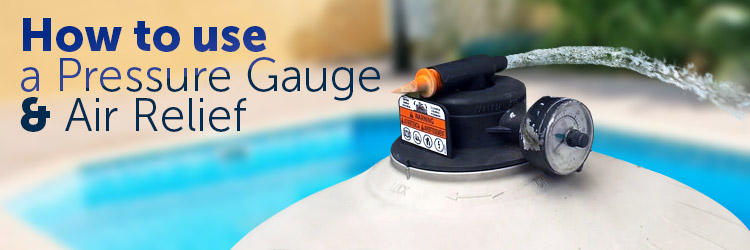
To get a read on this, your filter has a pressure gauge usually found on top of the tank.  The gauge has a round face numbered 0 – 60, a needle that indicates the pressure in pounds per square inch (psi), and a clear protective lens.  This small part is key to maintaining your filter and therefore your entire pool.
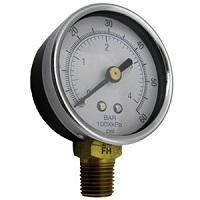
Filter Pressure Gauge

What’s Normal?

For your pressure gauge to be of any use at all, you first need to know the normal operating pressure of your filter.  Ideally this is a number you should record upon installation of your filter so you have a benchmark for all subsequent pressure readings.  If it’s not a new filter, then you want to note the starting pressure after your filter has been cleaned.  This number is not the same for all filters as there are way too many variations from one pool to another.

Normal pressure means pool circulation is in good order, with the pump’s suction drawing water, passing it through the filter, and returning it to the pool at the correct gallons per minute.  This is the sweet spot where pool owners can lean back in that lounge chair and relax, for a little while anyway.

Too High

Eventually the inevitable will occur – a higher than normal reading on that gauge.  The rule of thumb is that a reading 10 psi over normal indicates it’s time to clean the filter.  Cartridges that need to be cleaned, or sand or D.E. that needs to be backwashed are usually the cause of the higher reading.  In this case, the pump is still doing its job but the dirty filter media is slowing down the return of water to the pool and raising pressure within the tank.  In most cases, cleaning will decrease the pressure but sometimes replacement of the media is required.  Consider replacing filter media if you clean repeatedly and still see high pressure readings.

Too Low

Of course, the other scenario is that your reading might be too low; 5 psi below normal should get your attention.  This typically indicates that water going into the filter is somehow impeded.  Pressure within the filter tank is created by water so a low reading means restricted flow.  This comes from a source other than the filter itself; the problem is that the pump is sucking less water than normal.  In this case, check for debris clogging the pump basket and impeller, and any air leaks at the pump (the pump lid and/or lid o-ring are common culprits).  If the pump looks good, make sure the main drain covers aren’t blocked and check the pool water level to be sure enough water is reaching the skimmer.  If you can’t resolve low pressure after checking and correcting these most common causes, then you might require a qualified pool tech to assess the problem.

The gauge should also be inspected periodically to be sure it is in good working condition.  High or low readings could come from the gauge itself.  Signs of needing a new one are cracked or foggy glass or a needle that sticks.  If the gauge is questionable, it’s worth spending the average of $15 – $20 to replace it and ensure more accurate readings.

Air Relief Valve

Working alongside the pressure gauge is the air relief valve.  Air builds up inside the filter tank when the pump has been off or has lost prime.  Upon start-up, opening the air relief provides a vent for trapped air.  This is vital for a couple reasons.  First, when the pump starts, water starts rushing through the system.  If trapped air is not released, it is compressed by this flow of water, increasing pressure and possibly compromising pool equipment i.e., causing the top of the filter or the pump lid to blow out.  Second, trapped air competes with water for space inside the tank and can prevent water from flowing through the full filtration area available, reducing your filter’s efficiency.

Blog Image - Air Relief (200 x 200)
Air Relief Valve

There are quite a few ways air can get into the system so there will be different scenarios that require releasing it through the air relief valve.  Some of the possible causes are opening the pump lid (typically to prime the pump, clean the strainer or replace parts), backwashing, vacuuming with a cracked hose, or a water level that has dropped below the skimmer.

Both the filter pressure gauge and air relief valve are important to the overall health of your pool’s circulation and filtration systems.  Make sure yours are in good shape and if not, check with us for these easily replaceable and inexpensive parts.  We have a huge selection of filter parts for filters both well-known and obscure.

author avatar
Matthew Simmons Technical Writer & Pool Product Expert
Swimming pool expert at InyoPools and host of Poolside Chat, brings over a decade of experience in the pool industry.

Related Videos

79 responses to “How to Use a Pool Filter Pressure Gauge and Air Relief”

  1. Steve Avatar

    I have a jandy dev60 filter. I recently cleaned the filter and recharged with 10 scoops of De. The pool looks clean but when you swim at night with pool lights or when the sun is directly shining you can see small white particles throughout the pool so I’m thinking some De is getting back in. Also I noticed when I use the air pressure relief valve the water that comes out has De in it. All this equipment is brand new as is the pool. Any suggestions.

    1. Matthew Simmons Avatar

      My first thought is that it could be a torn grid. The only way to check that is to open the filter and scope out the grids for rips. We have a guide that covers the other possibilities, check it out here: Getting DE Powder Back in Your Pool

  2. Melanie A. Avatar

    If I run my Polaris pool cleaner, the filter pressure goes up by 10psi. Is this a normal thing?

    1. Matthew Simmons Avatar

      What type of Polaris pool cleaner is it? Is it a pressure side cleaner that uses a booster pump or a regular suction side cleaner?

  3. Benita Avatar

    Oh also pressure gauge didn’t work I replaced it… however it isn’t reading either… there is definitely a problem in my sand filter system.

  4. Benita Avatar

    I have a carefree sand filter. I hear air in the tank. ( I hear it bubbling) And no air relief valve. I have tried backwash. I also can’t find a leak…. everything is less than a year old. I’m at a loss… there are no professionals in my area that will check an above ground pool system.

    1. Matthew Simmons Avatar

      Sand filters usually do not have an air relief. The air is worked out of the tank eventually unless you have a constant air leak feeding new air. have you tried the smoke trick, to find any sucking air leaks? Use incense or a cigarette (anything that puts out smoke) and run it along the pipes and pool equipment. if something is pulling in air, then it will also pull the smoke.

  5. Christos Tsourakis Avatar

    When my pool pump is turned on the lid on my filter unit raises about a inch, is that normal?

    1. Matthew Simmons Avatar

      No that is not common. The lid should be securely fastened to the lower shell of the tank.

  6. Rita Kohms Avatar

    No pressure, won’t prime. Been fiddling with everything for 2 days. Should I try to release the air pressure valve while the pump is on (and just humming) or turn it off before doing it. Thanks!

    1. Matthew Simmons Avatar

      If the motor is humming and not turning, it sounds like a motor issue and not air in the system. You may have a bad capacitor, or something deeper is troubling your motor.

      Here is a guide on troubleshooting a pool pump motor

  7.  Avatar

    We had a new sand filter / pump installed last spring and paid to have our pool closed for the winter. We tried open our pool today and every time we run the filter, there is water shooting from the air bleed valve……even when it’s fully closed. We did already replace the O-ring but it did not help. Does anyone have any advice?

  8. Melissa Avatar

    There is a continuous stream of air coming from my air release thing at the top of my filter. The water never comes shooting out to tell me all the air is out of the system. What should I do?

    1. Matthew Simmons Avatar

      Can you see larger than normal bubbles through your pump lid while the pump is running? Do you see air bubbles coming out of your return lines?

      1. Kathy Avatar

        Melissa didn’t reply to your question (that I have found yet), but that is what mine is doing today after raccoons made a mess last night. I thought I had it cleaned well, but now have air bubbles coming out of the return lines and the air only out of the release. How do I proceed, please?

        1. Matthew Simmons Avatar

          First, make sure the water level in the pool is right. Second, prime the pump using a hose or a bucket. Next, start your pump as usual; the priming and air purging might take a minute. If that does not work, then you should start searching for an air leak. To Two guides that should help you in this troubleshoot: How To Determine Why a Pool Pump Won’t Prime & How to Identify and Correct Air Leaks

  9. Kevin Brooks Avatar

    I just installed a Hayward TriStar VSP pump, the rest of all my equipment is also Hayward. I’ve worked in mechanical systems my entire career and understand the importance in keeping the system free of air and vent during start up…when I’m there. As the industry goes more toward automation, we are not always there when the pump starts, I never am as it runs on a program set.
    I’m considering running a continuous vent by putting a tee where the gauge is and running a small 1/4″ Stainless line over to downstream of my Chlorine Generator (have a saltwater pool). You see any issues with this? I would bypass a very small amount of flow around the filters, but minimal.
    This way the filter housing would be vented all the time.
    The main reason I am considering is: if there is air in the filter housing, when the pump shifts modes, it trips on overload as the air bubble expands and forces water back into the discharge of pump while it trying to restart. Hayward and I troubleshot this for a couple weeks before we found the cause. If it’s vented, shifts beautifullly every time. When running, it stays full of water and vented. The issue comes when the system is down for a few hours and the filter housing eventually drains.
    Interested in your thoughts.

    1. Alex Avatar

      I’ve heard that the variable pumps and sand filters may not be a good match. Sand filters require a permanent water pressure… – that’s what my pool builder had said a few years ago

      1. Matthew Simmons Avatar

        Variable speed motors are a great fit for Sand, DE, or Cartridge filters. The pressure issue your pool guy is talking about I have not experienced in the years I have been in the pool industry. GAlso, dual speed motor which have been around for decades have a high and low speed, and they work fine no matter the filter media.

  10. pat Avatar

    My skimmer does not move in the pool. How do I get it to move again.

Leave a Reply

Your email address will not be published. Required fields are marked *