Home / Articles / How to Use a Pool Filter Pressure Gauge and Air Relief

How to Use a Pool Filter Pressure Gauge and Air Relief

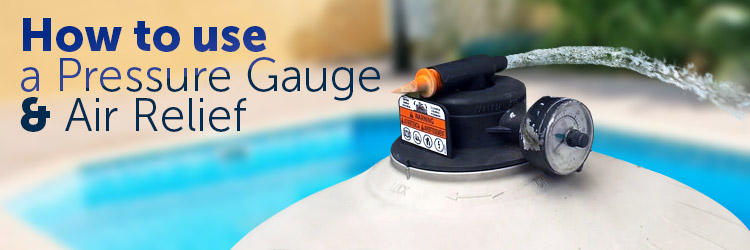
How to use a Pool Filter Pressure Gauge & Air Relief

A pool filter is a rather passive piece of equipment.  With no electrical components and no moving parts unless you include valve handles, it is mainly a tank that water flows through.  But there is still a complex swirl of activity going on in there, and part of that is pressure.

Pressure Gauge

To get a read on this, your filter has a pressure gauge usually found on top of the tank.  The gauge has a round face numbered 0 – 60, a needle that indicates the pressure in pounds per square inch (psi), and a clear protective lens.  This small part is key to maintaining your filter and therefore your entire pool.
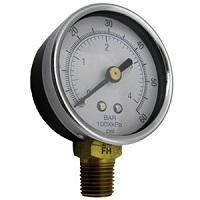
Filter Pressure Gauge

What’s Normal?

For your pressure gauge to be of any use at all, you first need to know the normal operating pressure of your filter.  Ideally this is a number you should record upon installation of your filter so you have a benchmark for all subsequent pressure readings.  If it’s not a new filter, then you want to note the starting pressure after your filter has been cleaned.  This number is not the same for all filters as there are way too many variations from one pool to another.

Normal pressure means pool circulation is in good order, with the pump’s suction drawing water, passing it through the filter, and returning it to the pool at the correct gallons per minute.  This is the sweet spot where pool owners can lean back in that lounge chair and relax, for a little while anyway.

Too High

Eventually the inevitable will occur – a higher than normal reading on that gauge.  The rule of thumb is that a reading 10 psi over normal indicates it’s time to clean the filter.  Cartridges that need to be cleaned, or sand or D.E. that needs to be backwashed are usually the cause of the higher reading.  In this case, the pump is still doing its job but the dirty filter media is slowing down the return of water to the pool and raising pressure within the tank.  In most cases, cleaning will decrease the pressure but sometimes replacement of the media is required.  Consider replacing filter media if you clean repeatedly and still see high pressure readings.

Too Low

Of course, the other scenario is that your reading might be too low; 5 psi below normal should get your attention.  This typically indicates that water going into the filter is somehow impeded.  Pressure within the filter tank is created by water so a low reading means restricted flow.  This comes from a source other than the filter itself; the problem is that the pump is sucking less water than normal.  In this case, check for debris clogging the pump basket and impeller, and any air leaks at the pump (the pump lid and/or lid o-ring are common culprits).  If the pump looks good, make sure the main drain covers aren’t blocked and check the pool water level to be sure enough water is reaching the skimmer.  If you can’t resolve low pressure after checking and correcting these most common causes, then you might require a qualified pool tech to assess the problem.

The gauge should also be inspected periodically to be sure it is in good working condition.  High or low readings could come from the gauge itself.  Signs of needing a new one are cracked or foggy glass or a needle that sticks.  If the gauge is questionable, it’s worth spending the average of $15 – $20 to replace it and ensure more accurate readings.

Air Relief Valve

Working alongside the pressure gauge is the air relief valve.  Air builds up inside the filter tank when the pump has been off or has lost prime.  Upon start-up, opening the air relief provides a vent for trapped air.  This is vital for a couple reasons.  First, when the pump starts, water starts rushing through the system.  If trapped air is not released, it is compressed by this flow of water, increasing pressure and possibly compromising pool equipment i.e., causing the top of the filter or the pump lid to blow out.  Second, trapped air competes with water for space inside the tank and can prevent water from flowing through the full filtration area available, reducing your filter’s efficiency.

Blog Image - Air Relief (200 x 200)
Air Relief Valve

There are quite a few ways air can get into the system so there will be different scenarios that require releasing it through the air relief valve.  Some of the possible causes are opening the pump lid (typically to prime the pump, clean the strainer or replace parts), backwashing, vacuuming with a cracked hose, or a water level that has dropped below the skimmer.

Both the filter pressure gauge and air relief valve are important to the overall health of your pool’s circulation and filtration systems.  Make sure yours are in good shape and if not, check with us for these easily replaceable and inexpensive parts.  We have a huge selection of filter parts for filters both well-known and obscure.

author avatar
Matthew Simmons Technical Writer & Pool Product Expert
Swimming pool expert at InyoPools and host of Poolside Chat, brings over a decade of experience in the pool industry.

Related Videos

79 responses to “How to Use a Pool Filter Pressure Gauge and Air Relief”

  1. Lee Avatar

    What if I open my PRV and water only runs out? I was expecting something more high pressure… with water blasting out a few feet. It’s a Hayward DE Filter. Any concerns?

    1. Matthew Simmons Avatar

      Different systems run at different pressures. Is it reacting differently than before? Also, do you have a dual or variable speed pump that was running at a lower RPM at the time of this test?

  2. Regen Suit Avatar

    Hey Matt

    I am needing a replacement for my pool pump but can’t seem to find the exact one. I now have a Waterway Hi-Flo II 48-frame above ground 115V 2HP dual-speed. It has a part #PH2200 – 6RP. It is making a loud whistling type noise and the neighbors are becoming annoyed ?. Can you suggest a replacement and where I can order one? Thanks so much!

    1. Matthew Simmons Avatar

      We do have the PH22006R listed on the site, but we currently do not show one in stock. Most current a/g pumps top out about 1.5 HP, but that should be suitable for pools up to 36′ round. A couple of 1.5 HP 2-speed above ground pool pumps to consider: Pentair Dynamo and the Hayward Matrix

  3. Elizabeth Avatar

    I have a Hayward DE filter. Pressure has been been fine since opening in May. Weekly backwashing. Water is crystal clear, no algae. Decided to clean and inspect the filter as it was not done yet this season. Cleaned it, inspected the grids, no tears or cracks. No leaks in any of the equipment. No bubbles in pump basket. DE replaced and pressure was at 10, which is normal for my pool. Great pressure out my jets. No DE returning through the jets. Two days later, pressure on my gauge reads 25. I backwash, rinse, backwash. Release the air pressure. (Even the backwash water was clean, just gray from the filter powder). Add the DE again. Two days, pressure up to 25 again. I am stumped. Any ideas?

  4. Karly Avatar

    I have a Hayward D.E. filter and have been trying to correct high pressure for two weeks now. It was reading at over 35. We have tried cleaning the grids and the strainer basket. We replaced the multi port valve, and we got a new motor for the pump. Pump is a single speed. We finally took the grids apart tonight and cleaned each one with a power washer. After putting it all back together, pressure was 10 for a while but is now 25. The only thing I know of is that the air breather tube is broken. The guy at the pool store told me this part has nothing to do with pressure. Is that true? Any other suggestions?

  5. Wendy VW Avatar

    New to pool owning…finally got the rusty water cleaned. We have been trying for a week to get Wanda the Whale vacuum to work. We have pressure in the hose all air bubbles out of Wanda and nothing. Our Hayward sand filter and pump have 0 psi as they should… frustrating ready to throw it all away… Help please

    1. Matthew Simmons Avatar

      Your pump and filter should not have a pressure reading of 0PSI if they are running. Take a look at this guide: How to Correct Low Water Pressure in Your Pool System

  6. Saundra Patterson Avatar

    I released air from the air relief valve and the water surged and pushed out the turn screw? I put it back it but now there is a continuous stream of water coming from a place on the valve.

    1. Matthew Simmons Avatar

      By the turn screw, do you mean the twist knob of the air relief? If the leak is coming from there, then an o-ring might be out of place or missing.

      What is the model number of your filter?

  7. Melissa Avatar

    My pump sounds like it is surging and it looks like air in top of the strainer lid.

    1. Matthew Simmons Avatar

      It could be an air leak causing the air in the strainer. The surging may be caused by the pump running dry. Take a look at this guide: How to Identify and Correct Air Leaks

  8. Sandy Avatar

    I have opened my air relief valve many times. Yesterday, I twisted it up and open until water came out. However, when i twisted it shut, it would only go a bit and would not fully close back. Pool man says come buy another one and replace it. What do you say?

    1. Matthew Simmons Avatar

      Did you cross thread the plug when you were screwing it in? That may cause the plug to go in cockeyed making it not insert properly.

  9. Ariel Avatar

    Hi Matthew!

    I’m new to pool maintenance. I figured out water testing, cleaning leaves out of filter and skimmer, just backwashed for the first time today ( I have a Hayward sand filter ). I had a recent water leak on a return hose that was repaired, no big deal. Now I am noticing water collecting on the top of my control valve and condensation on most my hose lines. Is this normal? Do I have a bad seal? Or is this due to weather change?

    1. Matthew Simmons Avatar

      When your pump is running do you see larger than normal air bubbles in the pool pump strainer lid? Or do you see water actively pouring from the top of the valve? if not, then it probably isn’t an issue.

      1. Ariel Avatar

        I don’t see either of those. After reading the manual for the pump, my concern is whether or not a seal is bad. But it was atrociously foggy this morning. I’ll assume that condensation is coming from weather changes. Is it normal for a little bit of water to squeeze out when moving the control valve between settings? (Thank you so much for your response!!!!)

        1. Matthew Simmons Avatar

          There should not be any water leaking from the top of your valve when the handle is turning. There are gaskets on the stem of the diverter handle (inside the valve) that should be preventing water from escaping. Also, make sure you are only operating the handle when the pump is off. If you move the handle when water is flowing it can play havoc with gaskets.

  10. Dean Avatar

    Hi whenever i go to open the air relief valve water usually starts spraying out like fast high pressure….i opened it today and the water is slowly coming out. What could be the problem?

    1. Matthew Simmons Avatar

      Is your pressure gauge at normal operating levels? Or is it low? If they are low, it could be a blockage or something else causing low pressure.

      Do you have a single speed, dual or variable speed pump? If you have one of the latter then you may be opening the valve when it is at a lower speed.

Leave a Reply

Your email address will not be published. Required fields are marked *