
Did you know that a swimming pool pump…
- Accounts for 25% of your household’s energy bill
- Is the largest electricity consumer in your home
- Uses three times the energy of a refrigerator
- On average costs $427 per year to operate
Recently my wife and I built a swimming pool in our backyard and from a professional standpoint this was such a great learning experience. Building our pool allowed me to test out many of the pool products that I have recommended over the years. During this process I found there were products that I absolutely loved, but at the same time there were a few products that I have recommended on a daily basis that I would not recommend in the future again.
One of my favorite items connected to my pool is my Jandy variable speed pump. It is so quiet, gives me great flexibility with my water features and most important it is extremely energy efficient. During the time period that I was building our pool, I also started to participate quite a bit in a few online swimming pool forums and whenever the topic of pumps would arise I would be eager to suggest a variable speed pump. As I commented on this topic I noticed that there were a few who felt that variable speed pumps were not the best choice and in many cases would suggest a dual speed pump. So, I decided that I would dig a little deeper into this topic and I have shared my findings in this blog post.
The three types of pool pumps explained
First, let’s start with a basic overview of each of the three types of pool pumps on the market today.
Single Speed Pool Pumps (Cost $250-$500)
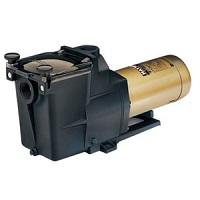
- Highest operational costs
- Least expensive upfront costs
- Operate at a single speed of 3450 revolutions per minute (RPM)
- Operate at a single horsepower ranging from ¾ HP to 3 HP
- Account for 75% of the pool pumps in the USA
Dual Speed Pool Pumps (Cost $500-$700)
- Lower operational cost that contributes to significant operational cost savings
- More expensive than Single Speed Pumps
- Operate at two speeds – 3450 RPM and 1725 RPM
- Operate at two different HPs
- Quiet at low speed
- Difficult to fine tune flow rates
- Additional controller or timer may be needed
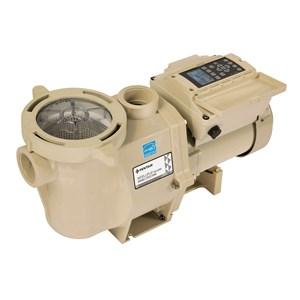
Variable Speed Pool Pumps (Cost $650-$1,200)
- Least expensive pump to operate
- Most expensive upfront costs
- Operate at full range of speeds from 600 RPM – 3450 RPM
- Operate at full range of HPs
- Easy to fine tune flow rates
- Extremely quiet
So why the debate?
The main point of the debate is if you should pay the extra upfront dollars for a pump to reap the rewards of lower operational costs in the future and subsequently how much more should you spend. Should you spend a little bit more on a dual speed pump for pretty good energy savings or should you pay more for a variable speed pump for even greater energy savings and the ability to fine-tune your flow rates?
Why do dual speed and variable speed pumps cost less to operate?
Typically single-speed pumps are too big for your pool. Dual speed and variable speed pumps address this wasted energy as they can operate at different speeds. Running your pump at lower speeds for longer periods of time will cost you much less in operational costs than running your pump at a high speed for shorter periods of time. The energy savings that are gained by replacing a single speed pump with either a dual speed or variable speed pump are based on an engineering principle known as the Pump Affinity Law. Without taking you back to high school algebra class, this principle states that the energy savings are disproportionately larger as you lower the speed of your pump. For example, if you reduce the RPMs of your pump by 50% you don’t get a 50% energy savings you actually get a 75% energy savings and lowering your RPM by 66% gives you an 89% energy savings.
For example if you reduce the RPMs of your pump by 50% you don’t get a 50% energy savings you actually get a 75% energy savings and lowering your RPM by 66% gives you an 89% energy savings.
Is your electricity expensive?
Electricity costs vary widely from state to state and this plays a big factor in determining which pump to choose. You pay for your electricity by the kilowatt-hour (kWh) and the pricing you pay per kilowatt-hour varies greatly from state to state. Dual speed and variable speed pumps use far less kWh than traditional single speed pumps with variable speed pumps using the lowest amount of kWh. If you do not know how much you pay for electricity then this website, The Cost of Electricity for All 50 States, shows you how much you pay. Below I have listed a few of the more popular states and if they fall into the expensive electricity, average electricity or inexpensive electricity categories. Currently, at the time of writing this blog post, the national average in the United States is 12.29 kWh.
Expensive electricity (.30 – .17 kWh) – Traditionally the most expensive areas in the United States for electricity are California, Hawaii, Alaska (a huge pool state), New York and the Northeast.
Average electricity (.11 – .16 kWh) – Florida, Michigan, Ohio, Arizona, and Texas.
Inexpensive electricity (.08 – .10 kWh) – Tennessee, Oklahoma, Louisiana, Kentucky, Mississippi, and West Virginia.
Do you run your pump all year round?
If you live in a warm climate then you will see the potential for greater energy savings than those in cooler climates. This occurs because pool owners in warm climates run their pumps 365 days per year and those in cooler climates shut down their pool pumps for a good percentage of the year. On average pool owners in cooler climates run their pumps 122 days per year. If you run your pool pump 365 days per year in a warm climate then this would be equivalent to three pool seasons in a cooler climate!
Let’s look at the #s
The proof is in the #s so let’s dig into the #s a little deeper. Below I am going to run through a few examples showing the operational costs for a single speed, dual speed, and variable speed pump. Hopefully, this will illustrate how much of an impact electricity cost and climate come into play when determining your pump.
If we take the average size pool of 22,000 gallons and use the guidelines of turning your pool over once per day we come up with the following #s.
Warm Climates
| Pump Type | Energy Use Per Year | Cost to Operate | Savings Per Year | Average Pay Back Time |
|---|---|---|---|---|
| Single Speed Pump | 4714 kWh | $613 | ||
| Dual Speed Pump | 2521 kWh | $327 | $373 | 6 Months |
| Variable Speed Pump | 948 kWh | $123 | $640 | 15 Months |
Note: Example above is using National Avg. for electricity of 12.29 kWh if you live in a state with expensive electricity like California then your savings will be far greater. Calculate exactly how much your pool pump will cost to operate in your state.
Cool Climates
| Pump Type | Energy Use Per Year | Cost to Operate | Savings Per Year | Average Pay Back Time |
|---|---|---|---|---|
| Single Speed Pump | 2723 kWh | $354 | ||
| Dual Speed Pump | 843 kWh | $109 | $244 | 12 Months |
| Variable Speed Pump | 317 kWh | $41 | $312 | 24 Months |
Note: Example above is using National Avg. for electricity of 12.29 kWh if you live in a state with expensive electricity like New York then your savings will be far greater. Calculate exactly how much your pool pump will cost to operate in your state.
Pump payback time
The two biggest factors that determine how fast a dual speed or variable speed pump will pay itself back are:
- Climate
- Cost of energy
In warm climates, you will run your pump 365 days a year meaning you have more opportunity for energy savings. In areas where energy is expensive, the payback will also be quicker.
Just tell me what to get
If your pocketbook can take the additional upfront cost of a dual speed or variable speed pump then I would always suggest one of these pumps as the payback on average takes six months on a dual speed pump and 15 months on a variable speed pump.
In general, my suggestion would be based on if you live in a warm climate or cool climate and secondly if you have expensive energy costs or cheap energy costs.
Warm climate & expensive energy – Variable speed pump
Warm climate & cheap energy – Dual speed pump
Cool climate & expensive energy – Variable speed pump
Cool climate & cheap energy – Dual speed pump
Other Considerations
There are quite a few other considerations apart from the cost of operation that you will want to consider to help you determine if a dual speed or variable speed pump is right for you. Below is a list of these considerations.
Power company rebates
Power companies are offering rebates as high as $400 for switching over to a variable speed pump. In many cases, the power company rebate can make a variable speed pump cost less than a dual speed pump. Make sure to check if your power company offers a Variable Speed Pump Rebate. If so, then it may be a no brainer to opt for a variable speed pump.
Ability to control flow
If you have a lot of bells and whistles connected to your pool like waterfalls, a spa, water features, etc. then I would suggest a variable speed pump as it will allow you to control your water flow for each feature.
Pipe size
Keep in mind your pipe size when selecting your pump as the diameter of your pipe will affect which HP pump you can use. Smaller pipe sizes may not be able to handle large HP pumps. Here is a guide showing the GPM ratings for the most common pool pipe sizes.
| Pipe Size | Flow Rating (GPM) |
|---|---|
| 1-1/12″ | 60 GPM |
| 2″ | 100 GPM |
| 2-1/2″ | 140 GPM |
| 3″ | 225 GPM |
This means that if you went with a 3 HP variable speed pump that can output 150 GPM and you only have 1-½” pipe which has a max flow rating of 60 GPMs then the majority of the higher speeds of the pump will go unused as the plumbing is unable to handle this high flow of water.
Additional controller or timer
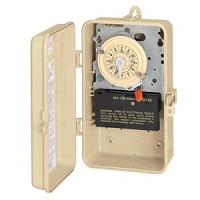
A consideration when looking at dual speed pumps is that in most cases you will need to purchase a separate dual speed timer. The price of this timer ranges between $140-$200 based on your current set up. If your pump is turned on and off by a standard yellow dial timer then you would go the $140 route which is a second timer which controls the switching between high and low speeds where your original timer would be for turning the power on and off to the pump. If you don’t have a timer for your pool or your project is the construction of a new pool then you would need a two clock timer which is the $200 timer. In most cases, for pools with automated control systems, an additional timer is not needed. There are a few systems like the Jandy Aqualink which require a special dual speed relay.
Motor replacement or pump replacement
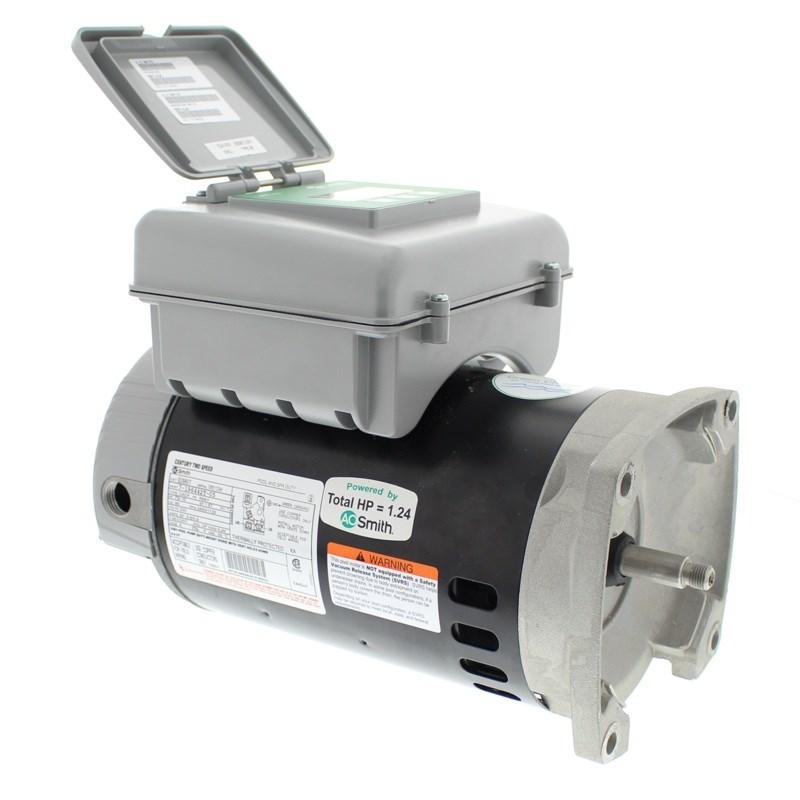
Often there is no need to replace your entire pump and you can save a considerable amount of money by just upgrading your motor to a variable or dual speed motor. So should you replace your entire pump or just your motor? A few questions to ask are:
- How old is your pump?
- Are there visible signs of damage to your pump housing?
- Are parts available for your pump?
In the case of the dual speed pump and motors, it often makes sense to upgrade your motor to a dual speed motor. The reason being is there is a great new motor on the market that has a digital timer mounted directly on the motor meaning that you don’t need to purchase the separate $100-$200 timers indicated above. For some reason unknown to me this digital timer option is only available on replacement motors and not an option on new pumps. Hayward, Pentair, and Zodiac, if you’re listening to this is your next big product and I will only ask for 20% of the revenue…
Pool size (High Stakes Poker)
Typically the larger the pool size the larger the pump which means the operational cost is going to be higher than a smaller pump. So with larger operational costs comes larger operational savings tipping the scales in favor of a variable speed pump on large pools.
Water Features
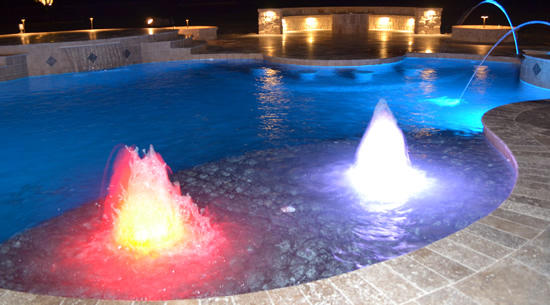
As mentioned earlier one of the key benefits to a variable speed pump apart from operational savings is the ability to control the flow of the pump. This feature comes in very handy if you have water features connected to your pool.
Do you like gadgets?
Many of us like the latest and greatest items on the market. I typically fall into this category. If you wait hours in line for the newest iPhone then you may be a prime candidate for a variable speed pump as they are pretty cool. It is neat to be able to dial your pump into the exact RPM needed and hear the pump ramp up or dial down.
Quiet
If your neighbors are complaining about your pump’s noise then a variable speed may be the way to go. Variable speed pumps are quiet because the motor is Totally Enclosed Fan Cooled (TEFC) meaning that it is much quieter than a single speed or dual speed pump. Often when I have had my pump on at very low RPMs I have to double-check that it is actually on.
In Summary
Your pool pump is most likely the most expensive energy consumer in your house so it makes sense to explore options on how you can minimize this expense. In almost all cases I believe that it makes sense to go with a dual speed or variable speed pool pump over a single speed pump. When choosing between a variable speed pump and a dual speed pump the two most important factors to consider are the cost of your electricity and how often do you use your pool.
Comment below with details about your swimming pool and details about where you live and we will help you determine which pump type is best for you.






Leave a Reply