Home / Articles / Why Your Pool Has No Chlorine: Common Causes & Easy Fixes

Why Your Pool Has No Chlorine: Common Causes & Easy Fixes

Have you ever tested your swimming pool water and couldn’t get a chlorine reading? Figuring you must have done something wrong, you retest your water. Still no reading. So what do you do? Add chlorine, right? After days of adding chlorine and testing chemical levels, you still have no chlorine reading. At this point, your attitude turns from curious to annoyed.

Are your chemical levels imbalanced?

Are you using a reliable pool water test kit?

These are just two questions that need addressing before you can get to the real question, why does my pool have no chlorine? 

Determining Why My Pool Has No Chlorine Reading

Balance Your Pool Water

Excluding chlorine, are the remaining chemicals in your pool balanced? Balancing your water is an important step that pool owners sometimes forget. The very first thing you want to do is get an accurate reading of your chemical levels.

If you don’t have a home testing kit, we recommend either purchasing one or taking a water sample to a local pool store and testing it there. Getting the most recent and the most accurate chemical readings is imperative before adding any additional chemicals.

High Chlorine Demand: What Is It and How Is It Caused?

If you test your pool water and can’t get a chlorine reading, it may be due to your pool’s high demand for chlorine. A high chlorine demand (sometimes referred as chlorine lock), simply means that although your water may appear clear and balanced, the chlorine in your pool is ineffective. But why?

If you need guidance on balancing your pool, check out our blog here.

Too Much Organic Material In Your Pool

One of the causes of a high chlorine demand is an excessive buildup of algae and phosphates. Although you’re adding chlorine to your water, bacteria or algae are overpowering the chemicals causing it not to show up on tests strips or in water kits.

It’s like when you overdraft $200 from your bank account but only add $100 back. You’re still less $100 from the original overdraft. The chlorine in your pool acts the same way.

Keep in mind, organic materials like algae, leaves, sunscreen, lotions, pee, poop, and etc., consume chlorine. As chlorine does its job, it is depleted in the process. To prevent the demand for chlorine from happening, help remove the organic material from your pool water by brushing the algae from the pool walls, cleaning your filter, and removing leaves and debris from the water.

Chemical Imbalances

One of the ways phosphates get into your pool is through household cleaners. There are certain household cleaners that weren’t designed for the pool. Cleaner manufacturers add additional components to the composition such as phosphates or nitrates. The extra phosphates interfere with the pool’s current sanitizer and can cause a demand for chlorine.

Having too much cyanuric acid in your pool is another way to create a high demand for chlorine. Sometimes, it’s just a simple case of pool owners adding too much stabilizer to the water. Sometimes, this occurs when you aren’t partially draining and refilling your pool periodically.

Adversely, very little or zero stabilizer also creates a demand for chlorine. Cyanuric acid, in a sense, acts like sunscreen for the pool. If you’ve ever worn sunscreen in the hot sun, you know that you have to consistently re-apply. Our pools are the same way. If your CYA levels are really low, the sun can burn through the chlorine in your pool rather quickly.

You can learn more about the relationship between chlorine and cyanuric acid here.

Rainstorms or Excessive Rain

Other ways that can potentially cause a chlorine demand in your pool is excessive rain. When it rains, air pockets form in the raindrops and allows oxygen into the water. When this happens, your pool’s chemistry offsets, resulting in the demand for chlorine.

Determining If Your Pool Has a High Demand For Chlorine

The quickest way to determine if your pool is experiencing a high demand for chlorine is to perform a test for free and total chlorine.

Free chlorine shows the level of disinfecting chlorine available to sanitize your pool. Free chlorine isn’t interacting with contaminants yet. Total chlorine is the amount of chlorine, used or not, in your water.

In the test, if your free chlorine reading matches your total chlorine reading, your pool is NOT experiencing a high demand for chlorine. This is a normal reading.

However, if your free chlorine reading is different than your total chlorine reading, then there’s a problem. You shouldn’t have a free chlorine reading of 3 and a total chlorine reading of 7.
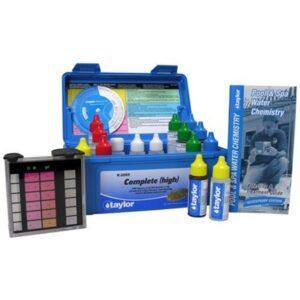
Pool Chemistry Test Kit

Breaking Your Chlorine Lock

While there are many ways to solve this issue, we will only be covering a few of them. Please select the option you are most comfortable with.

Partially Draining Your Pool

One of the simplest methods to breaking chlorine demand is by partially draining your pool. The severity of the chlorine lock determines how long this method takes. Unfortunately, there’s no exact science to this. Simply drain your pool little by little, refill it, test it, and repeat if necessary.

Shock Your Pool

Another method of breaking chlorine lock is shocking your pool. Bring your chlorine levels to 20ppm or three times higher than the current levels. We recommend using a non-chlorine oxidizing shock until your free and total chlorine reads the same.

We typically see more pools with a high demand for chlorine during the spring opening season. A lot of the times, pools sit for months, accumulating a ton of different contaminants. This is one of the reasons we always recommend balancing your pool before you close it. You don’t want to compile pool issues or push them to the side. Although high chlorine demand is more common than you might suspect, it is something pool owners can handle themselves.

Give us a call if you think your pool is experiencing this same issue. Make sure you have your most recent chemical readings before we can offer any help.

author avatar
Charlie Ramirez
Writer at InyoPools.com, brings a wealth of knowledge and expertise in pool care and equipment, helping pool owners make informed decisions for over a decade.

Related Videos

167 responses to “Why Your Pool Has No Chlorine: Common Causes & Easy Fixes”

  1. Susan M Avatar

    Hello! My above ground intex pool is a little cloudy. The test strips read:

    Bromine- 0
    Alkalinity – 80
    PH – 7.8
    Total hardness – 0

    Any ideas what to do? Yesterday i ran the hose for 40 mins to add a bit of water (as the pool is only about half full anyhow for kids safety) and then did a shock treatment and let filter run for 24hrs. The ph and alkaline went up a little in normal ranges but i still have a reading of 0 for bromine and hardness. Im just wondering how safe this is for swimming and what else i can do to increase those levels. Thank you in advance!

  2. Bill Reutzel Avatar

    I have in ground pool 16×32 I have the PH at 7.6-7.8 I have zero reading on Chlorine No matter how much I add the water is clear but with a green tint very puzzling never had this issue please help

    1. Matthew Simmons Avatar

      Ok, p is only one of the important balancer chemicals needed to ensure your chlorine is able to work efficiently. What are your total alkalinity, CYA, and phosphate levels? Give that section in the article a reread for an in-depth explainer on why they are important.

  3. Wanda Avatar

    Help!!! Everytime I test my pool, it shows no chlorine. However all other results are within range.
    Bromine 0
    FAC 0
    Alkaline 80-120
    Ph 7.2-7.8
    The pool is clear, so why am I not getting a fac reading?

    1. Matthew Simmons Avatar

      I’m pretty sure this is covered in the article, but I digress.

      What is your CYA Level? Also, have you taken your water to a pool store for a free water test? The in-store tests will give you more accurate test results than your average strips.

  4. Patty Avatar

    I am having a problem with my pool and have yet been able to swim in it this summer. I have taken it to our local pool store to have the water tested and it shows all levels normal except no chlorine every time. I’ve dumped algacide and shock in it repeatedly and still green with no chlorine. It now is having the shock floating on top and won’t even dissolve. The pool place is stumped with no more suggestions.

    1. Matthew Simmons Avatar

      What are your phosphate levels? A high phosphate count can gobble up chlorine.

  5. Lisette Avatar

    I just added 4 gallons of shock to my 16000 gallon pool and the strips show no chlorine. Should I add more shock?

    1. Matthew Simmons Avatar

      What are the results of your latest chemistry test? Blindly dumping shock into a pool, without knowing what your pool chemistry is, is throwing money down the drain.

  6. Ashley Avatar

    Hi there! I feel like I’m needing a lot of help. We opened our above ground 30 foot pool a couple weeks ago (cartridge filter) and have yet to get it clear. We were fighting iron and it always stayed cloudy blue never brown. This of course made it impossible to get a chlorine reading. This past Friday our pump broke as the temps soared to mid 90s! The water turned to a green color now. We have been using our robot sweeper constantly to sweep up anything and don’t have any algae on the floor anymore. Our new pump is finally running and upon testing everything, here are the results:
    Total Bromine: 0
    Free Chlorine: 0
    pH: 6.8-7.2
    Total Alkalinity: 80-125

    What are the next steps we need to take to get our pool crystal clear?

    Thank you so much!!

    1. Matthew Simmons Avatar

      You have to get your pH higher, then you can work on the chlorine. An easy tool for knowing how much of each chemical you need to add to balance your chemistry is Trouble Free’s Pool Math calculator.

      1. Ashley Avatar

        So raising the pH first by borax and then working on the chlorine how? I always thought we had to lower the pH first and then super shock to get a chlorine level??

        1. Matthew Simmons Avatar

          work on chlorine = Add chlorine and shock

          Optimal conditions for chlorine to works at its best, the pH should be between 7.2-7.8

  7. Lou Boarman Avatar

    We had a lot of pollen enter our pool (the crew that opened it in the spring just swept the pollen that was on the cover into the water as they removed the cover). This resulted in a very high CYA reading (>100). We drained about 16 in of water from the pool (capacity 29,160 gal). The readings at that time were:
    FAC/Bromine: 0.5
    ph: 7.2
    Total Alkalinity: 60-120
    Total Hardness: 200-500
    CYA: >100
    After refilling, the CYA is around 40, and I have added 12 gallons of Liquid Shock (sodium hypochlorite) but the FAC levels do not seem to have risen. Should I just keep adding shock? Is granular better? I was avoiding using granular sodium Dichloro-s-triazinetrione dihydrate because I was afraid it would introduce cyanuric acid, which we just lowered.
    Thanks

    1. Matthew Simmons Avatar

      Hopefully, you have taken care of the pollen issue as well. Use a clarifier to get rid of any leftover clumps.

      If you want an easy tool that will tell you how much to add, I suggest TrobleFree Pool’s PoolMath

  8. Trish Avatar

    Help please. Definitely experiencing chlorine block. All other levels are in line – phosphates a little high at 844.
    I was told to shock and retest. I did and the bromine level came up but the pool never cleared (its very cloudy) – I waited a couple days, retested – NO bromine level again.

    1. Matthew Simmons Avatar

      Can you post the full results of your latest water chemistry tests? I need to see the full scope of your water levels to understand what needs to be done.

    2. Terry Avatar

      844 is extremely high, that’s your problem

  9. Linda Avatar

    Could a filter that needs to be replaced cause the chlorinator to always have a red light for water flow and thus not make any chlorine? We have cleaned the cell and the filter and the problem persists.

    1. Matthew Simmons Avatar

      The issue could be two things, Either the cell needs replacing or the filter is so dirty it is restricting flow much the generator cannot turn on.

      To determine if your filter is the problem, bypass the filter media. For cartridge filters, remove the cartridges and the manifolds. If you have a sand or a DE filter, set your multiport valve to recirculate. If your salt generator still says low flow, then chances are it is not a filter problem.

      1. Linda Avatar

        We are total pool novices-so are you saying to literally take the filter out and then start the pump without it and see if it gets flow to the chlorinator?

        1. Matthew Simmons Avatar

          I am saying to bypass the filter media (aka the sand, cartridges, or DE grids) by either using the recirculate feature on the valve or removing the cartridge inside the filter. This means your water should have a straight shot through your system with little resistance. What kind of filter do you have?

          1. Linda Avatar

            We have a Pentair filter R173216. yesterday the chlorinator ran just fine. Today the lights flash between red/green on the salt and no water flow which is what it started doing last week. We’ll take the filter cartridge out and try it as you suggested and order a new filter just in case. Hopefully it is the filter and not the chlorinator. Appreciate your advice!

    2. Bvask Avatar

      We had the same waterflow problem with our Dive system chlorinator. The solution was simple: take one of the return jets out. They compared it to traffic on the highway. All those cars going through a small opening will cause a traffic jam way back. This slows everything down. Taking out One of the Jets is like opening for more lanes on the highway. More cars can travel less back up behind. Our water flow went from 21 gallons per minute up to 29 in a matter of seconds. Hope this helps

  10. Brenda Wetters Avatar

    We have a salt pool with a very low chlorine level

    1. Matthew Simmons Avatar

      Have you tried turning up the level of chlorine output on the controller? Also, how old is your cell? Low output could be a sign you need to clean or replace your cell.

      1.  Avatar

        My pool water is green but clear. I filled the pool with hose water from our town supply and right fr the time it was filled it looked yellowish or light green. I shocked the pool and ran the pump overnight and the water is crystal clear but still tinted green. There is sediment on the bottom of the pool now. I also used stain prevent and ran the pump overnight and the colour has not changed at all. Wondering what to do.

        1.  Avatar

          Could be copper, test for that

        2. Elsie Avatar

          Mine was green and I put stabilizer in it

        3. Anonymous Avatar

          Throw in me clean magic eraser

          1.  Avatar

            You can’t throw in a magic eraser!! They contain a chemical called melamine. Most pool owners have Cyuranic acid in them. When melamine from the magic erasers mixes with the stabilized pool water a toxin called “Melamine cyanurate” is produced. This chemical causes kidney damage and eventually kidney failure. Don’t put a magic eraser in your pool!

    2. Katie Avatar

      I have a saltwater pool, and the free chlorine level has been at zero. We’ve added salt to it and ran the pump and have shocked it. We opened it up middle to the end of May. Vacuumed it a few times, haven’t been able to get in yet because we’ve been having a lot of rain and storms this spring where we live, pretty much everyday in May and a few times so far this month. Our pool is not blue but it’s clear and has a greenish look to it. Could it be because of all the rain and that we need to scrub this sides to get rid of the algae?

      1. David Avatar

        I have the exact same problem!!!!

    3. Rocco Martino Avatar

      run your system !
      your saltwater generator can NOT make Chlorine with the pump off !

Leave a Reply

Your email address will not be published. Required fields are marked *