Home / Articles / Will a Salt Chlorine Generator Rust My Above Ground Pool?

Will a Salt Chlorine Generator Rust My Above Ground Pool?

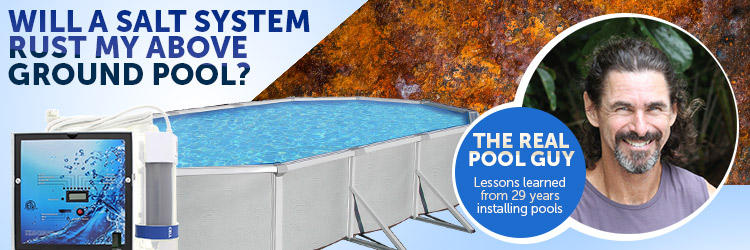
Will a Salt System Rust My Above Ground Pool

Will a Salt Chlorine Generator Rust out My Above Ground Pool?

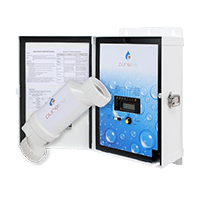
Does a Salt Chlorine Generator cause rust in an above ground pool? This has been a big controversy in the above ground pool industry for many years now. You talk to one pool guy and he’ll say, “It absolutely does.” Yet when you talk to another he’ll say, “No, it doesn’t.” Someone trying to sell you a salt chlorine generator will of course tell you that it would not cause rust while some above ground pool manufacturers will say that it would. So then what’s the answer really? What do I think? Well, I thought you’d never ask. Let me tell you.

My Opinion

My opinion is that it does not cause rust. This statement is pretty definite. It sounds like a statement someone would make if he/she were trying to sell you one or convince you to do something. However, that’s not me. I really don’t care whether or not you buy a salt chlorine generator for your pool and it doesn’t matter if you agree or disagree with my opinion. So now that you know I have nothing to gain, here’s why I think it will not cause rust.

My opinion is that salt systems do not cause rust on above ground pools.

So How Would a Salt Chlorine Generator Cause Rust Anyway?

This is a question no one ever seems to ask. They just think salt plus metal plus moisture equals corrosion. It makes perfect sense, right? Well yea, it does, except I’m from the real outside world and in that world it’s just not that simple. Back to the how.

First, a salt chlorine generator produces chlorine. Some think it is this chlorine that is produced that causes the rust. Sorry, but that can’t be true as about ninety-nine percent of all above ground pools use chlorine even if they don’t have a generator. So, if that were the case then all above grounds would get rusty and they don’t.

Others say it’s the salt content that is in the water that causes the corrosion. This is at least closer to a real possibility, but I don’t think so. A salt chlorine generator unit requires a certain level of salt to be present in the water in order to work. That level is only about a tenth of the salt levels present in the average ocean. Some say they can feel or taste the salt in a salt pool, but that is clearly subjective as the salt levels are really pretty low. In addition to this, saltwater surely is corrosive to metal but so is unsalted water.

Any moisture that is continuously in direct contact with metals will cause some degree of corrosion. Certainly, metals that are directly exposed to really salty water will have a greater rate of corrosion than metals that are exposed to unsalted water. However, check this out. The water in an above ground swimming pool is not directly exposed to its metal structure. This seemingly rarely observed fact kind of makes the whole question surrounding whether the salt content of the water will cause rust a moot point.  Then there’s still the question of fumes.

The water in an above ground swimming pool is not directly exposed to its metal structure.

Does the Water in a Salt Pool Create Corrosive Fumes?

This is really the last hope for a salt chlorine generator to rust out an above ground pool. Usually when I visit a pool where the owners think their salt pool caused rust, it’s very often the metal above ground pool parts above the waterline that are rusted. More specifically, the metal parts under the top rails are the most common places for rust. In that area under the top rails, fumes could gather on a regular basis causing premature corrosion. This absolutely happens. So, the big question is, “What creates these corrosive fumes?” Well, we know that chlorine in the water can create these fumes, but that’s not the fault of a salt chlorine generator as almost all pools have fume causing chlorine in them. So now it comes down to whether the salt content in the pool produces these fumes that corrode the higher parts of an above ground pool? To know for sure, you’d have to ask a chemical scientist and take his word for it. Personally, I think even if it does it wouldn’t be enough to greatly increase the metal’s natural rate of corrosion. Sleepy yet? OK, enough with the technical reasons. Now it is time for the real reason.

The Biggest Reason Why I Don’t Think a Salt Chlorine Generator Causes an Above Ground Pool to Rust

One simple word separates my opinion on this topic from most others here on this perfect planet called the Internet. That simple word is observation! For the last 29 years I’ve been building, rebuilding, relining, repairing, removing and replacing all types of above ground pools from all makers and all models. I’ve installed brand new pools and worked on above grounds that were more than 20 years old and every age in between. These pools have been right on the ocean, near lakes, high and dry, and in wetlands. Some were indoors, buried all the way in the ground, halfway in the ground, and totally above ground in open fields and deeply wooded lots. There were pools with wood decks built around them and some with screen enclosures. I’ve built and worked on above grounds used commercially for swim lessons, dog jumping competitions, and fisheries. The pools I’ve repaired or built have had every type of filter, every size pump, some with extra return lines and some with main drains. I’ve been involved with plumbing of all types of equipment, add-ons like ionizers, chlorinators, ozone generators, and, of course, many salt chlorine generators.

So with all this observation of above ground swimming pools in just about every imaginable scenario, I have been able to find consistencies and patterns that cause things like rust and leaks and so on. I have seen pools rusted prematurely in just about every location – from pools that were installed on top of the ground and were always dry to ones put in the ground that were always wet. In all these different places, there were just as many in the same extreme locales that didn’t have a speck of rust on them anywhere as there were that had a lot of rust. The same is true for salt clorine generators as there are some pools with them that get rust and some that don’t get rust. The same with pools that don’t have salt chlorine generators as some get corrosion and some don’t get corrosion. To make it simple, I’ll say this: I have never been able to make a connection between premature corrosion and salt chlorine generators.

I have never been able to make a connection between premature corrosion and salt chlorine generators.

Lord knows I’ve tried. I would love to be able to point a finger at salt chlorine generators and say they cause rust, but I can’t. I believe this because I just haven’t seen it consistently. So there you have my opinion. Certainly some pool owners will disagree. Many have and that’s cool. I get it especially when you have a pool with a generator and it gets rust. But keep in mind that pool owners who have the same rust in the same area on the same model but don’t have a salt chlorinator will blame it on something else. And that, I must admit, is a little comical to me.

If you have any questions on your above ground pool then we would be happy to help, feel free to give us a call at 1-877-372-6038 or email us at upload@inyopools.com If you liked this article then make sure to sign up for Blog and get our Free 128 Page Pool Care Guide.

author avatar
Dan Dougher

Related Videos

69 responses to “Will a Salt Chlorine Generator Rust My Above Ground Pool?”

  1. Elaine Avatar

    we purchased a pool and it will be installed in the spring. We have been talking about having a salt system installed right away instead of starting with the chlorine. The top rails and posts are resin but I believe the “ring” that clips to the top of the pool walls, to hold the liner in place, is metal. Would it be possible to have that “ring” powder coated prior to installation to help prevent any rust? we also purchased the gasket that has a slit to protect the pool wall by the filter. Just curious about your opinion on the powder coating and if you think it would work and still be able to fit over the liner.

  2. Jorge Avatar

    I owned an intex above ground pool with saltwater system. The salt did damage all the posts by the joints within a year. The corrosion and rust was so bad I could crush the posts with my hands.

    1. Matthew Simmons Avatar

      Or maybe you just got stronger? Joking aside, did you replace the pool or go the replacement parts route?

  3. vo Avatar

    I’m sorry but in our experience it does nothing but rust the steel frames and we have lost two pool frames to this in 4 years. salt water absolutely eats thru and rusts a steel pool frame

  4. Harmony Avatar

    Totally agree with everyone on here, had an intex ultra frame AGP and it rusted away within 3 years, also rusted the metal bases of our polytunnel that covers it, am on the 7th year on the SAME POOL with a chlorine only system haven’t had ANY rust

  5. ChrisM Avatar

    Hi Dan,
    Four years ago I had an above ground Imperial pool installed that was manufactured by Cornelius. Last summer I noticed some rust starting around the top rims but nothing too bad. Fast forward to this year and when I opened the pool I was shocked to see that there is significantly so much more rust. Rust is all around the bottom of all sides, it’s on the tops of all rails and sides, and the underside of all rims is horrifying to look at. Big chunks of rust are dropping into the pool and it’s awful. I have a salt generator that I LOVE and I do not blame it for the rust, especially since I am neurotic about ensuring that my water is balanced and clear at all times. The reason for my post is that I have absolutely no idea what to do or who to call about this rust issue. Do I call a pool installer or is there some special type of service person I need to call? And will my whole pool have to go? Is there anything I can do to save it? I’m just beside myself and not sure what my next step should be so I’m wondering if I can get some advice?

    Thanks in advance for any assistance or recommendations that anyone can provide. I just know that I can’t possibly cover this pool at the end of the season and forget about it til next summer as I’m sure another winter in Boston will do the pool in. 🙁

  6.  Avatar

    Thanks for the very interesting information regarding salt chlorination systems. We installed such a system in our inground pool about 6 years ago – love it! Pool maintenance is much easier now and our vinyl liner does not fade like it did with the traditional chlorine system. But, 3 years ago we got a new lab puppy who LOVES to swim (even more than most labs). Of course, she gets out and shakes off the water indiscriminately. In these 3 years our metal back doors (where she goes often to shake) have rusted out completely, as well as the legs of our patio furniture. Despite some of the information presented here it is clear that the salt is the problem. The top of the doors and furniture have not corroded at all and rust was never before a problem in our 20 plus years of pool ownership – before the salt. We will keep our salt system as we believe it’s a superior system, but we are replacing our doors with non-metal options and looking for some method to protect the legs of our metal furniture. Would welcome any ideas. Thanks again for the dialog.

    1. Matthew Simmons Avatar

      There are sprays like Guardsman Outside Metal Defense, that advertise they ward off corrosion; some homeowners have even had success with car wax/polish to ward off corrosion. Also, try covering your pool patio furniture when it is not in use to lessen the effects of the elements besides the salt.

    2. Dan Dougher Avatar

      Hi. It would be hard for me to believe that the salted water caused your deck furniture to rust, or your door. Really hard! Chlorine gas is what is most corrosive and will do damage when trapped somewhere over a period of time. I have no answer for your corrosion just like I can’t say how the tens of thousands of rusty outdoor furniture and metal doors got that way despite not having a salt chlorine generator or even a pool for that matter. The only thing I can add is that yes, I would replace anything that has corroded with something that has a tougher time rusting or can’t corrode.

  7. Melissa Gore Avatar

    This is our second year with a salt water system on our above ground pool. No the chlorine may not rust it faster but I believe the salt does. I have poles rusted completely in two. And as for the water not touching the metal… I dont know about anyone else kids but mine splash and cause waves and hang on the side. Also my ladder is completely unusable. The pool we had before this one last 5 years with just a regular chlorine system. No salt. So in my opinion salt water systems definitely contribute to the metal rusting faster. I wish I could find a pool with better metal bars that would last longer because the salt water system really is so much nicer then the regular chlorine.

  8. Renee Avatar

    Hey Dan, My pool is ten years old and is in great shape other than the top rails. It is a Doughboy above ground pool that we had put in the ground. We purchased the whole salt water system to go with it. There is a moat around the pool that we had a wooden deck built over. So my husband is able to go underneath and work on the hoses when opening and closing the pool. After two years my husband noticed pieces of rust in the pool and realized that it was the top rails rusting. He called Doughboy and they had said that their pools were not made for salt water systems and the dealer should not have sold us the salt water system with it. We then contacted the dealer we purchased the pool from and they came out, disconnected our salt water cell, replaced the rail and installed a frog chlorine system free of charge. To be honest, the frog system is extremely costly to run so other than the algicide I don’t use it and just use the old fashioned chlorine tablet method. The past two years we have been noticing that the rails are rusting a little again so I am thinking the original rust wasn’t caused by the salt water system but my husband still thinks it is. I LOVED the salt water system and would love to go back to it, (the dealer left us everything the cell was connected to and only took the cell), it was so easy to use! I have been wanting to paint the rails with a boat paint or something and go back to the salt water but my husband is not sold on that idea either. In your opinion, do you think something like that would help keep the rails from rusting with or without salt water? Or do you have any suggestions? Thanks!

    1. Dan Dougher Avatar

      If you mean the top rails of the pool, then maybe. I’ve seen some people paint them with fancy coatings and that works well. If you mean the stabilizer bar under the top rails, then maybe too. I’ve seen people coat them as well but with not have as much luck. A possible solution is to replace those stabilizer rails with 1/2 or 3/4 inch pvc piping used in electrical. They work well but are hard to make as you would have to use a table saw to cut a channel long-ways thick enough to firmly adhere to the top of the pool’s wall.

  9. RetroRich Avatar

    Dan, I know you have a lot of experience and I enjoy your articles but respectfully I’m fullstop disagreeing with you on this one. You seem hellbent here on disregarding some very basic chemistry (there IS a corrosive element brought into play) and the direct experience of a lot of pool owners who have had their pools adversely affected by saltwater systems.

    1. Dan Dougher Avatar

      I’m not sure which chemistry it is that you think I am disregarding. Chlorine is super corrosive. Chlorine is in about 99 percent of all pools. Salt is also present in about 99 percent of all pools. All of these pools, whether they have salt chlorine generators or not, have chlorine and salt in their water.

      You say too that I am disregarding the “direct experience of a lot of pool owners who have had their pools adversely affected by saltwater systems”. Don’t you mean pool owners who think they have had their pools adversely affected be saltwater systems? Unless of course they have some absolute proof which I have yet to see.

      To be more accurate, I’m not disregarding any chemistry or a bunch of pool owner’s opinions. But even if I were, it wouldn’t matter. My opinion on this is based solely on long term documented observation. I simply cannot make a direct link to corrosion and salt systems based on observation. I could link the two based on emotion, logic, and chemistry like you and many other pool owners have, but that would not match overall long term results. And for me, documented long term observation reveals the truth better than any other thing.

  10. Retha Avatar

    I had an above ground pool for a couple years, had no problem with rust, bought a salt chlorine generator last year, rust every where, all the rails were completely rusted. Had to take pool down and throw away. Salt chlorine generators will definitely rust your above ground pool and destroy it.

Leave a Reply

Your email address will not be published. Required fields are marked *