Home / Articles / 5 Biggest Problems with Pool Filters

5 Biggest Problems with Pool Filters

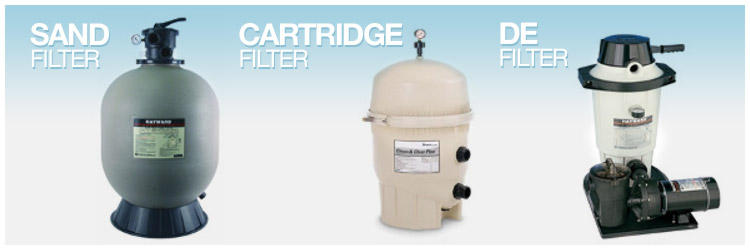
Pool-Filter-Types

For a piece of equipment that is not electrical, digital, or highly complex, a pool filter can still cause a great deal of pool owner stress.  You might be surprised how many questions we field regarding what is essentially a big tank that water passes through.  But since that tank is so vital to the operation and safety of your pool, I wanted to share the some of the most common issues our techs encounter and how you might troubleshoot some basic problems.

#1 The Spider GasketBlog Image - Spider Gasket (200 x 200)
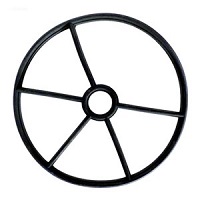
Inside the multi-port valve on DE and sand filters, you will find this gasket which somewhat resembles a spider web, featuring a small center ring and spokes (typically 4 or 5) that connect to a larger outer ring.  For a small, simple part, it can be the source of quite a few filter headaches.  Signs of a worn or damaged spider gasket include leakage around the valve or water coming out of the waste line even though valve is set to “filter”.  Damage to this gasket is commonly caused by moving the valve handle while the pump is running.

If you need to replace the spider gasket, look at the valve body itself (not the filter tank) for a model or part number.  With a valve model number, the correct gasket can usually be cross-referenced.  It is worth noting that some manufacturers include the spider gasket only as part of the diverter.  In this case, you would need to purchase the entire diverter assembly.  If you are unfortunate enough to find yourself in this camp of filter owners, you will want to compare the price of the diverter vs a completely new valve.

#2 True Grit

Probably the most ironic of filter problems is sand or DE powder flowing back into the pool.  For sand filters, one or more cracked laterals or a broken standpipe is typically the culprit.  Replacement laterals can be purchased individually or as part of a standpipe assembly.  The standpipe is available separately also, if you determine all of your laterals are in good shape.

For DE filters, you are usually looking at worn grids that have developed tears.  While checking the grids, also inspect the standpipe o-ring for wear and tear.  Another cause of DE in the pool is simply adding too much DE powder when recharging the grids.  Be sure to follow the manufacturer’s instructions; in the absence of an owner’s manual, a general rule of thumb is 1 lb of DE per 10 sq ft of filter area (this refers to the square footage of your filter, not your pool).

#3 Under PressureBlog Image - Pressure Gauge (200 x 200)
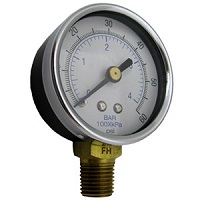
Feeling the pressure of pool ownership?  Then you and your filter might have something in common.  Some filter problems are caused by excessive pressure build-up inside the tank.  High pressure can be caused by having a filter that is undersized for the pump; this means the pump is pushing more gallons per minute than the filter is designed to handle.  Another cause is simply a dirty filter with cartridges that need to be rinsed, or sand or DE that needs to be backwashed.  If after cleaning, you are still faced with high pressure, there could be a clog in the plumbing lines.

High pressure can cause laterals to crack and leak sand into the pool.  It can also be the reason for a cracked tank or even more dramatic, the filter lid blowing off.

#4  Feeling a Little Low

As mentioned above, high filter pressure is a problem but so is low pressure which usually indicates some obstruction of the water going into the filter.  This can negatively impact pool circulation.  First step – check your pump strainer basket and impeller.  If either one is clogged with leaves and other debris, clean them out to increase water flow.

Low pressure can also be linked to the pool skimmer which could have a clogged basket or a weir stuck in the open position (the weir is the flap on the skimmer that sways back and forth).  Reduced water levels can also cause low pressure.

It’s worth noting that a broken pressure gauge can give a false reading, high or low.  Check to make sure the gauge needle returns to zero as it should when the pump is off.

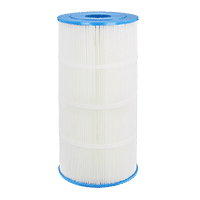
#5 The ReplacementsBlog Image - Cartridge (200 x 200)
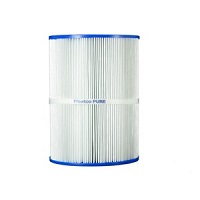
All your filter might need is new cartridges or grids but good luck trying to figure out which ones you need.  This is a very common conundrum.  Frequently, the filter manufacturers place a label or plate on the filter tank that lists all the different filter sizes for that particular model.  Then they put a check mark or punch out a hole next to the actual filter size.  That is, in theory.  I hear from many customer that there is no mark or it has worn off over time.  There could also be no readable part numbers on the grids and cartridges themselves, leading to a good deal of confusion.

The easiest solution in this case is to measure the actual media.  So for DE grids, you would measure the length and width of the full and the partial grids.  Most DE filters have seven full grids that are the same size and one partial (shorter) grid.  For cartridges, measure the length, the outside diameter of the cartridge, and the diameter of the hole.  Often people don’t want to take the extra step of opening the filter to get these dimensions and they take a guess at the correct size.  This makes for an awful lot of returns during pool season so I highly recommend doing it right the first time.

Replacing sand can also present a challenge or two.  The main question being “how much sand do I need for my filter?”  This will be in your owner’s manual but if yours has gone missing, feel free to contact us here as we have specs on many filter models.  The manufacturer can also be a resource for the proper sand amount for older, more obscure filters.  You will want to check on the recommended sand type as well which is typically #20 or #30 silica sand but does vary per manufacturer.

If you’ve been a pool owner for any length of time, you will not be surprised if you run into other filter problems not covered here.  As customers often tell me, “It’s always something!”  But rest assured, we’re happy to help you troubleshoot filter problems, find replacement parts, and get you on your way to enjoying that pool.

author avatar
Matthew Simmons Technical Writer & Pool Product Expert
Swimming pool expert at InyoPools and host of Poolside Chat, brings over a decade of experience in the pool industry.

Related Videos

127 responses to “5 Biggest Problems with Pool Filters”

  1. jovi Avatar

    My problem of my sand filter tank lid was frequently blowout and the sand back to the pool can you advise me what is the reason why it happened.
    Many thanks,

    1. Matthew Simmons Avatar

      This sounds like a pressure issue; caused by dirty sand, too much sand, or too strong of a pump.

      For dirty sand, backwash the filter thoroughly. if the sand is old, and backwashing doesn’t help you will need to replace the sand. If you have recently replaced the sand and you put too much sand in, then you need to scoop some out. The normal sand level should be about halfway to two-thirds up the tank. if this problem started after installing a new pump, you may be overpowering your filter. If it is a dual or variable speed pump, try the lower speeds. if it is a single speed, then you will need to change the motor and impeller to a lower horsepower.

  2. Helen Avatar

    I have a sand filter that the gauge won’t work but the pressure is good at inlit. When I vacuum algae not sand comes out inlit

    1. Matthew Simmons Avatar

      Try setting the valve to recirculate to bypass the filter. if the pressure gauge doesn’t read any pressure, then it is time to replace it. If the gauge does give a reading, then you likely have a clogged filter; the clog probably being alive/dead algae. If algae is present in the pool then you need to shock your pool, once or twice.

  3. Wendy Avatar

    We have a filter that is only 3 years old. My husband cleans it religiously and maintains everything per the manuals. We recently had all the piping replaced and converted the pool to saline.
    All the chemicals are in balance according to the pool store. There is some sand at the bottom of the pool and the pool is cloudy.
    We put chlorine granules in the skimmer and they blew out the jets.
    Do you recommend replacing the filter or is there another way we can trouble shoot the problem before replacing it?

    1. Matthew Simmons Avatar

      Sand int he pool could be a of things: you need to change the sand or there is a broken lateral.

      If your filter’s running PSI is high, and stays high even after backwashing then you likely need to change the sand. Old dirty sand can lead to channeling which allows dirt to bypass the sand and recirculate back to the pool. Broken laterals can happen with age.

      Luckily the fix is the same for both problems, remove the sand. Replace the old sand with new sand. or, remove the old sand, check the laterals, then reuse old or replace with new sand.

      1. Wendy Avatar

        It’s a filter system, not a sand one. We pulled apart the housing, took the filter out and then put it back in.
        It must have been slightly loose or something because as soon as we did that the filter started working properly and the pool cleared up the same day. 🙂 YAY!

  4. ana Avatar

    we replased the center tube with the black finger like tubes but sand is on bottom of pool i donot think we put it in right do i start over and do i put the tube in fist and then the sand or a quater of sand and then the tube and the more sand please help the water is clear but when i vaccum it looks like every thing iback becase when i back wash it is clear that inpossible for ipick up alge and it just comes back in and back wash clear HELP

  5. Charles Avatar

    I have a Crystal clear pool sand filter, the tank is made of polyethene and is cracked just under the multiport valve under the flange,. Can it be repaired ?? please

    1. Matthew Simmons Avatar

      Most of the times trying to mend a filter doesn’t work, but you can give it a try. The most common product I’ve heard used in these situations is JB Weld. We actually cover this topic in a Poolside Chat Episode #20: Should I Fix My Cracked Filter Lid?

  6. Brandon Mowry Avatar

    I just bought a house with a pool and I noticed today that sand is forming drifts in the bottom of my pool. I have a cartridge filter I believe. What is the problem?

    1. Matthew Simmons Avatar

      If you have a cartridge filter and you’re seeing excessive sand in the bottom of your pool, there may be a rip in the cartridge allowing it through, or you just need to vacuum it up. If after you vacuum the sand, and you see it coming through the return again, then there definitely is a tear in the cartridge.

  7. Tim Polyak Avatar

    The dome lid on my cartridge filter is leaking. May have been over tightened, what are my options and what should I do? Thanks

  8. Hilary Black Avatar

    Hello
    We have a hayward s240 filter and when pump is on filter there is a spitting and hissing from dome top screw. We just bought a new one and a new o ring and its still doing it. Also our pressure is at 21psi. We have 18×36 in ground

    1. Matthew Simmons Avatar

      Is your filter an S240S or an S240T? Did you replace any gaskets? If you are hearing a hiss and water is spitting out, then that sounds like a bad gasket moreso than a hardware piece.

  9. Chuck Haskins Avatar

    I replaced my sand before last season and it does not seem to be clearing my cloudy water. I added shock and the pool changed to a rust color. Do you recommend washing the sand with a running water? I have done this in the past by removing the multiport valve and inserting a hose with water running, pushing and puling the hose in and out of the sand. I let the water overflow carrying out and debris, drain filter and then scoop top layer of debris if there.
    I would rather not change sand again if I can help it. My experience is the sand lasting 2-5 years. This is a copper ionization pool system.

    1. Matthew Simmons Avatar

      If your water is rust colored, that is a sign of excess iron in the water. you can use a few different techniques to remove that problem. As for the cleaning of sand, that is what the backwash and rinse functions on your multiport valve is used for. The backwash reverses the flow of water, churning up the sand, then expels the dirt through the waste line.

  10. Rose Avatar

    Hi. My pool filter plastic drum has burst for the second time in 2 years. the indoor pool is heated to 32degrees celcius and I have been informed that this is too high as it cools overnight so will affect the plastic drum. The pool company has suggested a fibreglass drum. My issue is why was I not told and is this true

    1. Matthew Simmons Avatar

      How low is the water temperature dipping? So the pool is inside, is the filter inside or outside? What is the made and model of your filter?

      Most pumps and filters are made out of fiberglass or a noryl plastic. Both of which are made to withstand hot and cold temperatures. But if you leave a water-filled filter outside or in an unheated room whose temp drops to freezing point; it doesn’t matter which material it is made of, it is going to crack.

Leave a Reply

Your email address will not be published. Required fields are marked *