
Home / Articles / Advanced Wall Repair for an Above Ground Pool

Advanced Wall Repair for an Above Ground Pool

Advanced Wall Repair on an Above Ground Pool

I have observed over three decades that the average decent quality above ground swimming pool lasts between 10 and 20 years. Sometimes pool owners will replace their pool because its top rails are too rusty or some of the uprights and pieces of bottom track have rusted out. Mostly though, people decide that their pool is dead because it has a rusty or corroded wall. And this is what makes an above ground pool no good anymore as it’s the wall that holds all the water.

Most of the time, a rusty pool wall is noticed when a liner is changed. The pool gets drained and then the existing liner is removed which exposes the interior wall. A sinking feeling is experienced when you see that the interior wall is rusty. You’ve already bought a pricey replacement liner. You start to ask yourself, “Is this normal? How bad is it? Can I fix this? How do I fix this?” As you climb out of the pool to go look for that can of Rust-Oleum you bought two years ago, you wonder how bad this rusty wall really is and instead go search on the Internet.

You’re Going to Have to Do Some Poking Around

This blog post is about advanced wall repair for above ground pools, but before I can tell you about that you must find out if you need it. Most of the time the discovered rust on the inside of the pool wall is just surface rust and not much of an issue. With surface rust you can maybe get some sandpaper, sand the rusty areas smooth, and then use that can of Rust-Oleum you found and the wall is good to go.

What if it’s more than just surface rust? Maybe the rust is falling off in small pieces and looks pretty bad and deep. What’s important here is the wall’s integrity. The wall of an above ground pool wall has to hold thousands of pounds of water so if the rust has eaten its way deep into the steel or aluminum, it may no longer be strong enough to hold the water. A wall can look pretty bad and still be fine, but if there are spots where it has rusted all the way through then that is bad and cause for alarm. To find out, take a medium-sized screwdriver and poke at the rust. Scrape off any loose pieces of rust and firmly poke those areas. If the screwdriver pokes completely through the wall, then that’s not good. It may not be the end, but it’s not good.

Some Holes Are Worse Than Others

So you’ve poked around the rust and the screwdriver went all the way through in a couple of spots. That’s always bad, but you may still be OK. A small rust hole that’s located high up the pool’s wall is usually alright.In that case I will cut a small square of roofing tin or some kind of sheet metal and use duct tape to secure it in place over
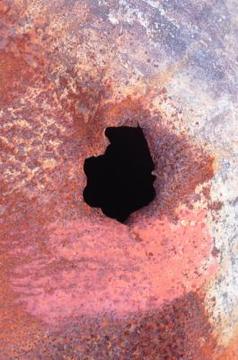
is there rust on my above ground pool
I Found the Hole

the area. I do this only to protect the new liner I’m about to install from the rust as this repair adds no strength to the wall.

If the rust holes are closer to the bottom of the pool’s wall, then that’s worse and should possibly require more than just a simple patch job. The reason a hole lower down is concerning is because the water creates more outward pressure there at the bottom. A rust hole at the bottom of the wall is much more likely to tear open under pressure and cause a “blowout” than one nearer to the top. In most cases a small hole towards the bottom of the wall won’t cause a blowout. I usually tell the pool owner about it, tape some tin over it, install a new liner and it holds. Though, there is always the possibility that it won’t hold and I leave the decision up to them. I’ll show them the concerning rusted area, give them the odds of whether I think it’ll hold or not, and let them tell me either to proceed with the change of the liner or wait and get it repaired. Worst-case Scenario

Worst-case Scenario

It has come down to this. Let’s say you have a lot of rust toward the bottom of your pool wall and it has rusted all the way through. What now? Well, there are three options at this point. You can tape over the rusty areas with some kind of sheet metal, install a new liner, fill the pool back up and hope for the best. This is a viable option for many as they have already purchased a replacement liner and don’t have the money for a new pool. Many times this is the best decision for them as the wall holds up and they get to have their pool. Though, with this option, you may not be so lucky, because if it doesn’t hold, you’re out the cost of the new liner, the installer (if you didn’t do it yourself), and all the lost water and chemicals.

The second option is not to take the chance and get a whole new wall. Or at least that’ll be what you think you’ll do until you try to find a replacement wall. It’s not easy to get just a replacement wall for an above ground pool as manufacturers don’t like to provide them for models which are more than a couple of years old. That’s OK though as you would soon find out, because if you do get lucky and find a replacement wall it’ll be way expensive. At that point in the story, people usually opt to get a whole new pool as the price is just slightly more than for just a wall.

The third option is to repair the wall. This is rarely done, though. The reason for this is not because it’s too expensive, looks bad, or doesn’t hold. Repairing a rusty above ground pool wall is rarely done, because there are not many people who know how to do it. Over the years I have learned by way of trial and error that there is only one true way to repair a wall and that is to add a new piece of wall from top to bottom.

The Only Guaranteed Way to Repair a Rusty Wall

Over the years I’ve tried to repair damaged pool walls in many ways. It was easy to experiment as people facing an apparent pool replacement would take a chance on my repair. I started by just duct taping some rigid steel sheeting over the holes and some failed. Then I would bolt the pieces of sheet metal to the existing wall all the way around the rust holes. Some failed. Then I tucked bigger pieces of sheet metal into the pool’s bottom track and upward to cover the holes and bolted them. Still some fails.

I finally realized that I needed to reinforce the damaged wall’s integrity from top to bottom and not just in the local bad spots. So, this is what has to be done:

  1. Get an entire piece of above ground pool wall.
    This may be the hardest part of the above ground pool repair for the do-it-yourselfer. The two ways to get an entire piece of pool wall are from an old pool that has been taken down or by buying a piece from a pool maker. The wall piece should be at least 4’ long or long enough to cover all the bad areas of your pool wall.
  1. Get at least 30 stainless flathead steel bolts and nuts and four pieces of metal steel channel.
    You’ll use these to bolt your new piece of wall to your existing pool wall. 
  1. Place the new wall piece against the pool’s wall on the inside.
    You’ll have to move away the bottom cove in that area so the wall piece can fit right up against the existing wall from top to bottom.
  1. Line up the metal channels to the edge of the wall piece and drill holes all the way through.
    You’ll be drilling holes from the inside of the pool through the inside and outside steel channel, the wall piece, and the existing wall from top to bottom.    
  1. Bolt everything together through the drilled holes.
    Make sure the nuts and bolts are nice and tight.NOTE: If I’m not making sense here, you can look at the way the pool wall was bolted together orginally and do the same thing with this.
  1. Use duct tape to fasten the bolts on the inside from top to bottom.
    Do it like they did with the pool’s existing wall bolts.
  1. Replace the coves at the bottom and you’re done.

Now you’ll have a piece of wall covering the bad place in the existing wall. And it’s bolted from top to bottom on both ends so the wall cannot split open when filled.

This is not an easy repair, but works well when done right. If you have a pool wall that has rusted away badly, my advice is to get a new pool to replace the wall and frame completely. If you don’t have the cash then try this. It may save you money, if you do it right.

author avatar
Dan Dougher

Related Videos

166 responses to “Advanced Wall Repair for an Above Ground Pool”

  1. Guy Avatar

    I have an above ground pool with bent and creased wall around the shimmer. I believe that the cord the holds the winter cover on may have been around the skimmer and put stress on the wall around the the skimmer. there is a small tear in he wall about an inch long near the skimmer opening.
    Can i release the liner from the section of the wall without emptying all the water from the pool?
    Can the wall be straighten by hammering it back into shape?

  2. Marc Avatar

    Was cleaning snow and caught the wall of above ground pool with a barried shovel. Tore a hole in the wall and liner about 3″ x 3″. The pool is frozen so the liner has the same size hole.\
    I will replace the liner, can i just patch the wall with a 12″ x 12″ aluminum flat stock. Rivets and then cover with several layers of duct tape over the edges???

    1. Dan Dougher Avatar

      You can try that and it may hold. It may not though as the rivets may be no match for the outward pressure from the water. Rivets are good at keeping two pieces of metal together but only provide some overall wall integrity. This is from my observations and not just theory.

      Keep in mind that the lower the wall, the more outward water pressure(as the water weight is pressing greater downward as well). So, the lower the tear, the less likely it will hold. The only way to repair with 100% surety is to bolt a piece of metal from top to bottom. Find you where your pool wall bolts together to see what I mean.

      1. Paul A. Avatar

        I tree branch fell on my pool as well. Can i send you pics so you can tell me if the integrity of the pool is compromised?

        1. Dan Dougher Avatar

          Yes you can send them. Inyo will forward them to me and I’ll take a look.

  3. Rachel Avatar

    The wind caused our pool cover wire to pull up the top caps around 1/2 of our pool. Is this repairable? If so, how?

    1. Matthew Simmons Avatar

      Most above ground pool top caps snap on and off. If you know the make and model of your pool, or can read a part number on the top cap, you should be able to find replacement parts.

      Can you send in pictures of your wall pattern, upright, top cap, and top ledge to (upload@inyopools.com)? With those pictures, we can try to match your pool and replacement parts.

  4. George Avatar

    I have a 12×12 above ground pool and need two 4 feet side wall panels because thy are rusted. Where can I buy them.

  5. Mary Avatar

    A tree has fallen and crushed 2 panels around 1/3 of the way down. Have you heard of just those panels being replaced or is it a total loss?

    1. Dan Dougher Avatar

      Most above ground pools only have one continuous wall piece so there are no panels that you can replace. You may be able to pound to wall back upright and replace any framing that is broken/too bent to be reshaped as long as the wall didn’t fold too badly. I would have to see pics to give a better opinion.

  6. Debbie Avatar

    Hi , I have a deck around my pool and when I crawled under the deck to secure the cover I noticed one whole panel of the wall from bottom to middle has a lot of rust. I noticed water on ground at that area . I touched a rust spot and water seeped out a little ! The rust is from ground to 3/4 up wall and half the wall panel also has rust spots . How can water be coming out the wall . Oh I do have the cover on pool which has rain on top and is making cover sink into pool water . Their was not a hole in the liner when I covered the pool . But how can water come out the wall ?

    1. Dan Dougher Avatar

      It’s hard to answer this. Water is one thing and moisture is another. If you felt moisture, then it could’ve been from splashing, taking the cover off, morning dew, ground moisture(if it’s close to the ground),or the last rain. Moisture can hang out for a long time especially under a deck.

      It’s more than just moisture and water is seeping out of the wall, then the water is coming from somewhere. If not from splashing, then probably from a hole in the liner somewhere or (if you have a beaded liner) coming down from the top. Doesn’t matter much anyway if your wall is rusted through. You may have bigger problems than a leak.

      Thanks
      Dan

  7. melissa Avatar

    had some yard excavation done and the corner of the bucket of the tractor brushed against the pool, which is only a month old. it caused a hole in the wall about 1/2 to 3/4 of the way down, about an inch or less wide. surprisingly the liner was not damaged at all and there has been no water loss. as we are on a well and its very costly to fill we did not want to drain that much out since liner is ok.. we were able to get a thin coating of rubber padding between the liner and the wall, in this spot, so the liner is not resting directly on the metal. is the pool safe with the small hole? will epoxy putty work to safely patch it until a more permanent fix can be done (prob when liner eventually gets changed out)?

    1. Dan Dougher Avatar

      I think you’ll be ok. Just keep an eye on it making sure it doesn’t rust into a bigger hole.

  8. Marc Avatar

    If i only have a small half inch hole mid way on the wall, do i have to put top to bottom tin sheet or just a smaller sheet 4 inches by 4 with duck tape?

    1. Matthew Simmons Avatar

      Just a small square will work fine.

  9. Jeff Avatar

    I have a pool that is only 2 months old. While mowing my grass I kicked out a rock and put a small hole about 3/4 of the way up the hole is smaller than a dime. I drained past the hole pulled back the liner and pushed the damaged wall back outward. Now the hole looks more like a crack. I then put jb weld followed by jb welding a piece of medium Guage stainless steel over hole. Also ensuring the metal was large enough to reach beyond the nearest upright. Then I covered entire piece with duct tape. I also used clear silicone on the outside of the pool to limit water behind liner. Do you feel this would be a recommended repair?

    1. Matthew Simmons Avatar

      From Dan:
      Yes this sounds like you did more than most. This hole is no big deal at all. Making sure it doesn’t become a starting point for major corrosion is the important part.

      1. Kenny Avatar

        I was mowing and I hit a piece of copper wiring and put a hole in my pool about 1/2 to 3/4 of the way down I patched my liner but my concern is the steel wall what do you suggest to do to stop it from corroding thanks

        1. Matthew Simmons Avatar

          Here is a reply from Dan, our above ground pool specialist: There’s not a lot you can do but you are probably ok. Sand the exposed steel inside and out, paint it with some rust inhibitor and cover with a tape a small piece of tin or something inside and out and it should be fine.

          1. Robbie deese Avatar

            I dont have any holes in my pool but I’ve gotta big wrinkle on the lower half I just bought it
            It was used but I’ve gotten new pump filter liner and all and didnt see the wrinkle because the metal wall was rolled up I had a company come out today to install it and once then seen yur big wrinkle they said they cant install it like that so is there anything I can do for that I’m not finding any replacement walls online what so ever

  10. Don Avatar

    Very good article!

    1. Ben Avatar

      Thank you Dan for providing such valuable info in such a no-nonsense way. You really have saved the day, as I was about to rip the whole thing apart. My hole was 1/4″ but the screwdriver found good metal around a 3″ hole, just a foot below the water level. My local pool store effectively told me I was screwed. All I needed was a nice panel of 26 gauge galvanized steel (for HVAC) from my local home store, fixed for $20!

    2. Tim Avatar

      when drilling the holes is there any specific pattern to use

Leave a Reply

Your email address will not be published. Required fields are marked *