
Home / Articles / Advanced Wall Repair for an Above Ground Pool

Advanced Wall Repair for an Above Ground Pool

Advanced Wall Repair on an Above Ground Pool

I have observed over three decades that the average decent quality above ground swimming pool lasts between 10 and 20 years. Sometimes pool owners will replace their pool because its top rails are too rusty or some of the uprights and pieces of bottom track have rusted out. Mostly though, people decide that their pool is dead because it has a rusty or corroded wall. And this is what makes an above ground pool no good anymore as it’s the wall that holds all the water.

Most of the time, a rusty pool wall is noticed when a liner is changed. The pool gets drained and then the existing liner is removed which exposes the interior wall. A sinking feeling is experienced when you see that the interior wall is rusty. You’ve already bought a pricey replacement liner. You start to ask yourself, “Is this normal? How bad is it? Can I fix this? How do I fix this?” As you climb out of the pool to go look for that can of Rust-Oleum you bought two years ago, you wonder how bad this rusty wall really is and instead go search on the Internet.

You’re Going to Have to Do Some Poking Around

This blog post is about advanced wall repair for above ground pools, but before I can tell you about that you must find out if you need it. Most of the time the discovered rust on the inside of the pool wall is just surface rust and not much of an issue. With surface rust you can maybe get some sandpaper, sand the rusty areas smooth, and then use that can of Rust-Oleum you found and the wall is good to go.

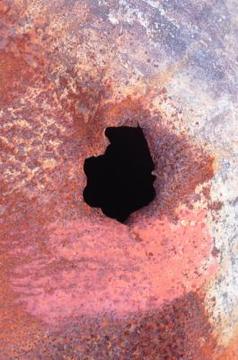
What if it’s more than just surface rust? Maybe the rust is falling off in small pieces and looks pretty bad and deep. What’s important here is the wall’s integrity. The wall of an above ground pool wall has to hold thousands of pounds of water so if the rust has eaten its way deep into the steel or aluminum, it may no longer be strong enough to hold the water. A wall can look pretty bad and still be fine, but if there are spots where it has rusted all the way through then that is bad and cause for alarm. To find out, take a medium-sized screwdriver and poke at the rust. Scrape off any loose pieces of rust and firmly poke those areas. If the screwdriver pokes completely through the wall, then that’s not good. It may not be the end, but it’s not good.

Some Holes Are Worse Than Others

So you’ve poked around the rust and the screwdriver went all the way through in a couple of spots. That’s always bad, but you may still be OK. A small rust hole that’s located high up the pool’s wall is usually alright.In that case I will cut a small square of roofing tin or some kind of sheet metal and use duct tape to secure it in place over
is there rust on my above ground pool
I Found the Hole

the area. I do this only to protect the new liner I’m about to install from the rust as this repair adds no strength to the wall.

If the rust holes are closer to the bottom of the pool’s wall, then that’s worse and should possibly require more than just a simple patch job. The reason a hole lower down is concerning is because the water creates more outward pressure there at the bottom. A rust hole at the bottom of the wall is much more likely to tear open under pressure and cause a “blowout” than one nearer to the top. In most cases a small hole towards the bottom of the wall won’t cause a blowout. I usually tell the pool owner about it, tape some tin over it, install a new liner and it holds. Though, there is always the possibility that it won’t hold and I leave the decision up to them. I’ll show them the concerning rusted area, give them the odds of whether I think it’ll hold or not, and let them tell me either to proceed with the change of the liner or wait and get it repaired. Worst-case Scenario

Worst-case Scenario

It has come down to this. Let’s say you have a lot of rust toward the bottom of your pool wall and it has rusted all the way through. What now? Well, there are three options at this point. You can tape over the rusty areas with some kind of sheet metal, install a new liner, fill the pool back up and hope for the best. This is a viable option for many as they have already purchased a replacement liner and don’t have the money for a new pool. Many times this is the best decision for them as the wall holds up and they get to have their pool. Though, with this option, you may not be so lucky, because if it doesn’t hold, you’re out the cost of the new liner, the installer (if you didn’t do it yourself), and all the lost water and chemicals.

The second option is not to take the chance and get a whole new wall. Or at least that’ll be what you think you’ll do until you try to find a replacement wall. It’s not easy to get just a replacement wall for an above ground pool as manufacturers don’t like to provide them for models which are more than a couple of years old. That’s OK though as you would soon find out, because if you do get lucky and find a replacement wall it’ll be way expensive. At that point in the story, people usually opt to get a whole new pool as the price is just slightly more than for just a wall.

The third option is to repair the wall. This is rarely done, though. The reason for this is not because it’s too expensive, looks bad, or doesn’t hold. Repairing a rusty above ground pool wall is rarely done, because there are not many people who know how to do it. Over the years I have learned by way of trial and error that there is only one true way to repair a wall and that is to add a new piece of wall from top to bottom.

The Only Guaranteed Way to Repair a Rusty Wall

Over the years I’ve tried to repair damaged pool walls in many ways. It was easy to experiment as people facing an apparent pool replacement would take a chance on my repair. I started by just duct taping some rigid steel sheeting over the holes and some failed. Then I would bolt the pieces of sheet metal to the existing wall all the way around the rust holes. Some failed. Then I tucked bigger pieces of sheet metal into the pool’s bottom track and upward to cover the holes and bolted them. Still some fails.

I finally realized that I needed to reinforce the damaged wall’s integrity from top to bottom and not just in the local bad spots. So, this is what has to be done:

  1. Get an entire piece of above ground pool wall.
    This may be the hardest part of the above ground pool repair for the do-it-yourselfer. The two ways to get an entire piece of pool wall are from an old pool that has been taken down or by buying a piece from a pool maker. The wall piece should be at least 4’ long or long enough to cover all the bad areas of your pool wall.
  1. Get at least 30 stainless flathead steel bolts and nuts and four pieces of metal steel channel.
    You’ll use these to bolt your new piece of wall to your existing pool wall. 
  1. Place the new wall piece against the pool’s wall on the inside.
    You’ll have to move away the bottom cove in that area so the wall piece can fit right up against the existing wall from top to bottom.
  1. Line up the metal channels to the edge of the wall piece and drill holes all the way through.
    You’ll be drilling holes from the inside of the pool through the inside and outside steel channel, the wall piece, and the existing wall from top to bottom.    
  1. Bolt everything together through the drilled holes.
    Make sure the nuts and bolts are nice and tight.NOTE: If I’m not making sense here, you can look at the way the pool wall was bolted together orginally and do the same thing with this.
  1. Use duct tape to fasten the bolts on the inside from top to bottom.
    Do it like they did with the pool’s existing wall bolts.
  1. Replace the coves at the bottom and you’re done.

Now you’ll have a piece of wall covering the bad place in the existing wall. And it’s bolted from top to bottom on both ends so the wall cannot split open when filled.

This is not an easy repair, but works well when done right. If you have a pool wall that has rusted away badly, my advice is to get a new pool to replace the wall and frame completely. If you don’t have the cash then try this. It may save you money, if you do it right.

author avatar
Dan Dougher

Related Videos

166 responses to “Advanced Wall Repair for an Above Ground Pool”

  1. Beth Avatar

    Our pool has a large hole(4″) that encircles the return hose near the top of the pool. Is it safe to top off the water and use the pool?

    1. Dan Dougher Avatar

      Any situation where a large spot of the pool wall has rusted thru, there is always a chance that it won’t hold water or water activity and split open. So no, not safe.

  2. Janet Hickman Avatar

    I bought a new liner and while filling with water I had 2 sections on far side of the pool bowing inside and one section bowing outside of pool. There is no rust. How can I fill my pool?

    1. Dan Dougher Avatar

      This sounds like you either didn’t set the liner evenly around the pool OR the pool is out of shape(egg shaped if round). Some liners fit super tight too so it may be that although I’m guessing it’s from one of the first two reasons mentioned or both.

      I would need to know more or see a couple of pics to determine what to do but my instinct says that if it’s not bowing too bad, just keep filling and it’ll work itself out with the outward weight of the water. Depending on how much water you have put in and for how long it’s been, you may not have a choice of doing anything else.

  3. Pat Avatar

    Dan, we have a 15×30 oval pool.. 16 tYears old, aluminum sides, decking and rail. I noticed our pool going down about a month ago and blamed it on liner that has leaked and we have repaired many times. So could not find leak but assumed was more underneath and bought new liner to install.in a week. I was cleaning out our stuff under pool deck and found a couple of smal holes then saw water coming out of one.. a little rust and down at the bottom but thought it could be repair and started checking online.. also found some more corrosion in next panel but no rust… why is water coming through the hole?
    This area is on same side as skimmer right behind where ladder…stays moist due to no sun exposure.. rest of pool from outside looks fine. based on what I read, If these are the only holes with some rust, but about 3 more dime size corrosion I am wondering how bad is the intregty of the pool.. what is best way to repair. I did fine rolled aluminum online but how would I know if would work for pool.. this pool has a 30 year warranty based on the heavy duty extruded aluminum. I thought because it does not rust??? Help…

    1. Dan Dougher Avatar

      Sounds like you have a regular wall aluminum pool. They corrode too so the same goes with it as steel ones. You getting corrosion all the way thru the wall usually means it’s time for a new pool. You may find someone to repair it but it is doubtful. Read more of my blogposts on the subject and get more info.

  4. janna Avatar

    My pool is rusted around the skimmer and right below it. I got it up and running now the water is seaping below the skimmer what do I do or can I save it by making new hole with a new piece. Trying to make it work just this year

    1. Matthew Simmons Avatar

      Janna, we covered this topic in another article. Read it here: Above Ground Pool Repair (Part 1) – Rust Around Skimmer

  5. Phil Avatar

    Hi,
    I have a 54” 24ft round pool with steel walls. Due to a hole in the liner the wall rusted and developed a hole. The hole is in the shape of a circle with a 10 inch diameter. It’s near the top (like where a skimmer would be) with ½ the circle at and under the water line and ½ above the water line.
    My thought is to get a large enough piece of galvanized steel maybe 48 x 24 inches. Slide it in the track and bolt it on both sides from bottom to near the top (above water line), then also bolt it across the top. Pool is built into a deck, and I can’t take off top rim of pool easily without taking deck apart. I have a beaded liner so can replace the liner without taking top rim off.
    Think this will work ?
    Also how think should the sheet metal be ? 25mil ? I was going to paint it with Rust-o-ilium pain (both sides, a few coats) is that good enough to protect it ?

    Thanks
    Phil

    1. Phil Avatar

      Ok, after some more research I found that galvanized sheet metal uses GA and G ratings.
      Interesting is that low gage = thicker. This seems to be opposite of pool liners.
      I’ll be looking for GA14 [thickness] and G(90)[zinc amount] – I could try to find G(235), but it may be harder to find and a few coats of Rust-Olium should help.

  6. WitsEnd Avatar

    Any suggestions on who to call to hire out to repair small rust holes on the upper section of pool wall? None of the pool stores in the area are willing to help. I highly doubt that i would be able to pull the liner back in order to try to repair the damage and get the liner back in place correctly.

    UGH!!

    1. Dan Dougher Avatar

      Probably won’t find a real pool guy to do it. Maybe a handyman or someone like that. You can always read my blogpost on how to find an installer. Maybe you can get one to do the repair during the off season.

  7. ROBERTA Avatar

    I NEED A PIECE OF POOL WALL TO REPAIR MY POOL WHERE CAN I FIND A PIECE. THE POOL STORES WONT SELL ME ANY.

    1. Matthew Simmons Avatar

      Most outlets do not sell the pool wall. You will need to contact the manufacturer directly for replacement walls.

    2.  Avatar

      I have seen multiple 4’x4′ wall pathes on ebay in varying heights.

  8.  Avatar

    Carol
    Our above the ground pool seems to be bowing inward. We noticed that the sides flex when pool is in heavy use.
    Is it a fixable issue. Pool about 8 years old.

    1. Dan Dougher Avatar

      Not sure it can bow “inward” if it is full of water. You may have some of the frame of the pool rusting and allowing the pool wall to move. Look around for rust and then make some determinations based on that. It may be fixable or it may be time for a new pool. Hard to say without looking at it.

      1. William Avatar

        I just put up a 33′ Samoan above ground pool. We decided to set it up ourselves as we did not have the money to have pay an installer. Everything went great with one exception. There are two outside posts that are bent kind of underneath the wall, also causing the wall to be bent. 1 is worse than the other one. I am worried about the pool giving out. Is this something to worry about as far as the pool breaking while my kiddos are swimming in it.

  9.  Avatar

    OUr pool is rusting around the skimmer and the water had dripped down the wall and not the wall is showing rust and the base is rusted in that area, crumbling. We had to replace the skimmer a few years back and the seal was never the same. There is a small hole on the opposite side of the pool about halfway up that we had noticed. now it rusted right through and the water started coming out. Apparently there had been a hole in the liner. Can this pool be repaired with a sectional metal wall and a patch? Or is it time to get a new pool? Where could I hire someone to do this repair? Where can I get the replacement pieces? It is so upsetting. I do home daycare and i so rely on the pool in the summer!

    1. Dan Dougher Avatar

      Your pool may be repairable if you can find the right guy to fix it. There’s not many of us that know how and you don’t want someone experimenting on your pool especially if you are responsible for small children. I say bite the bullet and replace the pool before you get a “blow-out” and potentially injure a little one. Raise your rates a little to pay for it.

  10. Dan Dougher Avatar

    Yes you can. Drain the pool only just below the skimmer so when you take the skimmer off, the screw holes stay in place.

    1. Alissa Avatar

      Hi, we recently put in an above ground pool (24×52) , finally got it filled and have been enjoying it. Today we had someone grading around our backyard and they poked a hole in the bottom of our brand new pool. Luckily the liner is not punctured, my husband got his pliers and turned some of the metal away from the liner and then stuffed something between the liner and hole. My question is can this some how be fixed without draining the whole entire pool? What would you recommend?

Leave a Reply

Your email address will not be published. Required fields are marked *