Home / Articles / Can I Go With A Higher Horsepower Pump?

Can I Go With A Higher Horsepower Pump?

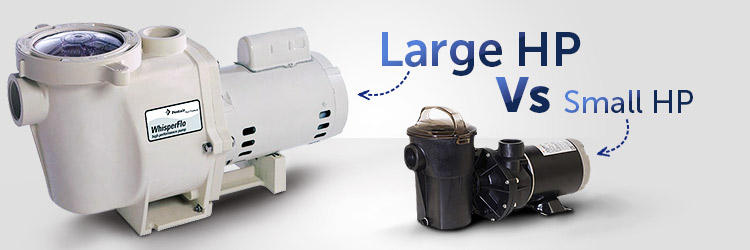
Can I go with a larger HP pool pump?

The proper horsepower for your pool pump depends on a number of factors.  So before you jump on the bigger-is-better bandwagon, take a moment to get the facts.  Let’s start with an unpopular and incredible statement:  A typical size residential pool can be circulated effectively with a 1 HP pump.  What?!  Only 1 HP?  Please accept my apology for the rude awakening that many pool builders and installers push unnecessarily over-sized pumps that are more expensive to buy as well as operate.

Pool owners often mistakenly believe if they choose a 2 HP pump over a 1 HP pump, they are getting double the performance.  This is simply not true.  In this scenario, you will get only about 15% more flow from the 2 HP model.  But the amp draw of the larger pump will be significantly higher, raising your electric bill.

There are situations where a larger pump is certainly warranted.  For instance, a pool with water features (deck jets, waterfall, etc) tied into the main pool pump might require a higher horsepower to provide enough flow.  The same would hold true for installations with a spa or solar panels running off of the pool pump.  Long runs of pipe might also require more power.  If the pump in these scenarios is undersized, going up to a more powerful pump or installing a second pump dedicated to the water features or spa might be desirable.

Taking all of the above into consideration, here are some key things to keep in mind when increasing horsepower:

For New Construction

If you are building a new pool, you have the option to go with pretty much whatever horsepower pump you want as long as it meets the minimum requirements of your pool and is properly sized for the filter and plumbing.  I can’t stress that last phrase enough – properly sized for the filter and plumbing.  Should you decide a smaller pump is simply not macho enough for you, be sure your filter flow rate is higher than the pump output.  Otherwise, you can end up damaging multiple pieces of equipment.  Be consistent in your machismo and oversize everything.

For Pump Replacement

​If you are replacing an existing pump and want to increase horsepower, you will have more to consider.  ​First, your current filter size.  Since pool filters have a maximum flow rate, your new pump cannot exceed the filter’s gallon per minute (gpm) rating.  It is also advisable for the filter to be slightly oversized so for example if your filter has a 62 gpm flow rate and the higher horsepower pump will output 62 gpm, we’d recommend a smaller pump – or a larger filter.  You don’t want to be operating right at the limit of the filter’s capacity.
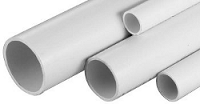
Blog Image - PVC Pipe (200 x 200)Second, plumbing lines also come into play.  Many residential pools have 1.5″ plumbing while higher horsepower pumps (2 HP and up) typically have 2″ ports to accommodate larger pipes.  You can use reducers to connect 1.5″ pipe to 2″ ports but this will restrict flow.  Keep in mind also that since pipe size has a maximum flow rate, you might not gain any benefit from a larger pump while you will lose money on energy.  Here are the most common pipe sizes with the correlating maximum flow rate:

Pipe Size
1.5″ – 60 GPM
2″ – 100 GPM
2.5″ – 140 GPM
3″ – 225 GPM

Third, be sure to check your voltage.  Higher horsepower pumps are mostly 230v only.  If you only have 120v standard household current available at your equipment pad, you will not be able to power a larger pump.

For Motor Replacement

Often a pool owner is replacing only the pump motor and sees this as an opportunity to upgrade to higher horsepower.  In this case, you will need to consider the same filter and voltage limitations as above.Blog Image - Motor (200 x 200)
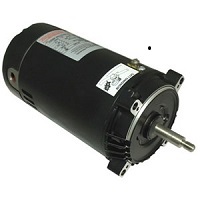
In addition, this will require the replacement of the impeller and possibly the diffuser.  Both of these parts are rated by the horsepower they are designed to handle.  The impeller definitely needs to be replaced whenever changing the pump horsepower, whether lower or higher.  Diffusers typically cover a range of horsepower ratings.  For example, when looking up the diffuser for your particular pump model, you might see one listed for .75 – 2 HP and then another for 2.5 – 3 HP.  If the new motor falls within the range of your existing diffuser, you can reuse it.

An ExampleBlog Image - Calculator (200 x 200)

To get an idea of the actual savings between a 1 HP pump vs. a 2 HP pump, we will do a bit of math.  An average 1 HP single speed pump draws 1.5 kWh while an average 2 HP draws 2.3 kWh.  If we use a run time of 8 hours per day and the national average of .13 cents per kWh, our calculations look like this:

1 HP pump 1.5 kwh x 8 hrs = 12 kwh per day x .13 cents per kwh = $1.56 per day to operate
2 HP pump 2.3 kwh x 8 hrs = 18.4 kwh per day x .13 cents per kwh = $2.39 per day to operate

Extended over 365 days, that’s $569.40 per year for the 1 HP and $872.35 for the 2 HP (adjust accordingly if you don’t run your pump all year).  Some regions have higher kWh rates so the savings will be more significant for some pool owners.

Undecided?

Some energy-saving options exist for those wavering back and forth between one horsepower and another.  First, dual speed pumps have both low and high-speed settings.  This type of pump is best for installations where you need higher flow only periodically.  For example, you mainly use the pump for circulation but in the evening you turn on the waterfall for an hour while you’re relaxing by the pool.  In a situation like this, you could get a higher horsepower dual speed pump or motor and still have the option to circulate at a lower speed.  Most of the time, the pump would be running at a lower, more energy-efficient horsepower while you have the security of knowing you’ve got bigger guns if needed.

Variable speed pumps and motors offer the same as dual speed but with a programmable range of speeds instead of only high/low.  This allows you to really fine-tune your pump operation to exactly the speed you need for each function (circulation, vacuuming, spa jets, etc.)  Variable speed pumps and replacement motors will vary in horsepower range from one brand and model to another but the max is typically around 3 HP.

The Bottom Line

We simply recommend properly sizing your pump based on your specific needs.  Ignore the pull of having greater power and just do some math (or let us do it for you).  The numbers won’t lie and could end up saving you some significant money on both the cost of a pump and its operation.

author avatar
Matthew Simmons Technical Writer & Pool Product Expert
Swimming pool expert at InyoPools and host of Poolside Chat, brings over a decade of experience in the pool industry.

Related Videos

84 responses to “Can I Go With A Higher Horsepower Pump?”

  1. Bob Avatar

    Bob- Davie, FL
    For the past month we have had a screaming noise from the pool pump and/or motor. I’m told we have a 1hp motor. I can’t read the specs on the motor. As of a week ago the flow stopped.
    We have a home service agreement and the pool pump is covered. The technician who came out wants to replace only the motor. He says that the piping needs to be modified by about 2 inches because it is out of alignment and wants $175 additional, not covered by the service contract.

    My pool service said we should have a 2hp pump, due to the pool being about 25,000 gallons. Our pool and system is 15 years old and the service contract people replaced the pump about 7 years ago.

    I’m not buying that I need to pay $175 to modify the piping and not sure about 2hp after reading your article.

    Your advice?

    1. Matthew Simmons Avatar

      The loud screaming noise would likely be a bad bearing or two within the motor. A new motor and new gaskets should be the extent of what you need. The whole “realignment” and the suggestion of going up to a high horsepower seems like a crock. If the pool and plumbing have been in place for 15 years, with this particular motor having done a good job for 7 years, I’d get a new motor and a new service company.

      Unless there is a piece of the story I am missing, it seems like they are trying to gouge you.

  2. Dan Dooley Avatar

    I just had to replace the filter pump which had burned out. As it had the impeller of the pump attached to the motor shaft when I took it in to get a new motor, the pump being over 30 years old with an old and worn bronze impeller and pump body, they suggested that the whole pump ought to be replaced.

    The new pump motor is 1.5 HP just like the one it replaced. The difference is that the plumbing is 2 inch. vs the previous 1.5 inch. I had to put in new plumbing on the inlet side and going to the filter multi-port valve. By the way, the filter (a large sand filter) is only a couple of years old. But the multi-port valve inlet as well as the pipe to the pool is also 1.5 inch.

    I also added a three-way Jandy valve before the new pump inlet. This valve is also 2 inch. So I had to make adaptions to go from 1.5 inch to 2 inch from the two suction lines into the Jandy valve on to the inlet of the new pump. On the outlet side, as the inlet to the filter multi-port valve is 1.5 inch, I had to change from the 2 inch outlet to 1.5 inch from there on to the filter.

    The system looks to be working ok but a couple of questions exist. The water in the pump hair-lint pot looks to have a vortex effect. It is hard to tell if there are bubbles with so much water movement but the pot other than the small area up against the clear cover is filled with water. The water swirls within the container in a circular pattern as though there is some sort of diverter inside. There is not, of course. The filter pressure is good and normal and steady and no indications of air getting into the filter. There is not what I would call cavitation within the pump pot and it does not run dry. Likewise, there are no bubbles coming from the outlet ports in the pool.

    I spent some time doing leak testing and initially I started with a marble sized bubble which came through the inlet pipe to the put when the pump is off. One perhaps every ten seconds or so. Some further tightening and now watching it for a good five minutes or so and I see no bubble at all.

    Does the fact that the water is making a swirling motion within the pump pot indicate something is still wrong? The new pump is a Pentair Challenger. The previous system did not display this action of the water. I am wondering if the change from 1.5 inch up to 2 inch piping could affect the character of the flow into the pump. Again, everything looks to be working ok otherwise. The pump makes no noise which I can hear and the only sound heard is the sound of the motor which actually is considerably quieter than the old one.

    1. Matthew Simmons Avatar

      I hate to say this after such a detailed comment, but I get the feeling you are overthinking this. If there are no air bubbles flowing from the returns, there no are no foul noises or sucking air leaks I would just let it be.

  3. Bryan Avatar

    I’m replacing the main pump on my spa. From what I can tell, the pump developed a leak at the shaft seal and it ran into the motor and rusted the guts. It’s in line, just before the heater (if that matters?) It’s a 6 person spa with a waterfall and 2 fountains in addition to a ton of jets. It currently has a 2 speed 3hp Waterway Executive 56 (model PF-30-2N22C). Is it an option to step up to a 4hp? Would it actually make any difference? I ask because most of the info above was geared towards pools. Due to the smaller pipes in the spa, could they possibly be near max flow already? Finally, for ease of install I’m planning on getting an exact replacement, but are there cheaper brands with the same specifications?

    Thanks for the help!

    1. Matthew Simmons Avatar

      Spas are trickier than pools. Because spas have so much flow and pressure in such a small amount of pipe. To be on the safe side, I would keep the 3 HP.

      Those other replacements may be rated as 3 HP, but flowrates, and port placements may vary. So you may think you’re getting a suitable replacement, but you could be getting a pump with a lower flow rate or one you have to replumb for.

  4. Steve Avatar

    I have a Hayward 1hp motor over 20 yrs old also filtration is 150 gpm with 2″pipe the pool is only under 10,000 gal. Looking at replacing the motor to a 2hp variable is this to much or should I just replace the motor back to a single speed? Hayward super 2?

    1. Matthew Simmons Avatar

      Because the pool is so small, I would stick with a single speed. Unless you have hefty utility company rebates that will reduce the cost of the variable speed, it would not be worth it.

  5. Rich Avatar

    My 2hp motor went. I have a 20,000 gallon pool. Replacing motor or pump seems so darn expensive. Would a 1.5hp pump work?

    1. Matthew Simmons Avatar

      A 1.5 HP should work for your pool, but if you step down in horsepower, you will also need to replace the impeller and possibly the diffuser.

      To determine if a 1.5 HP motor will work for your pool, I suggest completing the calculations we mention on this blog. You will need to know the make and model of your pump and to find the corresponding flow chart to figure out flow.

  6. Laura Avatar

    just purchased a 24 x 54 round pool and the pump has a Hi-lo switch. The lo side when started up pulls 25 amps then goes to 3 amps afterwards and the Hi side when started up pulls 52 amps the goes to 10 amp…isnt that a bit much for electric and its a 2HP motor 110 on a 15 GFCI which runs off a 20amp breaker. It worked for firs t day we checked it and then the following day put shock in the pool turned it on and 3 hours later it quit working 🙁
    it kept throwing the breaker then once we reset the breaker it was throwing off the GFCI so the electrician swapped out the 15 GFCI to a 20 GFCI and it seemed to work. But I’m really worried about the 52 amp pullage when started up and then it going down to 10 amp that seems way to high and I think there’s something wrong with the pump especially being brand new with the pool?

  7. Ian Avatar

    We are in the process of fixing our pool that came “as is” when we bought our house (California). I need to replace the pump which looks to be the original from the 60’s or 70’s. The current pump is 1hp but I’m wanting to go to a 1 1/2hp variable speed pump for financial savings and lower loads overall). The variable speed pumps all seem to have 2″ connections but my plumbing system is 1 1/2″ pipe. The suction side from skimmer is less than 10′ and return from filter runs 1 1/2″ for 16′ to first 1″ inlet return, then 12′ to next 1″ return inlet, lastly 12′ to last 3/4″ return inlet. I’m running thru a Pentair CCP420 filter that’s rated for 150 GPM. Planning to run only the skimmer thru the system by using a robotic cleaner, but would like the option to run a suction side cleaner if I later chose. Is there a problem with chockeing down the connections at the pump to fit within my system? The Jacuzzi vsp150, Pentair Intelliflo and Hayward SP3400VSP Eco Star are the models I’m looking at. Any help and feedback would be great.

    1. Matthew Simmons Avatar

      With the pump being a variable speed, the plumbing size is not that big of an issue. One of the biggest concerns of putting a big pump on a 1-1/2″ line is that it can cause pump cavitation, harming the pump. But because you are adding a variable speed, you can dial the pump back from its top speed, preventing an overkill situation.

      Why would you only want to pull water from the skimmer, pulling from the main drain will help ensure proper circulation. Also, calculating feet of head is a little more complex, please refer to this article: How Do I Calculate Feet of Head for My Pool?

  8. Dave M. Avatar

    Hi Dave,

    I just moved into a house with about a 10,000 gallon pool (my calculation) in Florida. The pump has a leak that I believe is from at least one hairline fracture in the plastic basket housing. I believe it’s the original pool pump from the house built in 2002. I think it’s a 1.5 hp based on a partial part number I can see, but the spec labeling on it is completely faded. out. I cannot even see a brand. It has 1.5 inch PVC. My neighbor has about the same size pool, pump located about the same distance from the pool as mine, 1.5 pvc and a filter that looks just like mine. He is running a fairly new looking Jandy FloPro, 1 hp. No leaks, pretty quite. The water in his basket looks smooth when running and mine looks like a washing machine. The only thing I have that my neighbor does not is solar panel heating on my single story house, I spoke to a pool equipment installer (friend of a friend) who lives too far to do the work but he told me based on my description to go with a single speed 1.5 hp (said a 1 hp would work but due to the solar panels 1.5 hp is probably a better option). Said he and an engineer did all the electric cost research and based on electric costs here in Tampa a single speed running 8 hours a day costs $27 per month so the savings of a variable speed will not be of any significance. All seems reasonable until I start talking to the manufacturers and do some internet research. Hayward, Jandy and Pentair customer service all tried to move me to their more premier 1.5 hp single speeds because they push 130 gpm at 60 head rather than 100 gpm for their less premier 1.5 hp single speed. But from all of my research given my 1.5 inch PVC, the most I can push through there is somwhere between 45-60 gpm. I even saw article that said solar panels require no additional hp and in fact less pressure is better for them. So estimating 60 feet of head (just a guess based on the distance of the skimmer to the pump – about 30 ft, and a few twists and turns and the solar panels on the roof) it would seem that I should be looking at about 45-60 gpm on the charts (due to the 1.5 pvc) and about 60 feet of head and I get to the standard 1.5hp (for example the regular Jandy FloPro 1.5hp falls right there). Seems to me there is no reason to have to get a “premier 1.5” and pay more. Is my logic correct? Thanks

    1. Matthew Simmons Avatar

      Dave, you are correct in your calculations. There is no need for you to go with a premium to satisfy your filtering needs for a 10K gallon pool. A Jandy FloPro would be suitable but if you want other options I would look into the Hayward Super II or the Pentair Challenger. Both are rugged pumps that have been in service for decades.

      Very nice thorough explanation.

    2. Jene Avatar

      Thank you! Your explanation was perfect for my home situation and validated many of my questions and concerns.

  9. Dave Avatar

    I have a hayward pump it is 1 hp. I can get a hayward 1.5 hp pump reasonable cheap on ebay do you think the 05 hp would make that big of a difference?

    1. Patrick Paroline Avatar

      Hi Dave,

      There are a few things you would want to check to see if you can get by with upgrading to a 1.5 HP pump. The main points you will want to check is that your filter can handle the output of the 1.5 HP pump, on your filter label there should be something that says max flow rate, a 1.5 HP super pump under normal conditions will be outputting 90 Gallons Per Minute (GPM) so you will want to make sure your filter can handle this flow of water. Secondly since 1.5 inch plumbing can only handle 60 GPM you will want to make sure you have 2″ plumbing going to your pump. We put together a Great Video on How to Size a Pool Pump which goes into greater detail, it is about 5 minutes long and I would highly reccomend it.

  10. NORMAND Avatar

    USE A PENTAIR VARIABLE SPEED PUMP 3HP BUT HAS FOUR DIFFERENT SPEEDS.. 1 2 3 4 ONE GIVES 795RPM AND ONLY USES 90 KW AND CAN RUN 24/7 WITH MINIMAL ELECRICITY2 HAS HIGHER 3 4 HIGHER ,CHECK IT OUT .LOOK ON LINE .LITTLE EXPENSIVE BUT GOOD IN LONG RUN

    1. NORMAND Avatar

      PAYS ITSELF IN COUPLE YEARS

      1. PAtrick Paroline Avatar

        NORMAND – Good point on the variable speed pool pumps they definitely can save you money on your operational costs. We have seen the biggest savings in areas where electricity is expensive and the pool pump is in use year round. Currently the national average to pay for electricity is about 12 cents per kilowatt-hour (kWH). So for states with expensive electricity like California 16 cents per kWh, Hawaii 33 cents per kWh and New York 19 cents per kWh then a variable speed pool pump is a no brainer. Also many states are offering nice rebates from the power company if you go with a Variable Speed Pump I have seen anywhere from $50 – $300 rebates from the power companies.

        1.  Avatar

          on the variable speed pumps have alot of people complaining on these pumps running half speed to save money for when it does there cleaner doesnt move or infloor cleaning system dont have the presure to clean there pool vac lines dont run they get up in morning pool is dirty spending 1200-1400 for these pumps is pissing them off if there pool is not operating their vacs just what Im hearing!

          1. Matthew Simmons Avatar

            It should be somewhat common sense that suction cleaners require strong suction for them to work properly. So if you are running a variable speed pump on its lower RPMs the cleaner is not going to work. But the good thing about the variable speed is that you can adjust the speed to a level that gets the cleaner to the operational threshold. Whether that is two-thirds or three-quarter speed of the motor, that is still a big saving over running a single speed or a dual speed.

            And when the cleaner is not hooked up, the user has the option of reverting to the lower RPMs for optimal savings.

          2.  Avatar

            YOU ARE 100% RIGHT! IF YOU DROP THE SPEED EVEN 1 LEVEL OFF THE HIGH, THE IN FLOOR CLEANERS WILL NOT DO THEIR JOB

    2. Larry Avatar

      I need some help.

      Can you call me if I give you my number?

      Larry

    3. Richard Acuarela Pool Avatar

      Pentair Intelliflo pumps are in full speed a 3.95THP pump.
      It has 8 programmable speeds programs from 450rpms to 3450rpms
      You need to calculate in order of which pipe size you have and the pipe design, water features ect, how is going to work properly. 750rpms in some cases where pump is under pool level don’t rise enough pressure to do the normal turnover in filtering.
      Make sure to read the manual or ask an expert

Leave a Reply

Your email address will not be published. Required fields are marked *