
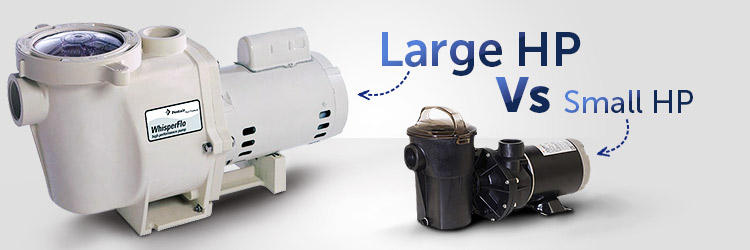
The proper horsepower for your pool pump depends on a number of factors. So before you jump on the bigger-is-better bandwagon, take a moment to get the facts. Let’s start with an unpopular and incredible statement: A typical size residential pool can be circulated effectively with a 1 HP pump. What?! Only 1 HP? Please accept my apology for the rude awakening that many pool builders and installers push unnecessarily over-sized pumps that are more expensive to buy as well as operate.
Pool owners often mistakenly believe if they choose a 2 HP pump over a 1 HP pump, they are getting double the performance. This is simply not true. In this scenario, you will get only about 15% more flow from the 2 HP model. But the amp draw of the larger pump will be significantly higher, raising your electric bill.
There are situations where a larger pump is certainly warranted. For instance, a pool with water features (deck jets, waterfall, etc) tied into the main pool pump might require a higher horsepower to provide enough flow. The same would hold true for installations with a spa or solar panels running off of the pool pump. Long runs of pipe might also require more power. If the pump in these scenarios is undersized, going up to a more powerful pump or installing a second pump dedicated to the water features or spa might be desirable.
Taking all of the above into consideration, here are some key things to keep in mind when increasing horsepower:
For New Construction
If you are building a new pool, you have the option to go with pretty much whatever horsepower pump you want as long as it meets the minimum requirements of your pool and is properly sized for the filter and plumbing. I can’t stress that last phrase enough – properly sized for the filter and plumbing. Should you decide a smaller pump is simply not macho enough for you, be sure your filter flow rate is higher than the pump output. Otherwise, you can end up damaging multiple pieces of equipment. Be consistent in your machismo and oversize everything.
For Pump Replacement
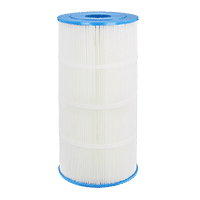
If you are replacing an existing pump and want to increase horsepower, you will have more to consider. First, your current filter size. Since pool filters have a maximum flow rate, your new pump cannot exceed the filter’s gallon per minute (gpm) rating. It is also advisable for the filter to be slightly oversized so for example if your filter has a 62 gpm flow rate and the higher horsepower pump will output 62 gpm, we’d recommend a smaller pump – or a larger filter. You don’t want to be operating right at the limit of the filter’s capacity.
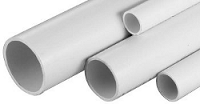 Second, plumbing lines also come into play. Many residential pools have 1.5″ plumbing while higher horsepower pumps (2 HP and up) typically have 2″ ports to accommodate larger pipes. You can use reducers to connect 1.5″ pipe to 2″ ports but this will restrict flow. Keep in mind also that since pipe size has a maximum flow rate, you might not gain any benefit from a larger pump while you will lose money on energy. Here are the most common pipe sizes with the correlating maximum flow rate:
Pipe Size
1.5″ – 60 GPM
2″ – 100 GPM
2.5″ – 140 GPM
3″ – 225 GPM
Third, be sure to check your voltage. Higher horsepower pumps are mostly 230v only. If you only have 120v standard household current available at your equipment pad, you will not be able to power a larger pump.
For Motor Replacement
Often a pool owner is replacing only the pump motor and sees this as an opportunity to upgrade to higher horsepower. In this case, you will need to consider the same filter and voltage limitations as above.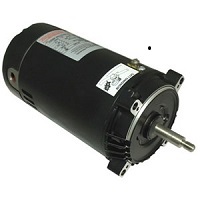
In addition, this will require the replacement of the impeller and possibly the diffuser. Both of these parts are rated by the horsepower they are designed to handle. The impeller definitely needs to be replaced whenever changing the pump horsepower, whether lower or higher. Diffusers typically cover a range of horsepower ratings. For example, when looking up the diffuser for your particular pump model, you might see one listed for .75 – 2 HP and then another for 2.5 – 3 HP. If the new motor falls within the range of your existing diffuser, you can reuse it.
An Example
To get an idea of the actual savings between a 1 HP pump vs. a 2 HP pump, we will do a bit of math. An average 1 HP single speed pump draws 1.5 kWh while an average 2 HP draws 2.3 kWh. If we use a run time of 8 hours per day and the national average of .13 cents per kWh, our calculations look like this:
1 HP pump 1.5 kwh x 8 hrs = 12 kwh per day x .13 cents per kwh = $1.56 per day to operate
2 HP pump 2.3 kwh x 8 hrs = 18.4 kwh per day x .13 cents per kwh = $2.39 per day to operate
Extended over 365 days, that’s $569.40 per year for the 1 HP and $872.35 for the 2 HP (adjust accordingly if you don’t run your pump all year). Some regions have higher kWh rates so the savings will be more significant for some pool owners.
Undecided?
Some energy-saving options exist for those wavering back and forth between one horsepower and another. First, dual speed pumps have both low and high-speed settings. This type of pump is best for installations where you need higher flow only periodically. For example, you mainly use the pump for circulation but in the evening you turn on the waterfall for an hour while you’re relaxing by the pool. In a situation like this, you could get a higher horsepower dual speed pump or motor and still have the option to circulate at a lower speed. Most of the time, the pump would be running at a lower, more energy-efficient horsepower while you have the security of knowing you’ve got bigger guns if needed.
Variable speed pumps and motors offer the same as dual speed but with a programmable range of speeds instead of only high/low. This allows you to really fine-tune your pump operation to exactly the speed you need for each function (circulation, vacuuming, spa jets, etc.) Variable speed pumps and replacement motors will vary in horsepower range from one brand and model to another but the max is typically around 3 HP.
The Bottom Line
We simply recommend properly sizing your pump based on your specific needs. Ignore the pull of having greater power and just do some math (or let us do it for you). The numbers won’t lie and could end up saving you some significant money on both the cost of a pump and its operation.






Leave a Reply