Home / Articles / How Long After I Shock My Pool Can I Swim?

How Long After I Shock My Pool Can I Swim?

Shocking your pool, or super chlorinating, is a cleaning method designed to keep your pool water clean and safe by adding three to five times the normal amount of chlorine. This drastically raises the chlorine level in a short period of time. Shocking your pool should not be a daily routine. Sure, there are times when shocking your pool is absolutely necessary like the times when you neglect your pool or when your pool is recovering from a terrible storm. However, if you have a salt water generator and consistently test and monitor your chemical levels, there shouldn’t be a need to shock your pool often.

Pool owners usually have a single concern when shocking their pool- How long after I shock my pool can I swim?

Unfortunately, there is no general consensus within the pool community when it comes to determining how long you should wait before swimming again. However, even with no general consensus, we were still able to discover many convincing factors that helped narrow down when the pool is safe for swimmers again after shocking. (If’ you’re a skim reader and just looking for the answer, read the last paragraph.)

How Dirty Is Your Pool?

Generally speaking, most balancing chemicals,(such as pH, alkalinity, and calcium hardness) become part of your pool water within an hour or so after adding them, at which time, you should be able to swim. Shocking, on the other hand, takes longer to adjust the pool. As a result, there has to be a longer waiting period before it is safe for swimming. But exactly how long must one wait before the water is safe for swimming? There are usually factors you need to consider before giving your swimmers a realistic time frame before jumping in.

First, assess how bad or dirty your pool actually is. Obviously, pools that are days away from becoming a swamp require more time and maintenance than a pool recovering from a rainy day. And swimming pools that require an extensive treatment due to algal blooms are in a class of their own. It can literally take weeks. On average, pool owners use three to five times the normal dosage when shocking. However, during serious conditions, some pools may need five to ten times the normal dosage.

The purpose for such a large dose is to break down the combined chlorine, organic waste, and other contaminants in your pool and re-establish a positive level of free chlorine. This process is not instant and can take several days to conquer. The condition and the chemical levels in every pool vary. That is why it is impossible for a pool technician to hand out specific time frames that are suitable for EVERY pool.

What Kind of Shock Are You Using?

The type of shock you use to shock your pool also affects how long you have to wait until you jump back into the pool. The two most popular shocks we encounter at INYO inyopools-shock-200x220are shocks with chlorine and shocks without chlorine. Shocks with chlorine, or cal-hypo, make up the majority of chlorine- based shock available today. The major differences lie in the concentration levels of the active ingredients. Most shocks with chlorine take longer to interact with your pool than non-chlorine shock.
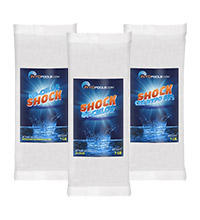
Chlorine- free shock oxidizes bacteria and organics in your pool without any additional chemicals. With this type of shock, you can swim in the pool just one hour after. Chlorine- based shock contains high levels of pH and will alter both your pH and chlorine levels in the pool. Chlorine- free shock has a neutral pH and will not affect any of your other chemical levels.

It’s a general precaution to monitor the type of chemicals you are putting into your pool. As you can see, even the type of shock you use can affect other chemicals that are already in your pool. And in turn, it will delay your swimmers from returning to the pool.

How Long Should I Wait… Exactly?

I’ve written a couple of paragraphs so far but haven’t actually answered the question at hand, how long after shocking your pool do you have to wait until you swim again?  Technically, if your free chlorine levels are holding up, swimming UP TO your shock level, depending on your CYA, is safe. Keep in mind, no one should swim in a cloudy pool, even if your free chlorine levels are holding. If the water clarity prevents you from seeing the bottom of the pool, we recommend you do not return back to the pool. From a security standpoint, it prevents you from watching for submerged children.

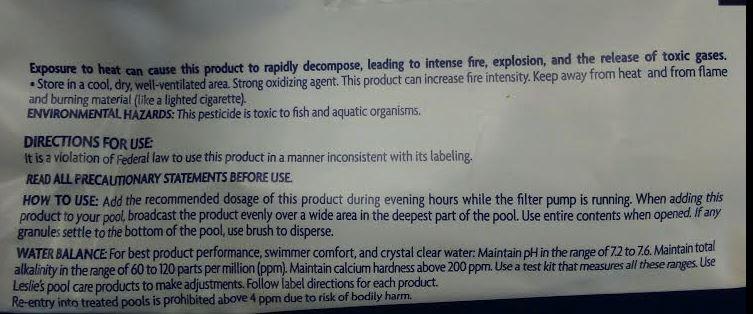
Another good rule of thumb is to follow the manufacturer’s instructions on the back of the product. Typically on all chemicals, the manufacturer provides directions for use, precaution warnings, and tips for storage and disposal. The back the bag of shock we analyzed states, “Follow label directions for each product. Re-entry into treated pools is prohibited above 4 ppm.” The manufacturer’s caveat runs parallel with swimming up to your shock level.

In short, if you want to be certain that your water is safe before returning to swim, test it. Once your free chlorine levels are holding and you can see the bottom of your pool, you can safely return swimming up to your shock levels for your CYA. Secondly, review the instructions on the back of your shock. Most companies provide the levels they recommend swimmers are safe to return back to the pool.
shockbag

author avatar
Charlie Ramirez
Writer at InyoPools.com, brings a wealth of knowledge and expertise in pool care and equipment, helping pool owners make informed decisions for over a decade.

Related Videos

81 responses to “How Long After I Shock My Pool Can I Swim?”

  1. M Avatar

    Total click bait crap content. Thanks for wasting my time. Stop listening to your SEO company. This is a bad business practice and won’t get you customers. Actually people will probably leave you bad reviews after you waste their time.

    1.  Avatar

      Why do you say that? I found the article informative and the advice reasonable. You are nothing but an out of touch jerk in thinking it was click bait. Grow up, moron…

    2. Donna Avatar

      There is no clear cut answer . Every situation is different . Common sense is in order and test the pool. I found the information helpful.

  2.  Avatar

    But i put way too much shock in my pool. I know that i put three times the amount i was suppose to… how long to wait to make sure…. once the water is clear should i be safe to swim… this was about 48 hours ago.

    1. Matthew Simmons Avatar

      In case you missed it in bold at the end:

      In short, if you want to be certain that your water is safe before returning to swim, test it. Once your free chlorine levels are holding and you can see the bottom of your pool, you can safely return swimming up to your shock levels for your CYA.

      There is this in the paragraph before that, as well:

      The back the bag of shock we analyzed states, “Follow label directions for each product. Re-entry into treated pools is prohibited above 4 ppm.”

  3.  Avatar

    I know

  4. Rick Avatar

    We had our 27′ above ground pool closed about 10 days ago. Weather is now crazy hot. Is it safe to swim with no pump running and winter chemicals in the pool?

    1. Matthew Simmons Avatar

      What do you mean by “winter chemicals” and have you tested the water to find out what the levels are? If so, post them in a reply.

  5. Stephen Avatar

    Thanks! I was looking through some of your older blogs, would I be better perhaps using a flocculating agent and vacuuming the pool until the filter is repaired?

    1. Matthew Simmons Avatar

      Yes, Flocculant would be the quickest way to clear it up.

  6. Stephen Avatar

    Hi Matthew – currently my pool water is cloudy, free chlorine levels and pH are fine although I haven’t measured Total chlorine yet however I was looking to shock the pool to try and clear the cloudiness. Additional problem is that our sand filter is currently broken so we are recirculating water but bypassing the filter.

    Obviously we need to replace the filter ASAP, but would a shock still be effective without it?

    1. Matthew Simmons Avatar

      Chances are, the cloudiness is either dead algae or some other particulates. The only way to remove these particles is by having an operational filter. The shock will keep your chlorine levels up, preventing more algae growth but it won’t clear the cloudiness.

      1. Lisa Avatar

        low Ph levels can cause cloudiness

        1. Matthew Simmons Avatar

          High pH is the more common cause.

  7. Duncan Avatar

    Hi Matthew. I have a 6×3 metre pool here in Valencia, Spain. Readings this morning show that ph is pretty much perfect, but chlorine is down. I’ve added a cup of shock via the skimmer. Pool is pretty clean, I’ll hoover and backwash this evening. If I test this evening (around 6 hours), and chlorine level is back to desired level, is it then OK to swim. Thanks buddy.

    1. Matthew Simmons Avatar

      If the chlorine is still at shock levels, no. If the chlorine level is within the normal range, yes.

  8.  Avatar

    Matthew thank you for making a pool thread entertaining

      1. Evelyn help Avatar

        I have a above ground blow up ring pool it is 3’by 14’ round pool. I have never own a pool I keep a floater with a chlorine table in it. It has free algae I don’t have no way of vacuum it put green algae seems to be on the bottom I put pool tech algae use in it water looks clearer but still greenish on bottom what should I do or do you think it’s safe to swim in

  9. kl Avatar

    OMG ANSWER THE QUESTION!!!!!!

    1. Matthew Simmons Avatar

      We do. In the article, the last paragraph in BOLD explains the answer. Or if you manage to skip past the article, I explain it in the comment section.

      um, yeah

  10.  Avatar

    Just answer the question??

    1.  Avatar

      ahahahahaha

    2. Nick Avatar

      if you are just shocking because it had too much use during the last few days like mine on the 4th of July, the water is clean and just shocking it to make it look better I say 2 Hrs. minimum. hope this help

      1. Matthew Simmons Avatar

        For the skim readers out there, the short answer is waiting for 24 hours after a heavy dose of shock. Or if you really want to swim before the 24-hours is up, test the water to make sure the chlorine is within safe levels.

        1. Teresa Avatar

          Curious where you get your info. What science is your recommendation based on?

          1. Matthew Simmons Avatar

            Years of being in the pool industry, as well the wealth of knowledge provided by the technicians in our office, as well as the underrated ability to read instructions on product labels.

            In my comment, there was not really any science, just more common sense.

        2. DM Avatar

          My tech shock my 10,000 saltwater pool just to raise my chlorine level and to take the load off of the generator, it’s been over 100 degrees a lot. After 24 hours my chlorine reading is off the charts? My test kit only goes up to 3 but it must be at 5 or 6? The water is clean and looks good but it looked fine before the shock treatment. Is it safe to swim in the pool?

          1. Matthew Simmons Avatar

            Is that the total chlorine level or free chlorine level you are providing?

            What level is your CYA?

        3. Tina Avatar

          What if my free chlorine is 4 but my total chlorine is low is it ok to swim in? And I just shocked the pool now because I found dog poop in it! Is shocking enough so we can go back in?

          1. Matthew Simmons Avatar

            How low is the reading? I need all the information to give an answer.

            For your poop situation, read this blog: Someone Pooped in My Pool. What Do I Do Now?

          2. Steve Avatar

            I’m not a pool man, just a pool owner struggling to get a handle on all this, but my understanding is that if your free chlorine is 4, it’s in the ideal range. Your total chlorine — which is the sum of the free chlorine and the combined, or used -up, chlorine — must therefore be at least 4 (since it includes the free chlorine), and ideally would be no higher than 4, since you only want free — or useable — chlorine and none, or as little as possible, of the combined — or unusable — chlorine.

          3. forepaws Avatar

            Sure it was not a Baby Ruth have Carl Spackler check.

          4. Anonymous Wolf Avatar

            How do you find dog poop in your pool???? is it in the ground or???

          5. Matthew Simmons Avatar

            If you can’t spot the dog poop in your pool, then your water is a lot dirtier than you think it is.

        4.  Avatar

          How can I test it

          1. Laura Avatar

            buy test strips that test 6 things in pool Not 4 or 5. Your not getting an accurate picture with the cheap test strips. Also, if your pool store says your water is fine, but your test strips say its off. Throw those test strips away, buy new 6 test strips, next day you test and take sample to pool store for free testing. Ask them to Always test for everything.

          2. Matthew Simmons Avatar

            I agree that throwing out old/tainted test strips is a necessary thing to do sometimes; who knows how many chemicals have been wasted in vain to correct an issue, falsely flagged by faulty strips. but the number of chemicals a strip can test for does not mark its quality. I would note the manufacturer of the kit as a sign of quality over the quantity of things the strip can test. I always lean towards Taylor kits when it comes to home testing.

          3. Russell Avatar

            Just used test strips from Walmart (test 6 things) and to my surprise it read Total and Free Chlorine @10ppm and CYA (stabilizer) @300 (as high as it can go). This worried me. I took my pool water sample to Pinch a Penny Pool store for more accurate reading and their test report showed FC @7.5 and CYA @100. Since numbers looked so different, I did another test at Leslies Pool Supplies (they claim to have better reading since they use computer based testing machine). Their reading showed FC @21 and CYA @185. In the end I decided to drain 1/3 of my pool and fill it with fresh water to fix high FC and CYA problem. So my recommendation is to start with inexpensive test strips that you can pick up at nearest Walmart and if some readings look off, then do more accurate computer test at one of nearest pool supply stores (usually free).

          4. Matthew Simmons Avatar

            Or you could buy some good test strips from the get-go to save gas money and the time it takes to go to pool stores for redundant tests.

          5.  Avatar

            OK.. the dog poop.. I can’t even!!

        5. Gawky Avatar

          Thanks this was very helpful

        6. Faith Avatar

          I know this is like 2 years after the fact, but I have a horrible pool guy that’s shocked it (nothing else) for about 10 Monday’s in a row, and the pool is very blue but foggy. Is it safe to swim?

          1. Matthew Simmons Avatar

            As I say in a lot of these comments test the water, if it is in the safe zone then it is likely safe. If the pool person used algaecide then the cloudiness is likely from that or it could be dead algae that need to be filtered out.

        7.  Avatar

          I have a 8000 gallon pool I put one in bag of shock in it Its a new pool so first chimicles wct. How long should wait

        8. Wes Avatar

          How do you test it? Test it how? And what am i looking for or doing to test it.

        9.  Avatar

          How do u test the levels

          1. Matthew Simmons Avatar

            Testing a pool for chlorine levels is a basic building block of water chemistry. Pool Water Testing

            If you have a pool, you should have some kind of test strips or a local pool company that tests your water. How it is done, depends on the type of test you have, but you just have to read and follow the instructions on the package.

      2.  Avatar

        that did help – thanks!!

      3.  Avatar

        Is this you son? 😉

      4. Amy S Avatar

        Thank you! Thanks exactly why I was just shoking mine! I tested my pool & it was showing low chlorine which never happens. Can that be because of all the people I had in my pool yesterday? It didn’t appear dirty. But I figured I should shock it after all the action it had & to get the chlorine levels back up.

    3. Casey Avatar

      well said.

    4.  Avatar

      Right..

    5. Laurel Avatar

      I was thinking the same thing!!

    6. Sarah Avatar

      There is no clear answer as every pool’s situation is different and also filtration type. The answer is there, just read the article.

    7. David Avatar

      No shit

Leave a Reply

Your email address will not be published. Required fields are marked *