Home / Articles / How Long After I Shock My Pool Can I Swim?

How Long After I Shock My Pool Can I Swim?

Shocking your pool, or super chlorinating, is a cleaning method designed to keep your pool water clean and safe by adding three to five times the normal amount of chlorine. This drastically raises the chlorine level in a short period of time. Shocking your pool should not be a daily routine. Sure, there are times when shocking your pool is absolutely necessary like the times when you neglect your pool or when your pool is recovering from a terrible storm. However, if you have a salt water generator and consistently test and monitor your chemical levels, there shouldn’t be a need to shock your pool often.

Pool owners usually have a single concern when shocking their pool- How long after I shock my pool can I swim?

Unfortunately, there is no general consensus within the pool community when it comes to determining how long you should wait before swimming again. However, even with no general consensus, we were still able to discover many convincing factors that helped narrow down when the pool is safe for swimmers again after shocking. (If’ you’re a skim reader and just looking for the answer, read the last paragraph.)

How Dirty Is Your Pool?

Generally speaking, most balancing chemicals,(such as pH, alkalinity, and calcium hardness) become part of your pool water within an hour or so after adding them, at which time, you should be able to swim. Shocking, on the other hand, takes longer to adjust the pool. As a result, there has to be a longer waiting period before it is safe for swimming. But exactly how long must one wait before the water is safe for swimming? There are usually factors you need to consider before giving your swimmers a realistic time frame before jumping in.

First, assess how bad or dirty your pool actually is. Obviously, pools that are days away from becoming a swamp require more time and maintenance than a pool recovering from a rainy day. And swimming pools that require an extensive treatment due to algal blooms are in a class of their own. It can literally take weeks. On average, pool owners use three to five times the normal dosage when shocking. However, during serious conditions, some pools may need five to ten times the normal dosage.

The purpose for such a large dose is to break down the combined chlorine, organic waste, and other contaminants in your pool and re-establish a positive level of free chlorine. This process is not instant and can take several days to conquer. The condition and the chemical levels in every pool vary. That is why it is impossible for a pool technician to hand out specific time frames that are suitable for EVERY pool.

What Kind of Shock Are You Using?

The type of shock you use to shock your pool also affects how long you have to wait until you jump back into the pool. The two most popular shocks we encounter at INYO inyopools-shock-200x220are shocks with chlorine and shocks without chlorine. Shocks with chlorine, or cal-hypo, make up the majority of chlorine- based shock available today. The major differences lie in the concentration levels of the active ingredients. Most shocks with chlorine take longer to interact with your pool than non-chlorine shock.

Chlorine- free shock oxidizes bacteria and organics in your pool without any additional chemicals. With this type of shock, you can swim in the pool just one hour after. Chlorine- based shock contains high levels of pH and will alter both your pH and chlorine levels in the pool. Chlorine- free shock has a neutral pH and will not affect any of your other chemical levels.

It’s a general precaution to monitor the type of chemicals you are putting into your pool. As you can see, even the type of shock you use can affect other chemicals that are already in your pool. And in turn, it will delay your swimmers from returning to the pool.

How Long Should I Wait… Exactly?

I’ve written a couple of paragraphs so far but haven’t actually answered the question at hand, how long after shocking your pool do you have to wait until you swim again?  Technically, if your free chlorine levels are holding up, swimming UP TO your shock level, depending on your CYA, is safe. Keep in mind, no one should swim in a cloudy pool, even if your free chlorine levels are holding. If the water clarity prevents you from seeing the bottom of the pool, we recommend you do not return back to the pool. From a security standpoint, it prevents you from watching for submerged children.

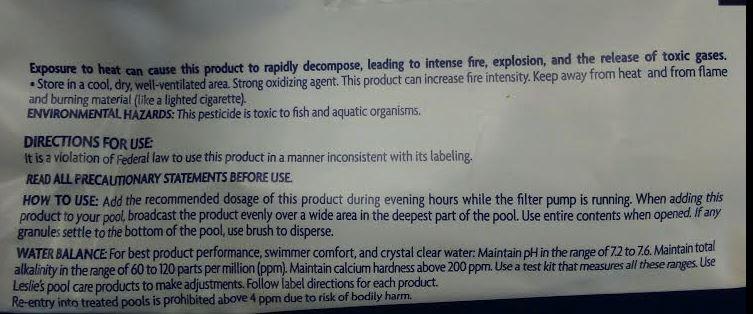
Another good rule of thumb is to follow the manufacturer’s instructions on the back of the product. Typically on all chemicals, the manufacturer provides directions for use, precaution warnings, and tips for storage and disposal. The back the bag of shock we analyzed states, “Follow label directions for each product. Re-entry into treated pools is prohibited above 4 ppm.” The manufacturer’s caveat runs parallel with swimming up to your shock level.

In short, if you want to be certain that your water is safe before returning to swim, test it. Once your free chlorine levels are holding and you can see the bottom of your pool, you can safely return swimming up to your shock levels for your CYA. Secondly, review the instructions on the back of your shock. Most companies provide the levels they recommend swimmers are safe to return back to the pool.
shockbag

author avatar
Charlie Ramirez
Writer at InyoPools.com, brings a wealth of knowledge and expertise in pool care and equipment, helping pool owners make informed decisions for over a decade.

Related Videos

81 responses to “How Long After I Shock My Pool Can I Swim?”

  1. Anonymous C Avatar

    We filled our poor and the water is brown no one has been in it yet. So I went and got some shock treatment and the filter is on. So my question is, is it safe to swim in the brown water and it’s a 14ft x 42in pool. I’ve never had a pool before and clueless but my kids wanted a pool so here I am and completely lost but they are dying to swim and I don’t know if it’s okay.

    1. Matthew Simmons Avatar

      Did you fill the pool with well water? If so, that brown is minerals and metals. Use a treatment of metal control to clear up the brown, and make sure the rest of your water chemistry levels are in the proper ranges before allowing the kiddies to swim. Untreated water can make swimmers sick.

  2. whoop Avatar

    hahaha…got me to read the whole thing, then never gave an answer to the title of your article! What a waste of time. Thank YOU all the responders for actually providing something useful!

  3. Karin Avatar

    So,if I shock say at 8:00 am and it’s apparent it was enough shock for the algae, do I add more shock up to the amount I should have done in the am or do I start from scratch ?

  4. Rick Avatar

    I just shocked my pool a few minutes. Do I need to wait before adding additional chemicals like calcium and alkalinity?

    1. Matthew Simmons Avatar

      To be on the safe side, I would wait four hours between the application of each chemical.

    2. Donna Avatar

      Alkalinity and PH should be in range before shocking. In your case you should wait until chlorine levels are 3-5 PPM. Unless you have a heater which require a certain calcium hardness reading to keep your warranty you should wait until all other chemicals are in check. Add Calcium slowly. NEVER more than 10lbs at 1 time. I raised mine using half the amount recommended adding 5Lbs a day.

  5. Yannos Avatar

    Thanks for the article. Really useful. So I’ve got into a situation I can’t find explained anywhere.

    I shocked my pool due to heavy use. Before shocking both TC and FC were both about 1ppm. After shocking FC went up to 10ppm. So far, so good.

    Firstly, I wasn’t sure whether I was supposed to put a “normal” (as in non shock related – the ones I always use) chlorine block in the shutter filter straight after shocking. It’s not mentioned in any blogs I could find or on the instructions. Figuring more chlorine is what I was after I did put it in as per my normal maintenance routine.

    Now after 3 days, FC remains really high registering 10ppm so I don’t want to allow my kids in the pool. And more worryingly TC is higher than I’ve ever seen it – looks around 5ppm.

    I’m confused as I expected the FC to come down more quickly. The pool has been covered and it hasn’t been very sunny which may explain it. But its a vinyl liner and I understand high chlorine isn’t good for that so I’m wondering firstly if the water is in a good status (it looks great – really clear)? and secondly if the TC and FC are anything to worry about – should I remove all chlorine from the system for, say 24 hrs, to let FC drop below 5ppm to start swimming again?

    1. Matthew Simmons Avatar

      Remove the cover and after sunny day or two, the chlorine should drop to a safe enough level.

      1. Yannos Avatar

        That simple – thanks very much Matthew.

  6. J. Lopera Avatar

    Hello there i tried reading all the comments to see if I can find my answr before asking, however I did not. What happens if you get in like 15 min after the treatment started??!!! I had not know the pool people were here and when I got our the pool I saw they left a note on the door. I have a salt water pool.

  7. Mavis Avatar

    Enjoying this exchange. How can I tell how much free chlorine I have and total chlorine? I just shocked our 10K gal. above ground pool with three bags of shock (1 lb. ea.). The pool store told me this kind of chlorine is pH neutral, unlike the liquid. It’s hot outside! I really want to go in. Crying emoji.

    1. Matthew Simmons Avatar

      There are tons of test strip kits that measure free chlorine (FC) and total chlorine (TC). You can get those at a local pool store.

      1. share Avatar

        When can you swim after going through the salt generator process?

        1. Matthew Simmons Avatar

          Do you mean after installing a brand new salt generator? We suggest doing a shock dose of the pool after you install the SWG and it is up and running. This will boost your chlorine levels while the cell builds a solid base of chlorine in the pool. So again, it would come back to testing the water to determine to determine when you can swim. I would hold off getting in the pool until the level is 5 ppm.

  8. Taylor Avatar

    15×8 pool starting to turn a little green, can pool shock still save it if I change my filter too?

    1. Matthew Simmons Avatar

      Yes, the water can still be saved. Read this article for some guidance: How to Clean a Green Pool?

  9. TimToolManTaylor Avatar

    I have unsafe chlorine levels and put in 5x the amount of shock I should have. CAN I JUMP IN?

    1. Matthew Simmons Avatar

      Ooooph, this is a tough one. I’m going to have to say, no.

      mind blown

    2.  Avatar

      For real??? Hahaha

      1. Rhondajones297@gmail.com Avatar

        We put a bag of shock in our big pool Around 10:30 this morning is it OK if we start swimming in it Or how long do we have to wait for it to be OK

        1. Matthew Simmons Avatar

          Test your water. Is your water still at “shock level” or has it returned to normal?

  10. me Avatar

    Sounds like somebody just wants to jump in! Go ahead!

Leave a Reply

Your email address will not be published. Required fields are marked *