
Home / Articles / Why Do I Keep Getting Bubbles In My Jets?

Why Do I Keep Getting Bubbles In My Jets?

Bubbles coming out of my pool return line

Everybody loves a bubble bath, show me a person who doesn’t and I’ll show you a liar. Bubbles are fun but for pool owners bubbles represent a time for panic. For us, bubbles are no longer the sign of fun in the sun and frolicking, they are a harbinger of doom. Ok, that was a little excessive but you get the point. A stream of bubbles is a sign of the unwanted presence of air within our pool’s plumbing system. This air is likely the cause of a sucking air leak from a pump, union or diverter gasket. The leaks and the air pockets they form will lower water pressure and greatly decrease the capacity of our filter system.

Knowing bubbles are bad is one thing but knowing where they are coming from and how to stop them is another. In this blog we will walk through the common culprits of pool air leaks and provide you tips on diagnosing your own system.  Let’s begin!

Fresh Air is Sometimes Bad

Bubbles streaming out of your return could be a result of low water levels in the skimmer. The optimal water level is halfway up the skimmer face plate. Most skimmers have four screw holes going up the face plate vertically; the optimal water level would be between the second and third screws. This will supply your skimmer with enough water to keep your pipes full and your pump happy.

If the pool requires refilling more often than usual then that might be a sign of a leak in the plumbing or the basin. Natural evaporation rates top out at a quarter of an inch even in the hottest of of temperatures. If you are unsure of your pool’s evaporation rate or water loss, we can use the Bucket Test to test for both. Even in hot temperatures like Florida or Texas, it is unlikely that the evaporation rate would rise above ¼”. To check your evaporation rate try the “Bucket Test.” Sounds fun, right?

The steps of the Bucket Test are as follows:

  1. Fill 5-gallon bucket with pool water until the water level is two to three inches from the top. Mark the fill line with a pencil.
  2. Mark the current water level of the pool with a piece of duct tape and Sharpie marker. Place five to seven inch piece of tape along the wall partially submerged in water. Mark the water level using the Sharpie on the tape. This prevents us from marking up the wall or liner.
  3. Set the bucket on the first step of your pool entry so it is partially submerged. On the second piece of tape mark the water level of the pool as it rises on the outside of the bucket.
  4. Wait 24 hours. Do not run pump during this test. Also keep animals away from bucket as they may drink from the bucket, skewing results.
  5. After 24 hours mark the current water level of both with the pencil.
  6. Measure the difference between the original measurements and the day after; if the measurements differ more than 1/4″ – 1/2″ you may have a leak

Pump Lid O-Rings

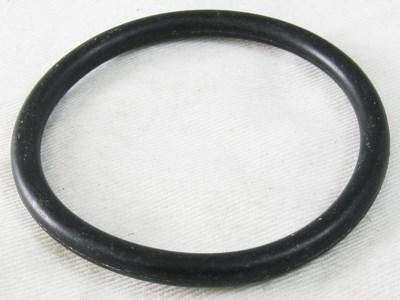
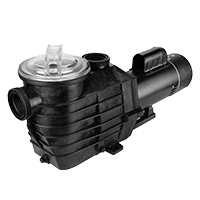
This little bugger can cause more troublePUMP GASKETS than it’s worth. Located on the strainer housing of the pump, it creates a vacuum lock seal for the pump housing to guarantee pump priming. If this o-ring is out of place it will allow air to seep in as the pump draws from the pool. A common byproduct of a bad lid-o-ring is cavitation (large pool air leak bubbles in strainer basket) or inability to prime itself.
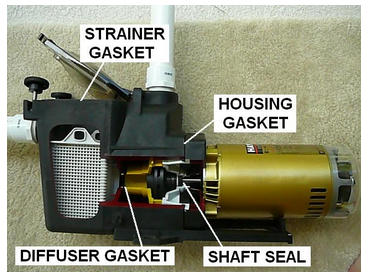
The need to empty the pump basket of debris is the number one cause of this o-ring getting out of shape. That type of maintenance is unavoidable so the best remedy is to treat it with care and freshly lube it after every strainer cleaning. Clean the groove of the o-ring before replacing to make sure it sits securely in place. If it is not properly seated in the groove it can become pinched and/or warped when tightening the strainer lid.
4590-55U-N-I-O-N, It’s a Union

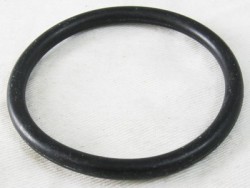
Pump and standard plumbing unions contain an o-ring to maintain the integrity of the joint. A good hint that a union is malfunctioning – if the o-ring is visible when the nut is removed, it is likely the source of air. The union o-ring should fit snugly into the groove of the union, out of view. Remove the gasket and place it on a flat surface to determine if it has retained its circular shape. If the gasket appears oblong or pinched, replace the gasket with a fresh one. Union gaskets are more rigid than your pump’s gaskets; once they become misshapen there is little chance of reforming them to the proper shape.

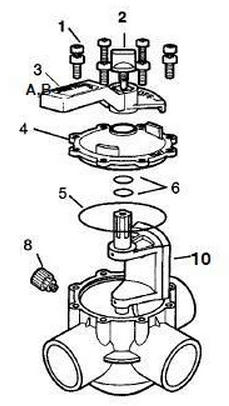
Diverter Valve O-RingDiverter Valve Parts
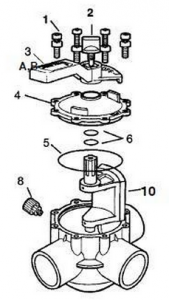
These can be tricky as a pool may have several valves feeding water to the pump. An air sucking valve is likely to prevent the pump from priming and create cavitation within the housing if it is able to prime at all.  Pool technicians have become inventful attempting to source a sucking air leak from a valve. One of these cool tricks is using incense.  Light a few sticks of incense and hold the stream of smoke close to the valve seams; if a sucking air leak is present, the smoke will be seen getting sucked into the valve.

For pumps having issues with priming, I would suggest using your garden hose to source the pool air leak. While your pump is circulating, run a steady stream of water over the suspect valves and its seams; if the pump is pulling air when water is applied to the leak it will block air from entering the system. When the leak is blocked by the water the pump should prime in a few seconds as long as there are no further leaks.


author avatar
Matthew Simmons Technical Writer & Pool Product Expert
Swimming pool expert at InyoPools and host of Poolside Chat, brings over a decade of experience in the pool industry.

Related Videos

30 responses to “Why Do I Keep Getting Bubbles In My Jets?”

  1. Phil Hambrecht Avatar

    When pool is operating normally there is no air coming out of spa jets. When turning on spa valves to use spa jets to heat, getting air bubbles out one of the four wall jets. Could this be a check valve problem with the blower? Thanks.

    1. Matthew Simmons Avatar

      The air blower’s job is to create air bubbles in the lines. So, if the air bubbles were coming out of all four jets before, but aren’t now then there is an issue there.

  2. Alan Darwiche Avatar

    The grease cap on my Jandy diverter valve has fallen off/broke – the other part is still stuck in there. Could this be a cause of air leak into the pump? I know I have bubble coming out of the jet streams. Possibly I need to replace the O-rings too.

    1. Matthew Simmons Avatar

      If the valve is on the suction side of the pump, yes it could be the cause of the air leak. Read and use the techniques shown in this guide to figure out where the leak is coming from: How to Find Suction Side Air Leaks In A Pool

  3. Mario Frangella Avatar

    I just replaced my Hayward 1 HP motor with a Hayward 1-1/2 HP pump/motor assembly because my above-ground Aqua-bug vacuum was not moving on the floor of the pool. It appeared that I was not getting enough pressure, and still am not getting enough pressure with the new pump. I noticed this problem last season, but it was not as bad as now. I also change my sand every year. Is it an air leak problem? I also noticed that my filter (sand reservoir) moves easily (it’s not as heavy as it used to be), when I try to turn the handle on the multi-port valve. The only part that I have not yet replaced is the Valve. Also, all of my hoses are new and the clamps are tight. My pool water is getting cleaned, etc., but the bug vacuum doesn’t work. And, I bought a new vacuum too, with no luck. Any suggestions? Thank you very much.

    1. Matthew Simmons Avatar

      Okay, so you got a bigger pump, changed your sand, changed your plumbing hoses, tightened all the connections, got a new cleaner and I presume using new cleaner hoses and it still doesn’t work?

      My advice is, ¯\_(ツ)_/¯. You can check the skimmer’s vacuum plate to see if it is making a seal. Outside of that, I am at a loss.

  4. Carol WB Avatar

    Thank you.

  5. Carol WB Avatar

    I just paid a lot of money to have an in ground vinyl pool (3X6X36) replaced with plaster. I’ve noticed that Bubbles are seeking out from ALL four jets returns a week after contractors completed the work. The two jets returns closest to the skimmer shows the most bubbles than the other two at the end by the steps. I have contacted the contractors to come back and find what’s exactly is the problem. But as you know, I have been getting the run-a-round with the contractors and it seems like this matter is headed to the courts. I’m tired of trying to deal with these people and getting no satisfaction. In the mean time, what can I do myself to solve this matter prior to having this matter dealt with legally?

    1. Matthew Simmons Avatar

      It seems like your plumbing system has a sucking air leak(what the entire article above covers) which can be relatively easy to find and fix. We also have the following guides that show you how to troubleshoot the problem: How to Identify and Correct Air Leaks & How To Find Suction Side Air Leaks In Your Pool Using Smoke, Soapy Water, or Shaving Cream.

      Because this is a pretty common issue in any type of pool, I do not think the plastering company was the cause of this problem. The purview of their job would not have them altering or disassembling the pipes or equipment that would cause an air leak of this nature.

  6. Carol WB Avatar

    I just paid a lot of money to have an in ground vinyl pool (3X6X36) replaced with plaster. I’ve noticed that Bubbles are seeking out from ALL four jets a week after contractors completed the job. The two jets closest to the skimmer (the shallow end of pool) shows a great deal of the most bubbles than by the other two at the end by the steps. I have contacted the contractors to come back and find what’s exactly is the problem. But as you know, I have been getting the run-a-round with the contractors and it seems like this matter is headed to the courts I’m tired of trying to deal with these people and getting no satisfaction. In the mean time, what can I do myself to solve this matter prior to having this matter death with legally

  7. Kevin Bridges Avatar

    I had a phosphate issue and ran pump 48 hrs to remove with phos out product. Filter pressure was at 20 psi prior. Once the 48 hr. Period was completed I backwashed and rinsed as instructed. When I put back to filter position I could not get pump to prime without several attempts to get flow. Once I got flow the skimmer basket would not fill complete and once at 10psi. So today I cleaned filter and started pump again and still same 10psi and air bubbles from jets in pool.

    Any suggestions?

    1.  Avatar

      pool is only 2 1/2 years old, started getting air bubbles coming out of all the jets in the pool a couple of months ago. when that started there was a gurgling sound coming from the sand filter where you turn the knob to backwash it. when pump is off there sounds to be a seeping noise coming from the lid on the pump.

      1. Matthew Simmons Avatar

        It sounds like you’ve found at least one of the issues, the pump lid o-ring is sucking air. The air leak may also happen when the pump is running, but you can’t hear it over the noise of the motor. Your pump may be strong enough, or the leak isn’t severe enough (yet) to negate the pump’s ability to prime. I’d start with replacing the pump’s lid gasket, this will eliminate the most glaring issue, and you can pick off any others as they arise.

Leave a Reply

Your email address will not be published. Required fields are marked *